Please read this first.

Welcome! This blog is devoted to considerations of morality in the The Elder Scrolls V: Skyrim by Bethesda. Rather than a fansite, review, or walkthrough, it is a serious attempt to examine the game through a moral lens. Please note that the purpose of this blog is to discuss morality within the context of the game, not to determine whether playing the game is immoral in and of itself; the latter type of "discussion" tends toward tedium and inhibits, rather than promotes, a meaningful conversation.

If you have not visited this blog before, it might be helpful to read the posts labeled "Orientation," most of which are the first few entries in the blog archive (see right). These posts include a short introduction to this project, a content-specific author bio, and a few other pieces that explain key concepts relevant to this study. These posts are of particular use to those readers less familiar with Skyrim (or video games in general).

PLEASE NOTE: HERE BE SPOILERS!

If you have visited this blog before, thanks and welcome back!
Showing posts with label Ulfric Stormcloak. Show all posts

Friday, February 14, 2014

Civil War, Part 1 (Katnys)


Reconnecting with the Alik’r in Whiterun really helped Katnys place the whole “Dovahkiin” thing in its proper perspective.  Being Dragonborn was only of value to the degree it could help her take down the Empire that had abandoned Hammerfell, betrayed her parents, and killed her sister; the Greybeards and all of their “Way of the Voice” business could wait.  Right now, she needed to get to Windhelm and join up with the Stormcloaks.

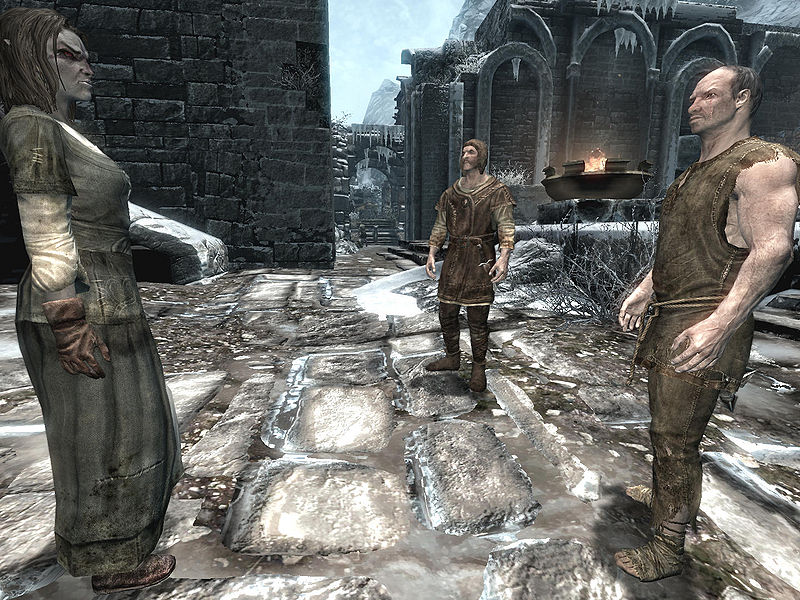
Upon arriving in the capitol of Eastmarch, Katnys and Jenassa were treated to the sight of two Nords (Rolff Stone-Fist and Angrenor Once-Honored) harassing a Dunmer woman (Survaris Atheron).  At first, she was too dumbstruck to intervene; while her parents had often talked of their life in Windhelm, actually seeing one of her own as a.) an established citizen of Skyrim and b.) a victim of racism was a little too much to process all at once. 

The welcome wagon
Eventually, she pulled her wits together and beat some respect into Rolff (not that it lasted -- she would later encounter him drunkenly shouting in the Grey Quarter), then made her way to the Palace of the Kings for her audience with Ulfric.

Having lived most of her life outside of Skyrim, Katnys had been unnaware of Ulfric before the events at Helgen, so she approached him with neither awe nor ire.  She cared little for the intricacies of Nord politics, and even less about Talos, so she expected to express her desire to join the rebellion, grab her bow, and start killing Imperials.  But when Ulfric began talking about missing his father's funeral and about the obligation he had to the men in his command -- those who fell and those who still fought for him -- she found herself moved far more than she had anticipated.  Surely, a man who cared so deeply for his brothers-in-arms deserved her respect.  She still had no strong feelings about Talos, but her hated of the Empire only grew as she listened to Ulfric's story.  Therefore, when Galmar asked her why an elf would join the Stormcloaks,  she could proudly exclaim her thirst for Legionnaire blood.

The first task -- killing an ice wraith -- seemed like a pointless Nord test of courage, but she had grown used to that kind of requirement among the Alik'r.  Looking for the Jagged Crown felt silly as well, but once she got a chance to pick off some Imperial soldiers, Katnys finally felt like she was on the right path.  Under Ulfric's leadership, the Stormcloaks would drive the Empire out of Skyrim and, who knows, perhaps out of existence entirely.

It was this last thought -- that Ulfric might be the one to bring down the Empire -- that allowed Katnys to stomach the racism she encountered from certain residents of Windhelm.  Sure, one beggar and the town drunk (whom everyone tolerates because he's Galmar's brother) liked to toss epithets around, but that kind of impotent bigotry did little to dampen her spirits as she explored the Gray Quarter; after all, it was hard to be upset when she was in her parents' adopted hometown, surrounded by more Dunmer than she had even seen in one place.  In fact, even as she and Jenassa sipped Argonian Bloodwine and listened to Ambarys Rendar complain of the Nords' maltreatment of the Dark Elves, she couldn't help but think that some of these Windhelm Dunmer lacked perspective.  Sure, the Gray Quarter was a bit of a dump, and some of the Nords were less than hospitable, but what did Ambarys and his ilk expect?  From her time with the Alik'r, Katnys well understood that mercy and kinship are not the same.  The Alik'r took her and Prim in -- fed them, protected them, shared knowledge with them -- but they were never really part of the clan...and why should they be?  They weren't Redguards, after all.  People prefer their own kin, their own kind, and there's nothing wrong with that.  You can be generous to a stranger, but you only really love your own. 

It is precisely that generosity -- the kind shown by the Alik'r to the Evyrdene girls -- that Katnys saw in the Nords.  After the Red Mountain erupted, the High King of Skyrim gave entire portions of Solstheim to the Dunmer refugees, and the Jarl of Windhelm opened the Snow Quarter to them.  The Nords' magnanimity, however, was that of a powerful ally, not an adopted family.  The Sons and Daughters of Skyrim have helped the refugees of Morrowind, and that is enough.  For a Dunmer like Ambarys to expect the Nords to treat him like one of their own was not only foolish, but borderline ungrateful in Katnys's eyes.  It is natural to favor one's own, even as it is valorous to help an ally.

In fact, this history of Nord generosity throws a harsh light on the duplicity of the Empire.  Even as the Nords were opening their borders during the Red Year, the East Empire Company was pulling up stakes to avoid the ash.  The events of the Great War further demonstrated that the Empire exists solely for the benefit of Cyrodiil -- which would be fine if the Empire consisted only of Cyrodiil.  The Emperor had no problem abandoning Hammerfell to the Dominion, and then slapped Skyrim in the face by agreeing to the Concordat.  While the Nords might call you names and start a fight with you, they will also open their homes and keep their promises.  The Empire, on the other hand, calls you "citizen" while it sells you to your enemy.  Tamriel would be better served by an alliance of strong, independent nations than this shame of an Empire.  The Dominion would never be able to stand up against the cunning of Cyrodiil, the brawn of Skyrim, the skill of Hammerfell, and the sorcery of High Rock acting in concert as equals, rather than as thralls to a dying Empire.

Now that she held Balgruuf's axe, Katnys was poised to speed that process along.
Tuesday, July 23, 2013

The Main Quest: Finale

Special thanks to Kurt Kuhlmann for pointing out some factual errors in an earlier version of this post!


After Paarthurnax, the Main Quest provides very few opportunities for moral agency.  Capturing Odahviing, travelling to Skuldafn, visiting Sovngarde, and defeating Alduin are all dramatic and engaging quests, but they present no significant moral quandaries.  There are, however, some events that bear further examination.

The latter part of the Main Quest reveals that not all of the dragons share Alduin's views. During The Fallen, I learned the shout that summons Odahviing, thus providing me another opportunity to converse with a dragon.  Odahviing is an active ally of Alduin, but when we captured him, he agreed to help me track down the World-Eater in exchange for his own freedom.  Because of his dialogue, Odahviing comes off as an opportunist who betrays Alduin not on principle, but on the likelihood that the Dovahkiin will defeat him:

 
Once Alduin is defeated, Odahviing pledges to aid the Dragonborn whenever he calls; he is not, however, another Paarthurnax, who promises to teach the pacifist Way of the Voice to all of the dragons he can convince.

He might actually succeed, as Paarthurnax and Odahviing are not the only non-hostile dragons in the game.  Until Skuldafn, I had never encountered a non-NPC dragon that did not attack the moment it detected me (or anyone else for that matter).  At Skuldafn, however, I ran into a dragon who, despite being perched directly above the portal to Sovngarde and witnessing my defeat of his comrades, did not attack.  He watched me closely, but made no aggressive moves at all.  Given my experience with Paarthurnax and Odahviing, I decided to hold back, and it began to dawn on me that all of the dragons (not just the named ones) might be morally complex creatures who are as apt to choose "the high road" as their mortal counterparts.  Perhaps this moral range explains why, at the Throat of the World, dragons can be seen celebrating the World-Eater's fall. 

As it turns out, the complicated moral tableau presented at the portal to Sovngarde was reflected on the other side as well.  While the scenes inside the Hall of Valor are interesting from a cultural perspective (of course Nords brawl in Heaven!), the encounters before I met Tsun were the most enlightening:

  • Kodlak: It was satisfying to see Kodlak in his beloved Sovngarde.  Even though he had assured me that the purification was successful, I was happy to see the results for myself.

  • Torygg: The High King's dialogue suggests that the popular story that Ulfric "shouted him to pieces" is closer to the truth than Ulfric's account, but I'm not sure if this is an important distinction.

  • Ulfric: This was by far the most substantial encounter in Sovngarde.  First, it appears that Ulfric's ascent to the Nord Paradise has erased any animosity he might harbor for the man who killed him in battle.  Second, Ulfric expresses a profound and sincere regret for his part in Skyrim's strife.  He stops short of saying that he was wrong, but his sadness is undeniable.  I suspect that, if he had the opportunity to  do it all again, he would probably try harder to convince Torygg of the need for secession, rather than kill him.  This conversation confirmed both my decision to support the Empire and my respect for Jarl Ulfric.


As for the final battle with Alduin, there is little of moral significance to examine, with the possible exception of the emphasis on unified effort.  In order to defeat the World-Eater, I had to join forces with the heroes of old -- perhaps an object lesson on the necessity of community.  Now that I think about it, that may be the best moral for a war-torn Skyrim after all.

Tuesday, July 16, 2013

Paarthurnax: Further Considerations

The conflict at the core of the Dovahkiin's rise to power is analogous to that faced by Raskolnikov in Dostoyevsky's Crime and Punishment.   Raskolnikov considers himself to be an extraordinary man -- the creator of a "New Word" -- and therefore above the laws of ordinary men.  He finds himself torn between two models of this "extraordinary man": the Nietschzean Übermensch, who subjugates those beneath him by virtue of his greater power, and the Hegelian superman, who transcends the law in order to perform great and noble deeds.  Raskolnikov considers his murder of the evil pawnbroker as evidence of his superior nature; he breaks the law in order to rid the world of a great evil.  Once he does so, however, he finds himself becoming more Nietschzean, seeking power over others for its own sake.

While Raskolnikov only thinks of himself as extraordinary, the Dovahkiin is emperically superior to those around him, capable of supernatural feats beyond those of the most powerful NPCs and creatures in the game.  During the course of the game, the Dovahkiin can defeat Alduin the World-Eater, challenge the Daedra, decide the outcome of the Civil War, and simultaneously become the leader of the Companions, the Thieves' Guild, the Dark Brotherhood, and the College of Winterhold.  Furthermore, the Dovahkiin literally possesses a "new word" -- or, more accurately, several ancient words -- that denotes a unique role in Tamriel's history. The question is not whether the Dovahkiin is extraordinary; the question is whether he or she will take the Nietschzean or the Hegelian route.  Obviously, the player as moral agent ultimately decides which kind of superman the Dovahkiin will become, but the game provides several prominent models of the Nietschzean Übermensch against which the player can be defined.

The central Nietschzean character in the game is, as I mentioned in the previous post, Alduin.  The World-Eater seeks power over mortals and dragons alike, not for the benefit of his kind or the glory of some divine being, but for his own sake.  He conquers because it is his nature to do so.  He does not bother to justify his actions to anyone, because to do so would suggest that someone else has authority over him.  He enslaves or destroys the weak and commands the strong.  He is the lust for power personified.

Paarthurnax provides a useful Hegelian counterpoint to Alduin.  Here we have a being who, like his erstwhile ally, instinctively seeks to conquer, yet consciously chooses otherwise.  In helping the Tongues and the Greybeards, he betrays his own kind and violates his own innate nature to serve a noble cause: the Way of the Voice.  He creates a new law to supplant the Nietschzean rule of Alduin.

Paarthurnax, however, is not alone.  Brynjolf, Kodlak, Argenir, and even Ulfric Stormcloak demonstrate the power of "honorable transgression."  Each of these characters violates some law or taboo or tradition in order to serve, at least in their estimation, a greater good.  While one could argue against the particular motivation in each case (Jarl Ulfric's cause being the most obvious example), these characters are all motivated by something greater than and outside of their own individual selves.

What is noteworthy here is that each of the more Hegelian characters is presented as decidedly more heroic (or at least respectable) than their Nietschzean counterparts.  Paarthurnax's dialogue is eloquent and thought-provoking, while Alduin's is full of self-aggrandizement and menace.  Consider the conflict between Mercer and Brynjolf; the former amasses power and wealth for himself alone, while Brynjolf and Karliah seek to revitalize the Guild and to serve Nocturnal.  Dawnguard presents another example in the persons of Isran and Lord Harkon.  Despite the freedom of choice available to the PC, the game presents the Nietschzean Will to Power as something the Dovahkiin must overcome at every turn.


Perhaps the most prominent example of this bias occurs in the Dragonborn DLC.  During the Main Quest, the Greybeards warn the Dovahkiin not to abuse his power, but in Dragonborn, we are presented with an antagonist who did precisely that.  What separates Miraak from the other two "final bosses" is that he is a dark reflection of the PC: a Dovahkiin who uses his power for himself rather than for some higher purpose.  In other words, Miraak plays Svidrigaïlov to the PC's Raskolnikov.

While one may choose to play a Nietschzean Dovahkiin, the game clearly favors the Hegelian model.  The vast majority of the minor and side quests ask the player to do something for someone else's benefit.  The Nietschzean role-player has to work around that through cynicism: I am doing this favor for the sole purpose of getting a reward.  Of course, a player can wreak mayhem in the streets, but really, almost every scripted quest invites the player to help someone else.  Even the Dark Brotherhood quests are presented in the context of helping the "family."  Furthermore, each main quest (Skyrim, Dawnguard, Dragonborn) pits the PC against a Nietschzean adversary in order to save the world.  At no point can the player choose to join a Nietschzean NPC in his quest to destroy or enslave Tamriel.  Yes, one can join the Volkihar, but Lord Harkon is still the enemy because his insane plan puts all vampires at risk.  One could argue that joining a Nietschzean faction would be nearly impossible to script because a faction centered around an Übermensch would be a cult, an cults negate the agency of the member, which would run counter to the necessary agency of the PC in an RPG.  This objection merely pushes the question down the road: are all RPGs anti-Nietschzean?

In short, Paarthurnax underscores the Hegelian tilt of Skyrim.  How else to understand a game in which one of most beloved characters is essentially a Hegelian version of the Nietschzean villian?

Saturday, November 10, 2012

Civil War Epilogue: Season Unending

One of the things that bothered me about the Civil War quest was the absence of a peaceful solution to the conflict.  While I am well aware that Skyrim is a combat-oriented game, Bethesda does provide non-violent solutions to several other quests, so I was hoping for a non-partisan option for resolving the rebellion.  Obviously, as I outlined in my previous post, that option did not exist in my playthrough.

During my post-quest research, however, I discovered that the two parties can be brought to the negotiating table in a quest called Season Unending, which is part of the Main quest line.  Because I had decided it would be wiser to settle the civil war before attempting to deal with the dragon crisis, I had not advanced far enough along the Main questline to open Season Unending.  Initially, I was disappointed that I had missed out on an opportunity to bring a peaceful end to the rebellion, but upon further reading, I realized that the truce afforded by Season Unending is, at best, temporary and at worst, completely illusory. 

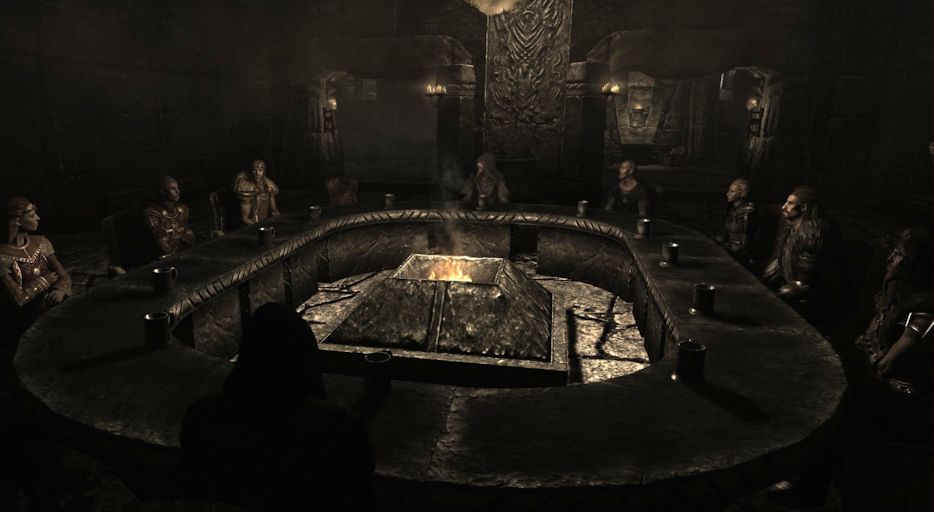
Jarl Balgruuf the Greater insists on a Greybeard-hosted and Dragonborn-mediated end to the hostilities before he will allow his castle (Dragonreach) to be used as an instrument to defeat Alduin.  His logic is that, because Whiterun is both geographically and politically betwixt the Stormcloaks and the Legion, a risky adventure such as the one proposed by the Dragonborn could be seen as a opportunity by one of the sides to gain advantage by taking Whiterun while its Jarl is distracted. General Tullius and Jarl Ulfric Stormcloak sit down at the table and agree to the terms of the truce negotiated by the Dragonborn.  Regardless of the specifics of the negotiation (and the combinations of possible interactions and outcomes is one of the most complex in the whole game), the quest ends successfully when everyone leaves the conference with a hard-won cease-fire.

The negotiation table.
The problem is that, as soon as Season Unending is complete, the player can pick up the Civil War questline wherever he or she left off.  In other words, both sides are willing to violate the terms of the truce to which they just agreed hours ago (in game time).  If Bethesda really meant for the truce to last, the Civil War questline would have been complete (or perhaps failed) at the end of Season Unending. Furthermore, I learned that completing the Civil War quest for either side renders Season Unending not only unavailable, but automatically completed when the player reaches that stage of the Main quest.  I am therefore left to conclude that the civil war was never meant to end peacefully.

From a moral role-playing perspective, the question of who to blame for the truce violation is vital.  While this issue depends somewhat on the stage of the Civil War questline at which the player completes Season Unending, most scenarios suggest that the Stormcloaks are the aggressors.  First, the Empire has nothing to gain by violating the cease-fire.  The Legion is fighting a defensive battle against secessionists within an Imperial Province; if the rebellion stops fighting, then the Legion has no more reason to expend its already stretched forces to "punish" the rebels.  Second, the Empire's major flaw is its adherence to the law, even when the law is unjust (such as the White-Gold Concordat), while the Stormcloaks have little interest in sticking to agreements that violate their ideology; if someone is going to break the treaty, its probably going to be the party that formed around the breaking of another treaty.  Third, and most importantly, nearly every stage of the Civil War questline, regardless of the side chosen by the player, starts with an aggressive act by the Stormcloaks (finding the Jagged Crown in order to legitimize Ulfric's bid to replace Torygg as High King, taking a fort that legally belongs to the Empire, etc.).  In fact, Ulfric's willingness to agree to the terms of the truce forged at High Hrothgar seems, in retrospect, to be a complete sham.  As an ideologue, Ulfric has little to gain by holding to the terms of an agreement that is only slightly more palatable than the Concordat itself.

In my second playthough, I will be sure to complete Season Unending; the number of variables is impressive, and it is a rare moment of NPC communication in a combat-based game.  Still, I wish that Bethesda had scripted a peaceful outcome to the civil war.  While the player can certainly choose to not complete the Civil War quests, the hostilities do not resolve until the player, in effect, chooses a winner by fighting for either the Stormcloaks or the Legion.  As it is currently written, Skyrim does not offer peace as a viable option.

Thursday, November 8, 2012

Civil War


While the Civil War questline presents a variety of gameplay challenges and opportunities, its moral component boils down to one choice: to side with the Empire or with the Stormcloaks.  As I hinted in some previous posts, I had been leaning toward the Imperial side since the opening quest, but did not fully commit until well into the game.  I visited Solitude to hear the Imperial argument from General Tullius, then traveled to Windhelm to listen to Ulfric Stormcloak’s side of the story.  Not wanting to rush into anything, I set about earning the title of Thane in as many Holds as possible, which gave me the opportunity to listen to sympathizers on both sides.  While everything I heard and experienced ultimately led me to join the Legion of the Empire, the choice was by no measure easy. What follows is a breakdown of my considerations in choosing a side.

The White-Gold Concordat

There is no question that the Stormcloaks’ disgust at this egregious treaty is completely justified.  The fact the Empire would allow the Aldmeri Dominion to dictate religious practices within the Imperial Provinces is utterly outrageous, and permitting the Thalmor free reign to enforce the ban on Talos worship almost defies comprehension – which is exactly the point.  Having gained the upper hand after fighting the Legion to a standstill, the Dominion was in a position to ask for anything; why, therefore, would they demand a purely ideological concession (rather than another material or strategic one)?  The answer lies in the ultimate goal of the Aldmeri: total domination of Tamriel.  Because they could no longer afford to wage direct war with the Empire, they had to find a way to use the peace to their advantage.  They had already separated Hammerfell from the Empire; if they could sever Skyrim as well, they would effectively cut off the Empire’s supply of skilled warriors.  What better way to drive a wedge between the Imperials and the proud Nord race than by forcing the Empire to outlaw the worship of their apotheosized ancestor?

Ulfric’s primary error is in taking this bait, thereby weakening not only his beloved Skyrim, but the whole of the Empire as well. As I have suggested before, the ideal scenario would be a untied Empire biding its time, rebuilding its forces, and focusing the Nords’ righteous indignation on the real enemy in preparation for a renewed assault on the Dominion.  While I concede that I have yet to hear any Imperial representative suggest such a strategy, there is a strong possibility that this plan is being kept under the tightest of wraps in light of the Thalmor propensity for espionage.  However, even if the Empire did simply roll over to save itself, Skyrim only stands to lose by divorcing itself from Cyrodiil and High Rock.

Jarl Ulfric Stormcloak vs. General Tullius

Because I am playing with an eye toward moral agency, I have to consider not only the moral claims of the warring sides in the Civil War, but also the ethics of the men and women who represent each party.  One of Bethesda's major accomplishments in this game is the creation of morally complex antagonists; both Ulfric and Tullius possess a melange of admirable and lamentable traits, which makes following either one far more complicated than a simple good/evil split.

Jarl Ulfric Stormcloak of Windhelm is obviously the aggressor in the conflict, but his rationale carries a legitimate claim to justification.  The Concordat is a direct violation of the freedom of religion that we in the West tend to view as inalienable.  Furthermore, his speeches reveal him to be a man haunted by the soldiers who laid down their lives at his side during the Great War, and a Jarl unwilling to insult their memory by acquiescing to the Dominion's blasphemous demands.  While not an blatant zealot (such as Heimskr, the street preacher of Whiterun), Ulfric cannot separate his worship of Talos from his love for Skyrim, seeing the abandonment of the former as a betrayal of the latter.  Despite the accusations of his Imperial foes, Ulfric does not appear to be acting out of an inflated sense of self; even his most extreme actions, such as the killing of High King Torygg, come from a deep passion for Talos and for Skyrim.

He did, however, kill the High King.  The question of whether the killing was part of a legitimate challenge according to Nord tradition or a flat-out murder is in some ways irrelevant.  Instead of making his case and biding his time, he plunged his homeland into chaos on ideological grounds.  Furthermore, one cannot ignore the fact that using the Thu'um against an opponent who did not possess that power is tantamount to attacking an unarmed foe.  Throughout history, many honorable men have allowed their devotion to a legitimate cause to mutate into a kind of monomania that excuses any evil in the service of that cause.

Although not directly related to the Civil War, Ulfric's record as Jarl of Windhelm did not sway me to his side, either.  First, not only did he seem largely unconcerned with the serial killer running loose in his Hold, he had no comment when the killer turned out to be his own court wizard.  Second, when the boy Aventius Aretino was in his hour of need, the childless Ulfric decided to send him back to an abusive orphanage in another Hold entirely, instead of perhaps adopting him and gaining an heir for himself in the bargain.  Lastly, his treatment of the Dunmer was utterly deplorable.  While it is true that I never heard him utter any racial epithets himself, I cannot ignore the fact that he consigned the Dunmer to a ghetto and allowed the racial harassment going on in front of his own palace to go unchecked.  None of this should be a surprise, however; a quick perusal of the Markarth Incident raises the question: if Ulfric was willing to wage a nearly genocidal campaign against other races of men (Breton/Reachmen/Forsworn), what can we expect him to do to the non-human races?  Add his experiences as a prisoner of the Aldmeri Dominion to the mix, and we have a recipe for a racially-intolerant Jarl whom I could not follow in good conscience, regardless of his other virtues as a warrior and a leader of men.

As much as I liked Jarl Ulfric personally, I found his political views impossible to support; quite the inverse is true of General Tulius, whose repellant personality failed to dissuade me from the Imperial cause.  Tullius is a culturally insensitive boor who routinely, if unwittingly, insults his faithful Legate Rikke's homeland with dismissive comments such as:
What do you mean, "You people"?
Nevertheless, Tullius is on the right side of this conflict.  The Empire had a hard choice: sign a treaty that insults the Nords and defames its own progenitor, or risk annihilation after a long and bloody war with a seemingly implacable enemy.  While it may be noble to sacrifice one's own life for religious freedom, committing an entire Empire to that cause is another story entirely.  Tullius, who is no fan of the Thalmor,  understands that signing the Concordat was the bitter pill that saved the Empire.  What Tullius lacks in personal magnetism and tact, he makes up for in judgement.

Perhaps the best indicator of Tullius's leadership qualities is his second-in-command, Legate Rikke.  A proud Nord "daughter of Skyrim," Rikke bears Tullius's slings and arrows for the good of the Empire, and in return, Tullius looks the other way when Rikke expresses sympathy for Ulfric's cause or lets a "Talos guide you" slip out.  Rikke agrees, as I do, with the justness of Ulfric's outrage, but believes, also as I do, that a unified Empire is the best solution to the Thalmor problem.  That Tullius is willing to overlook the fact that his most trusted lieutenant is not only clearly violating the Concordat but also is apparently an admirer of his enemy speaks volumes about his priorities.

This tendency among supporters of the Empire to ignore the most offensive element of the Concordat is one of the main reasons that I feel good about my choice.  Yes, the Temples of Talos have been closed in Solitude and Markarth, but beyond that, no one seems to be enforcing the ban.  Balgruuf lets Heimskr preach in front of his Shrine all day every day in public.  Tullius knows that Rikke worships Talos, but says nothing beyond "Excuse me?"  In fact, the only character who ever reported any Talos worshippers was, well, me -- which I did in order to gain Ondolemar's trust, then promptly assassinated him and returned the Amulet of Talos to Ogmund.  The Imperial laxness in enforcing the Concordat beyond the bare letter of the law undermines Ulfric's claim that the Empire has become the lapdog of the Dominion.

Rikke and Balgruuf the Greater

The two characters I most admire in the Civil War quest both side with the Empire, which certainly influenced my decision.  I have already mentioned the long-suffering yet formidable Legate Rikke who, unlike Galmar Stone-Fist, her Stormcloak counterpart, resists the urge to demonize her opponents.  I cannot say this strongly enough: the fact that Rikke sympathizes with the Stormcloaks but grudgingly fights against them because she believes they are wrong is evidence of a moral character that approaches Kohlberg's Principled stages (5 and 6).  Galmar, on the other hand, relishes the prospect of savaging the Legion he and Ulfric once served.  Even if I sided with the rebellion, I would find Stone-Fist's taunts about "Deadking Torygg" tough to abide.

The other character who swayed my choice was Balgruuf the Greater, the Jarl of Whiterun.  Unlike Legate Rikke, Balgruuf has no real love for the Empire; his primary concern is the welfare of the people in his Hold.  As much as he hates the Concordat, and as much as he resents Imperial interference, he lambasts Ulfric for throwing Skyrim into chaos.  He knows that the Thalmor are the real enemy and, above all, he really wants people to focus on that pesky dragon problem.  He remains neutral as long as possible, because he knows that his decision will hasten a full-blown civil war.  When he finally chooses a side, it is because Ulfric forces his hand;  Balgruuf makes no secret of his reluctance to garrison Imperial troops within the walls of Whiterun and makes it abundantly clear to Tullius that he has no intention of giving up control of his Hold to the Legion, even as he sides with the Empire.

Rikke and Balgruuf demonstrate that one need not love the Empire nor agree blindly with its actions in order to see that seceding from the Empire would weaken Skyrim and further strengthen the Aldmeri Dominion's hand.

The Death of Ulfric Stormcloak

Once I chose a side, the individual quests in the Civil War line were morally simple. A band of Legionnaires and I would take a fort from the Stormcloaks, then I would be called in to do a more stealth-oriented quest (lean on a Stormcloak sympathizer, steal plans, etc), then take another fort, and so on.  There were very few serious ethical decisions to make until the end of the Battle for Windhelm.

The final battle of the Civil War took place in Ulfric's own Hall.  Legate Rikke, my Solitude housecarl Jordis, General Tullius and I faced off against Ulfric, Galmar, and a small band of Stormcloaks.  After Galmar fell, we forced Jarl Ulfric to surrender.  When Tullius offered him the chance to face the formal execution he had escaped after the dragon attack on Helgen, Ulfric refused, saying that he wanted me, the Dragonborn, to have the honor of killing him.

To be perfectly frank, I had no desire to kill Ulfric; as I said earlier, he is a good man with a bad idea.  Ulfric's death, however, was inevitable, and I sympathized with him enough to spare him the humiliation of dying by Tullius's hand.  In fact, when Tullius offered me his sword in order to do the deed, I refused.  Jarl Ulfric Stormcloak of Windhelm was a great man who committed great crimes, and his death needed to reflect both of those realities.  I therefore decided to kill Ulfric in the same manner he had killed High King Torygg -- a Dragon Shout.  A fitting end for one of Skyrim's greatest warriors.