Please read this first.

Welcome! This blog is devoted to considerations of morality in the The Elder Scrolls V: Skyrim by Bethesda. Rather than a fansite, review, or walkthrough, it is a serious attempt to examine the game through a moral lens. Please note that the purpose of this blog is to discuss morality within the context of the game, not to determine whether playing the game is immoral in and of itself; the latter type of "discussion" tends toward tedium and inhibits, rather than promotes, a meaningful conversation.

If you have not visited this blog before, it might be helpful to read the posts labeled "Orientation," most of which are the first few entries in the blog archive (see right). These posts include a short introduction to this project, a content-specific author bio, and a few other pieces that explain key concepts relevant to this study. These posts are of particular use to those readers less familiar with Skyrim (or video games in general).

PLEASE NOTE: HERE BE SPOILERS!

If you have visited this blog before, thanks and welcome back!
Showing posts with label Orientation. Show all posts

Saturday, July 21, 2012

The Story So Far

My interest in TES V: Skyrim began when I caught the live-action trailer:

It had a been a while since a video game commanded my attention (Minecraft), but Skyrim promised the kind of in-game storytelling that I love, in a fantasy setting reminiscent of the AD&D campaigns of my youth.  My long-suffering and ever-generous wife bought me the Xbox version for Christmas, and I have been playing consistently since then.

In a previous post, I established the importance of plot and backstory in my approach to gaming.  The conventions of fiction are important enough to me that I will "fill in the blanks" if a game does not provide a rich enough storyline.  When playing Street Fighter II, for example, I amused myself by inventing a plot arc for each character that not only explained his or her ending but also how each battle leads up to that ending: Blanka's search for his mother takes him from Brazil to the Soviet Union, where he is captured and must fight his way out of the gulag in order to find the next clue, and so on.  From the trailer alone, I could tell that Skyrim offered the fictional elements that make playing a game worthwhile for me.

As in TES titles, the PC starts out as a prisoner, which places the character in the position of an anonymous outsider.  As Skyrim begins, you wake up on a cart, being transported to your execution.  Through conversation with the other “passengers,” you learn that with civil war looming, the Empire is taking no chances with strangers crossing the border into Skyrim.  In fact, the gagged figure to your left is none other than Ulfric Stormcloak himself, who killed High King Torygg then escaped from Solitude, the seat of power in Skyrim’s Haafingar Hold.  Also in the cart is another Stormcloak rebel and a common thief; the fact that all of you face the death penalty throws into high relief the draconian nature of Imperial justice, and sets up the first major choice point in the game.  As you are led off the cart, Nord Legionnaire Hadvar asks you for your name; it is at this point that you create your character.  Given that fact that you will soon discover that your PC is none other than the long-anticipated Dragonborn (“Dovahkiin” in dragon tongue) – a mortal with the soul of a dragon – it is noteworthy that this messianic figure could be a mortal of any race or gender; it also means that the game leaves the Dragonborn's backstory as open as it does the race, gender, and name.

Given my penchant for storytelling in games, it should come as no surprise that character creation took me quite a while.  As I often do, I created an avatar that depicts an idealized version of myself, this time inserted into the TES context. I made him a Nord because I wanted my PC to face internal conflict with regard to the civil war.  I named him Lothar Ironfoot, which reflects a hodgepodge of influences.  "Lothar" is a Germanic name meaning "famous warrior," but it is also an homage to one of my favorite Saturday Night Live sketches, Lothar of the Hill People.  "Ironfoot" is a surname that uses the Nord kenning-like patronym tradition (Battle-Born, Snow-Shod, Stonearm, etc.) to suggest a wanderer, which fits the PC's opening "crime."  Lothar's backstory is that his parents were both Nords in the Imperial Legion who died in the Battle of the Red Ring when he was a young boy (which makes him about 30 when the game starts).  After the death of his parents, he was raised by an old Imperial blacksmith, a friend of his parents (I retconned this part after meeting Alvor and deciding to level up in Smithing first).  When his surrogate father passed away, Lothar, now a teenager with no family and no further ties to Cyrodiil, began to make his way in the world as an wanderer, doing odd jobs here and there.  Eventually, he decided to "return" to his parents' homeland, which leads to the conditions and the start of the game.

I was a good way into to Skyrim before I decided to conduct a coherent study of moral agency in the game, so most of the posts will discuss quests I have already completed.  At this writing, Lothar has reached level 44, and my style of play has favored the Warrior skill type, with my work in the Mage skill set focusing on Destruction and Enchanting, and my work in the Thief set empasizing Sneak and Alchemy.  I am a little more than halfway done with the main questline, but I recently completed the Companions questline, and have begun the Imperial Legion, Bards College, College of Winterhold, and Thieves Guild questlines, going back to each occasionally.

Although this study is not meant to be a "novelization" of my gameplay (a surprisingly popular form of fan fiction), there are some narrative elements extant in my treatment of moral agency in the game.  I have organized the relevant quests in a rough chronological order, so a kind of plot might well develop, but this effect is mostly unintentional.  Therefore, I will begin my account with the quest entitled Unbound.

Friday, July 20, 2012

The Rules of Engagement

In order to maximize my engagement with the story and optimize my role as a moral agent, I have developed a handful of rules to guide this playthrough.  They are divided into two groups, gameplay and moral, and are more descriptive than prescriptive; I follow them most of the time, and indicate in my posts instances in which I deviate from them significantly.

Gameplay Rules
  1. Limited use of the save-reload: The ability to endlessly reload takes away the sense of consequence and permanence required in order to act fully as a moral agent.  Although I am an obsessive saver, I try not to reload except under the following conditions:
    1. PC death: Obviously, if the PC dies permanently, the game is over, which defeats the purpose of this whole project.  Moreover, the game reloads automatically from the last save point anyway.
    2. Quest failure: If I fail a major quest objective through ineptitude (rather than by choice), I will reload.  I am interested in decision-making, and quest failure tends to cut off the sequence of decisions.
    3. Negative outcomes due to experimentation: At one point, while I was overburdened with loot, I dawdled at a Word Wall while trying to figure out how to get down the steps and back to my horse.  When I finally stopped fooling around, dropped the extra loot, and found my horse, I discovered that a pair of sabre cats had already killed him.  Because the horse's death was a direct result of a gameplay failure (wasting time trying to overcome the encumbrance system) and not a result of a PC decision or failure, I felt justified in reloading, heading down the hill at my normal rate, and arriving in time to save my horse.  Later in the game, the same horse died during a Forsworn ambush; there were no extraordinary gameplay issues and I fought in my normal manner, so I did not reload, and had to obtain a new horse.
  2. Limited use of the wikis: Wikis, while helpful, tend to act as spoilers.  In order to make real decisions, I'd rather not know what the "right" answer is (if one even exists) until after the fact.  Furthermore, as a stranger in Skyrim, my PC probably would not have access to encyclopedic sources, so it seems more immersive for me to limit my access as well.  After I complete a quest, however, I do explore the relevant articles to find out what I may have missed.
Moral Rules:
  1. Killing: In a combat-based game, violence is the norm, so most of the in-game ethical dilemmas will involve decisions about whom to kill:
    1. Hostiles: In most battles, Skyrim does not offer a "subdue" option, so I feel justified in killing any creature or NPC that attacks me without provocation.  This has led me into some troubling situations, such as killing members of the Forsworn or the Afflicted, even though I'd really rather not.
    2. Unsuspecting "bad guys": Bandits prey on the innocent and necromancers are always involved in some kind of abomination -- not to mention the fact that both groups always attack me on sight.  Therefore, sneak attacks on these types of groups are usually justified.
    3. Wild game animals: While I don't typically go out of my way to hunt, non-hostile wild animals drop valuable resources (hides, meat, petty souls), so as long as an animal isn't owned by an NPC, I feel justified in "harvesting" deer, goats, foxes, rabbits, and fish.
    4. Thalmor agents: Although I haven't finished the main questline yet, I'm reasonably certain that the Thalmor are the root cause of Skyrim's problems, including the dragon attacks and the civil war.  Even if Thalmor agents don't attack me first, I still feel that their machinations are destructive enough to justify my killing them.  Also, if I'm being honest with myself, their outright sneering racism and gleeful repression of Talos worshippers makes killing them more of a pleasure than a chore.  Perhaps I should feel more conflicted on this one, but I don't.
    5. Vampires: Most undead (draugr, skeletons, and zombies) fall into the "hostiles" category, but vampires are a bit different.  First, even though they are considered "undead" for purposes of undead-related spells and weapons, they are actually NPCs suffering from a disease rather than mindless automata.  Secondly, the ones I have encountered so far are all classically villianous and usually carrying out some kind of larger plot (see the post on Laid to Rest).  Therefore, my general policy is to kill them when possible, but there are some limits (see the post on Hitting the Books).  Obviously, the Dawnguard questline, once I start it, will affect my views on this category.
    6. "Special Cases": There are a few situations, such as the random encounter the Old Orc, in which killing is uniquely appropriate.  The Old Orc wishes to die honorably, so he asks if I will help him by fighting him to the death.  I have no quarrel with him, but because he clearly wishes to die with honor, killing him in battle is justified (and perhaps even virtuous, from the orc's standpoint).
  2. Stealing vs. Taking: The game draws a clear distinction between stealing and taking by indicating items that can be legally taken with a white "Take" caption and those that cannot with a red "Steal" caption.  Stolen items can only be sold to the fences who work with the Thieves Guild, and a bounty is incurred if anyone witnesses the theft.  The game mechanics, however, do not cover the full range of possibilities:
    1. Stealing from enemies: Stealing from an NPC I feel justified in killing seems to be likewise justified.
    2. Stealing from neutral NPCs: I try to avoid this unless it is necessary, such as completing a quest that helps to prevent a greater evil.  To be honest, the NPC's disposition toward me matters more than I can morally justify; if NPCs are rude or dismissive, I feel less guilty about stealing from them.
    3. Stealing from friends or allies: There must be a very compelling reason for me to do this.  As far as I can recall, I have not stolen from a friendly NPC.
    4. Taking from enemies: Obviously, if I am comfortable stealing from a live enemy, looting from a dead one is justified as well.
    5. Taking from neutrals, friends, and allies: This category varies greatly from instance to instance.  In some cases, friendly NPCs directly offer some of their belongings, so there is no moral conflict apart from a minor misgiving that I might be taking advantage of a friend's generosity.  In other cases, even though an item is marked "Take," it seems more like stealing. 
    6. Taking from barrows, burial chambers, etc.: Dungeons full of draugr often contain valuable loot, but the lore suggests that these items were left in honor of the dead buried there.  I routinely take these items.  Even though I am trying to play a religiously orthodox PC, I find it hard to justify leaving useful items in a tomb.  Furthermore, these places have already been desecrated, as evidenced by the presence of the draugr themselves.
    7. Taking from shrines and temples: My behavior in these places depends almost entirely on the focus of worship.  Although religious tolerance is a virtue, most of the Daedra are nefarious entities, and their followers likewise, so I have little problem ransacking their unholy places.  Sites devoted to the Divines, however, I generally respect.
  3. Other NPC interactions: Although most game time is spent exploring and fighting, dialogue with NPCs is a major component of Skyrim, so a few guidelines are in order:
    1. Response options: When given a choice among responses, I usually choose the most polite and respectful option.  It seems to make little difference to gameplay, and it is in keeping with the kind of PC I am trying to run.
    2. Miscellaneous quests: When an NPC asks me to complete a miscellaneous quest, I usually accept, unless the quest goes directly against my own sense of right and wrong.  Again, I want to run a beneficent PC, so helping the citizens of Skyrim whenever possible makes sense.  This habit sometimes leads me to have too many open quests -- a problem I usually have in the real world as well.
    3. Persuade/Intimidate/Brawl/Bribe/Lie: In some interactions I am required to convince NPC to do things they'd rather not do.  I usually try to Persuade, but if that fails, I might chose to Intimidate or Brawl (if available); violence or the open threat of violence seems slightly more honorable than the more underhanded Bribe or Lie option.  It may seem strange to prefer the violent options over bribery, but since virtue in this setting comes from valor and honor, beating up an NPC feels less "evil" than paying him to do something he shouldn't do.  Still, I would not be eager to defend this point in a debate.
    4. Hold Guards: I try to avoid incurring bounties, but when I am stopped by Hold Guards, I will typically try to talk my way out of getting arrested (using my status as Thane, if applicable).  Failing that, I will pay the bounty.  With one quest-related exception, I have not yet been arrested; if I were to be arrested, I would not resist.  Since I am playing a mostly Lawful Good kind of PC, fighting with the guards is hard to justify.
As I mentioned the the beginning of this post, these rules are not the Ten Commandments; I have broken most of these at some point. In fact, I would argue that the instances in which I have deviated from these guidelines have provided some of the most morally compelling moments of my gameplay.

Tuesday, July 17, 2012

A Note on Person and Persona


The conventions of writing about video games are still being codified, so some explanation of my use of the point of view in this study is in order.

When discussing the game in general, external terms, I tend to use the third person to refer to the player, as in “the player is required to choose a race for his character” or “the player may want to save her perk choice until later.”  I usually switch genders in order to avoid both the sexism of using one gender over the other and the inelegance of “his/her.”  I also use third person to refer to my PC from an external player perspective: “I chose a stockier body type for him because I thought it fit my warrior-oriented gameplay.”

When describing general in-game events that are not part of my own gameplay, I most often use the second person, as in “in order to join the Legion, you have to prove yourself on a solo quest.”  The inclusiveness and informality of the second person works well in these cases.

When narrating my own playthrough, I use first person almost exclusively, as in “I attacked the troll with a war axe.”  I find that trying to maintain the third person, which would otherwise be appropriate for this kind of storytelling, both tedious and contrary to my project of discussing moral agency.  “I chose to join the Legion” is more active and concise than “I chose to have Lothar join the Legion.”

As with all of my guidelines, stylistic or otherwise, I am sure I have deviated from these several times already.

Monday, July 16, 2012

Skyrim as a Moral Setting

Despite the very real differences between religious faiths, most moral systems in the everyday world are very different from in-game morality, largely because of the kinds of challenges presented to the players.  Mercy and compassion are core values of most modern religions, but they have no place in chess, in which deception and ruthlessness are celebrated.  This does not mean that chess is immoral; it means that the moral code of chess is appropriate for the game, but not necessarily for daily life.  Likewise, the moral environment of an RPG is best evaluated within the context of the fictional world it creates

Fantasy RPGs tend to take place in Iron/Middle Age settings, in which violence is a daily occurrence.  Skyrim, because it cribs so extensively from Beowulf and the Poetic Edda, occurs in an Anglo-Saxon/Viking moral setting; valor in battle and personal loyalty are more important than mercy, and cowardice is considered worse than assault in most cases. Some NPCs, like Uthgerd the Unbroken, cannot be recruited as followers or approached as potential spouses until the PC brawls with them. fistfights aside, all other battles are to the death. If an opponent's health drops low enough during a (non-brawl) fight, he might cry "Mercy," but as soon as the PC stops attacking, the opponent will resume fighting once his health regenerates.  Conversely, the PC can yield during a battle, but only Hold guards will accept the gesture; all other enemies will continue attacking.  Most quests cannot be completed without killing at least a few enemies.  While Skyrim allows room for finishing some quests successfully without actual combat (through sneaking, speech, or fear spells), a truly pacifist PC would be excluded from most quests, and main questline in particular.

However, even though mortal combat is commonplace in Skyrim, the game still forbids certain kinds of violence.  Children, for example, cannot be harmed by the PC; if the player attacks a child, other NPCs will immediately turn on the PC, but a health meter will not appear above the child; in other words, attacking a child leads to instant punishment, despite the fact the child literally cannot be harmed.  The game has a different, but just as effective, way to discourage violence against women.  All adult NPCs are capable of attack, most are armed at all times, and there is no difference between men and women in battle statistics.  Therefore, if a male PC attacks a non-combatant female NPC, he may be in for a real fight.

Because TES V: Skyrim is a combat-based RPG set in a fantasy version of a Viking-like warrior culture, violence is the rule, rather than the exception, and any moral code the player wishes to follow must take the setting into consideration.  More often than not, the moral dilemmas will revolve around fighting.  Do I kill the bandit leader just because the Jarl said he would pay me to do it?  Do I side with the Empire or the Stormcloaks in the Civil War?  Should I sneak past the Thalmor guards or just kill them?  Is it acceptable to kill an NPC to gain another NPC's trust?  I need to get this NPC to stop harrassing another NPC -- should I persuade, bribe, threaten, or just beat him up?  In order to navigate this setting as a moral agent, the player must tailor her PC's moral system to the violence that forms the basis of many of the in-game challenges.

Saturday, July 14, 2012

The Metrics of Morality

Morality has been an integral part of gaming since the early days of tabletop RPGs.  Advanced Dungeons & Dragons, for example, used a moral alignment grid to systematize the rather nebulous concept of moral inclination:


The two axes represent competing obligations; the good-evil axis tends to measure a character's concern for others, whereas the law-chaos axis measures the same character's concern for order.  King Arthur might be considered Lawful Good, but Robin Hood would probably be seen as Chaotic Good.  Conversely, a serial killer might best be described as Chaotic Evil, while a mafia hit man would be in the Lawful Evil area of the chart.  Other axes have been created to represent other areas of moral concern, but the system depicted in the chart above is by far the most pervasive.

Moral alignment in tabletop gaming can be fairly arbitrary because it depends entirely on the interpretation of the GM. In classic AD&D rules, for instance, the character class of Paladin requires that a PC maintain a Lawful Good alignment; if player begins conducting the PC in a way that runs counter to that alignment, the GM has the option (and, some might argue, the responsibility) to rescind the PC's Paladin status, along with its attendant powers, and force the player to run the PC as a common fighter. What constitutes sufficient deviation from the PC's alignment, however, is completely up to the GM.

In computer RPGs, the GM is digital, which poses some interesting issues for games that incorporate moral alignment. Ambiguous and complex ethical decisions must ultimately be reduced to data that the game can process. Once a game establishes moral agency (see the previous post on this subject), there are two possible options for dealing with the consequences of a PC's actions.

The first option is to include some type of scale or continuum by which the game can track a PC's morality. Sometimes, this scale is purely internal; the game engine decides what is good or evil and rewards or punishes the PC accordingly -- new powers or closed-off missions.  Other scales are external; the consequences of the PC's actions are meted out by NPCs who increasingly react to the PC as either a hero or a villain.  A handful of games combine these two types of metrics.  Please read Laura Parker's excellent Gamespot article, entitled "Black or White: Making Moral Choices in Video Games," for a more detailed account of morality systems in gaming.

The other method of creating morally rich gaming environments is simpler, but far more abstract.  Some games create morally complex scenarios, but do not include any discernible consequence system beyond an NPC reaction protocol.  If, for example, a PC steals from a store, he might affect the store owner's willingness to help him in the future, or perhaps get arrested by the police, but because morality is not one of the PC's measured attributes (like skill levels or hit points), future gameplay remains relatively unaffected -- especially if there are no witnesses.

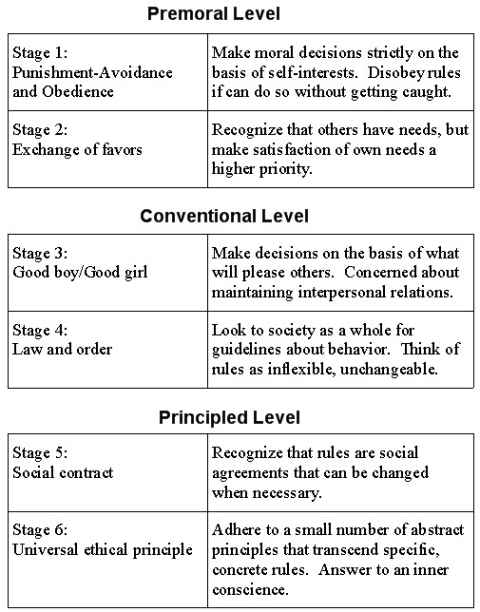
The core difference between these two approaches can be best understood through psychologist Lawrence Kohlberg's seminal work on the stages of moral development.  In his 1958 dissertation, Kohlberg built on Jean Piaget's and John Dewey's work with children in order to systematically describe the process of an increasingly competent intellect "learning" morality: 
A summary of Kohlberg's stages

Although Kohlberg's work is more complex and controversial than the scope of this study allows (see this excerpt from Theories of Development for a more in-depth treatment of Kohlberg's theories and the criticisms thereof), it forms a convenient framework for understanding the role of moral metrics in computer RPGs.

Consider Kohlberg's iconic dilemma:
Heinz Steals the Drug
In Europe, a woman was near death from a special kind of cancer. There was one drug that the doctors thought might save her. It was a form of radium that a druggist in the same town had recently discovered. The drug was expensive to make, but the druggist was charging ten times what the drug cost him to make. He paid $200 for the radium and charged $2,000 for a small dose of the drug. The sick woman's husband, Heinz, went to everyone he knew to borrow the money, but he could only get together about $ 1,000 which is half of what it cost. He told the druggist that his wife was dying and asked him to sell it cheaper or let him pay later. But the druggist said: "No, I discovered the drug and I'm going to make money from it." So Heinz got desperate and broke into the man's store to steal the drug-for his wife. Should the husband have done that? (Kohlberg, 1963, p. 19)
Whether one answers the question "yes" or "no" is irrelevant; what matters is the reason for the decision.  A Stage 1 thinker, who tends to think only of immediate benefit or punishment, might say "yes" because Heinz will be sad if his wife dies, or "no" because Heinz will go to jail if he gets caught.  Conversely, a Stage 4 thinker, who sees issues of justice in terms of social norms, might "yes" because the druggist is unfairly gouging Heinz when he obviously can't afford it, or "no" because breaking the law is never right, even in these circumstances.

Dichotomous morality engines, such as those found in Knights of the Old Republic (Light Side/Dark Side) or InFamous (Karma), label the PC "good" or "evil" and hand out the appropriate consequences, thereby encouraging the player to remain at the premoral stages (1 and 2).  The player tends to make decisions based on creating optimal gameplay conditions for himself -- gaining greater powers, avoiding penalties, unlocking achievements, and the like.  This is not to say that moral agency is impossible in these games; rather, the game mechanics create a Skinnerian system of positive and negative behavior modification that neither invites nor prevents moral agency.  NPC disposition systems offer greater freedom, but they only function properly when NPCs are aware of the PC's actions, and even then they really invite only a Stage 3 kind of thinking.

Imagine the Heinz dilemma as a decision point in a computer RPG.  If the game employs a simple, internal "red/blue" dichotomy, then one choice will be considered good and the other evil.  Perhaps breaking the law is coded as an evil action, so Heinz's "Karma Meter" will slide toward the red if he chooses to save his wife.  Instead of considering how stealing the medicine impacts his PC's potentially complex ethical code, the player may well be placed in the ironic position of doing something he considers wrong in order to maintain his PC's "good" status.

Games that limit their moral metrics to NPC disposition and delayed consequence (such as The Witcher and Skyrim) allow players greater agency.  If we relocate Heinz from Europe to Skyrim, we create an in-game dilemma that invites higher-stage thinking.  Let's say that Heinz is a PC with a high enough Sneak skill that he can expect to steal the drug without being detected by either the druggist or the guards; without a dichotomous meter or NPC reactions to consider, the player is more free to base his decision on Stage 3 thinking or above.  Forcing the player to choose between loyalty to one's spouse over allegiance to the law without inordinate concern for the impact on gameplay encourages greater moral agency in the player.

As Parker suggests, future games may have morality engines sophisticated enough to engender moral agency on Stages 5 or 6 of Kohlberg's scale.  Until then, it seems that less is more in this area.  Games that create morally complex scenarios but refrain from evaluating the player's decisions allow the development of rich and multifaceted PCs who cannot be easily reduced to "good guy/bad guy" status -- in other words, PCs more like us.

For further reading, check out these articles:

Tuesday, July 10, 2012

The World of Skyrim: Religion

Religion in The Elder Scrolls is perhaps an even more complicated subject than politics, and it has a more direct impact on gameplay than history.  The gods and goddesses of the game have particular import in this study, as they form the moral framework of this fictional world.  As in the previous orientation posts, I will not attempt an exhaustive explanation of the supernatural elements of TES V: Skyrim.  Those readers who would like more detailed information are directed to the wikis in the right-hand column.

Each racial culture in Tamriel has its own creation myth and its own set of divine beings, but because these entities play a key role in the games themselves, each culture's mythos is really an ethnocentric interpretation of an objective supernatural phenomenon; because he created the Amulet of Kings (an in-game item that affects gameplay), we know that Akatosh the Dragon God of Time objectively exists in the game, even if the Khajiit call him Alkosh the First Cat or the High Elves call him Auri-El and believe he favors the races of Mer over those of Man. The ideas on which the religions concur can essentially be treated as cosmological fact.

What can be known is that the universe began as a stasis (Anu) into which came change (Padomay, or Sithis), thus creating the original spirits (et'Ada).  One of these formless beings created an identity for itself (Akatosh) thus creating time.  Other entities followed suit.  At some point, one of these et'Ada (usually known as Lorkhan the Trickster God) convinced a small group of others to help him create and populate a new plane of existence (Nirn).  These nine beings, known as the Aedra ("our ancestors" in Aldmeri), soon began to understand that Lorkhan was draining their divine essence in order to complete his project; those who abandoned the creation scheme earlier kept more of their power, while those remained later were left in a very weakened state (relative to their former existence, not to humans) -- the last of whom was Lorkhan himself, who is generally thought to have given his life for the creation of the planet itself.  The rest of the Aedra, now depleted of much of their power, are bound to their own planets in the fictional solar system.  The many et'Ada who did not join Lorkhan in his plan are known as the Daedra ("not our ancestors"), and retain the capacity to leave their own planes and interfere with the inhabitants of other realms (most notably Nirn).

Of particular interest to this study is the relationship of Tamrielic religion to real-world belief systems.  Because Tamriel is a fictional setting, it is necessary to be very fluid when drawing connections to actual religions.  Perhaps the best models for this genre are the works of J. R. R. Tolkien and C. S. Lewis that invent worlds in which neither the Abrahamic God nor His Son exist, yet nevertheless faithfully represent many of the core tenets of the Christian faith their authors professed.  Tamrielic religion, as imagined by a collective entity such as Bethesda and its fans, is likewise bound to incorporate a wide variety of belief systems, including atheism.

Given the key role of the Nords in the TES series, and Skyrim in particular, the prominence of Viking mythology is to be expected.  Sovngard (the land of the honored dead), for example, is essentially a stand-in for Valhalla.  The Aedra themselves are based on the Nine Noble Virtues distilled from the Poetic Edda and the Icelandic Sagas:

Aedra
Role
Viking Noble Virtue
Akatosh
 The Dragon God of Time and the chief god of the pantheon
Discipline
Arkay
 God of Life and Death
Honor
Dibella
 Goddess of Beauty
Self-Reliance
Julianos
 God of Wisdom and Logic
Truth
Kynareth
 Goddess of Air
Perseverance
Mara
 Mother Goddess and Goddess of Love
Fidelity
Stendarr
 God of Mercy
Hospitality
Talos/Tiber Septim
 God of War and Governance
Courage
Zenithar
 God of Work and Commerce
Industriousness

Despite the Viking influence, these Aedra (a.k.a. the Nine Divines) do not correspond neatly to the Norse gods.  While one might be tempted to draw a connection between Lorkhan and Loki, the similarity between the two disappears beyond the trickster role.  Unlike the Norse gods, the Aedra are not personally active in the world; rather, they function more like transcendent divinities (similar to the New Testament God), granting blessings through their shrines, but not manifesting themselves directly on Nirn. 

Worship of the Divines is the orthodoxy of the Empire, hence the use of the Cyrodilic nomenclature; Nords worship the same gods for the most part, but sometimes under different names.  Although there are separate sects for each deity, these groups do not see each other as contradictory, but rather as distinct in emphasis; in this aspect, they are like the priests of ancient Greece or perhaps even modern Catholic religious orders.  Other racial groups worship some combination of these gods and their own deities, some of whom are Daedric Princes.  The unisex term "Prince" distinguishes the more powerful Daedra from the less potent Daedric rank-and-file.

The Daedric Princes, as divine beings who are able to manifest themselves actively in the mortal world, read more like the gods of ancient pagan pantheons than the Aedra do.  They interfere directly with the affairs of mortals for their own purposes; the destruction they frequently cause is of little import to them.  Their spheres of influence tend toward the ignoble: Boethiah the Daedric Prince of Usurpers, Assassins, and Secret Plots; Molag Bal the Daedric Prince of Enslavement; and so on.  The less powerful Daedra usually appear in the games as Dremora, humanoids with a demonic appearance who can be summoned from their plane as bound servants or fought as enemies.  Taken together, these attributes lead to a picture of the Daedra as evil, but there are a handful of Daedric Princes who seem more benevolent (Meridia and Azura, for example).

The reality is that attempting to see these divine entities through the western or Judeo-Christian dichotomy of "good" and "evil" is problematic.  The Aedra act as makers and sustainers of the known world, and therefore represent creation and order.  Because the PC is part of that creation and order, it is natural to see these beings as the embodiment of "good."  Likewise, the Daedra view mortals as means to an end, or even as playthings, which is insulting and threatening to the player's view of himself, so the Daedra are "evil."  These ideas do not, however, necessarily correspond to conventional ideas about morality.

This issue would be purely academic were it not for the presence of Daedric quests in TES V: Skyrim.  To play as a moral agent, the player must examine the reasons for his actions, the likely foreseeable results of his actions, and the justice of his actions.  Quests undertaken at the behest of a Daedric Prince are likely to involve some inextricable combination of "good" and "evil," which can seriously complicate the attempt to adhere to a moral code.  These quests are examined in detail in later posts.

Another interesting religious issue that can create fruitful ambiguity for the player as a moral agent is the status of Talos/Tiber Septim.  As detailed in a previous post, Talos is the Nord hero who founded the Third Empire (the current Tamrielic Empire).  At the end of his earthly life, Tiber Septim was apotheosized (in a manner similar to that of Romulus in Roman mythology) and admitted to the Cyrodilic pantheon as the patron of Mankind -- a type of replacement for Lorkhan, who sacrificed his existence for the creation of Nirn.  The races of Men see themselves as created by Lorkhan alone, whereas the races of Mer think of themselves as descendents of the Aedra.  They therefore have a distaste for Lorkhan, who they believed tricked their ancestors out of their immortality, and for his successor Talos, who brought their nations into a Man-dominated Empire.  The Altmer in particular believe that worshiping the once-human Talos as a god is a kind of heresy.

About 25 years before TES V: Skyrim opens, the battered Empire ended The Great War by signing the White-Gold Concordat: the Aldmeri Dominion agreed to end hostilities in exchange for a ban on Talos worship in the Empire.  Furthermore, the Thalmor are permitted to roam freely throughout the Empire to uncover and prosecute any adherents of the outlawed religion.  Because Talos was a Nord before his ascent, Skyrim is especially grieved at this situation.  The nation is on the brink of civil war, with one side supporting the Empire (even if they disagree with the ban on Talos worship) and the other rallying around Ulfric Stormcloak, who wants to secede from the Empire in order to preserve the Nord way of life against the onerous terms of the Concordat.

An additional complication for the morally-oriented player is the obvious connection between Talos and Jesus Christ. Aside from Tiber Septim's dual nature (as a Dragonborn, he possesses the soul of a dragon in the body of a man -- not too far from the Theanthropos) and his ascent to godhood, the persecution of his faithful invites the player to read Talos as a Christ figure.  The Thalmor quickly begin to feel like Pharisees hunting down the heretical cult of the God-Man, and Heimskr's diatribes sound a lot like the fiery sermons of Christian street preachers.  Even the visual symbolism contains allusion:

Heimskr preaching in front of the cruciform Shrine of Talos.

At the start of the game, the PC enters into a setting rich in moral conflict, and in order to navigate it in a meaningful way, the player must have a handle on the religious realities of Tamriel.  While some parallels between the metaphysics of the real world and those of Skyrim exist and might provide some guidance in the thornier decisions, care must be taken not to confuse the moralities of the two realms.

Saturday, July 7, 2012

The World of Skyrim: Gender, Sex, and Marriage

One of the grand ironies of fantasy RPGs (both tabletop and video) is that, despite their Iron/Middle Ages setting, the in-game roles available to female PCs and NPCs are sometimes more varied than they are in modern society.  In Skyrim, for example, gender has absolutely no impact on gameplay -- no skill or ability advantages as there are for race.  A PC of either gender can play any kind of character type and can achieve the maximum level in any skill.  Male characters have no advantage in combat, and female characters have no advantage in cooking.  As far as the mechanics of the game are concerned, gender is a purely aesthetic distinction, affecting only a character's appearance (including male and female versions of every clothing and armor type).  This gender equity extends to NPCs as well, both fixed and radiant.  Skyrim boasts female jarls (Idgrod Ravencrone of Morthal, Laila Law-Giver of Riften, and Elisif the Fair of Solitude), bards, and housecarls (all "fixed" characters), and the randomly-generated (or "radiant") bandits, necromancers, and Forsworn have even chances of being either sex.

Gender becomes even more interesting when one examines the marriage feature in Skyrim.  Once a PC obtains the Amulet of Mara, he or she can marry one of several eligible NPCs of either gender.  Bethesda scripted the marriage function to operate without regard to gender; in other words, gay marriage is legal in Skyrim.  This programming choice allows players to run homosexual PCs while simultaneously rendering the PCs sexual orientation inconsequential to gameplay.  In fact, from a gameplay perspective, the profession of the spouse is the only factor worth considering; merchants usually mean better available goods and perhaps more household income, but warriors can actually go on quests with the PC, providing backup in combat and assistance with carrying loot. While marriage itself provides other strategic benefits as well (see below), the gender of one's mate is utterly irrelevant.

A side effect of this arrangement that, because the default courtship initiating dialogue for many NPCs is gender-neutral toward the PC, a paradoxically gender-specific picture of romantic love emerges.  Once the PC establishes a positive relationship with an eligible NPC (usually through completing a minor miscellaneous quest), the default opening dialogue (the line an NPC speaks when the PC comes into range, but before the player chooses the "Talk" option) for male NPCs is...
"You've been a good friend to me.  That means something."


...while the opening dialogue for a female NPC is...
"It's a fine day with you around."
The overall effect is that female romantic interest comes across as recognizable flirting, whereas its male counterpart makes desire sound more like an intense form of camaraderie.  If a female PC marries a female NPC, neither becomes less feminine.  Likewise, if a male PC marries a male NPC, neither character becomes less traditionally manly-- truly fascinating in such a hypermasculine setting.

While the fact that Skyrim allows gay marriage (for PCs at least -- there are no overtly homosexual NPC pairs) might not sit well with moral conservatives, the fact that the sexual options for the PC are completely limited to marriage falls right in line with the traditional Judeo-Christian view of sexuality.  Moreover, the physical aspect of marriage is only implied, never depicted.  The most explicit reference to PC sex is the "Lover's Comfort" bonus: a 15% boost in skill improvement speed for 8 hours after sleeping in the same bed as one's spouse.  While sex outside of marriage is discussed (most notably in Haelga's Bunkhouse), there are no explicit images of sex in the game.  Even if the PC is in the bedroom of a married couple (while attempting to steal something, for example), all the player will see is two clothed figures, perhaps even wearing armor, lying separately on top of the covers of a double bed:
Jarl Idgrod Ravencrone and her husband/steward Aslfur, alseep in their bed [his position is slightly glitched in this picture]

Despite the game's M rating, the PC has no options for sex outside of marriage, nor will the PC witness any sexual behavior.  Furthermore, if one's spouse dies (on an adventure or in a dragon attack), one cannot remarry, and there are no scripts for divorce in the game's code.

Skyrim presents a very progressive view of gender roles, but a fairly traditional (and demure) picture of marriage.  This arrangement has a double-sided effect on the player's moral agency.  One the one hand, the player, regardless of gender or sexual orientation, is able to create a character with which he or she can fully identify.  On the other, issues of sexual promiscuity and fidelity are completely off the table.  While one could create a scenario in which one's spouse might not like the constant running off on adventures with other NPCs, such a story is directly contradicted by the in-game dialogue:

This PC [not mine] married Camilla Valerius, a merchant from Riverwood

In total, TES V: Skyrim presents marriage as a partnership of equals, regardless of gender or orientation.  Whether the PC's spouse is a valuable asset in battle and dungeon-delving or a shrewd steward of the household income and resources, the institution of marriage takes a position of high honor, unsullied by some of the more complex moral entanglements presented in the game.

Thursday, July 5, 2012

The World of Skyrim: History and Politics

Because they create and populate entire fictional worlds, science fiction and fantasy games often give rise to complex back stories that, while they do not directly impact gameplay, provide a sense of context and continuity for dedicated players.  In fact, these players often act as "historians" themselves, working hand-in-hand with the game designers to weave a coherent story for the games proper.  The Elder Scrolls series is no exception; the first title in the franchise, Arena, takes place in the year 399 of the Third Era, which means that at least 4000 years of history have unfolded before the game even starts (for an outline of this history, click here).

Since this study focuses on one aspect of one title in the series, a detailed account of Tamriel's history would be both tedious and unnecessary.  Those who would like more information are encouraged to explore the lore contained on the wikis listed in the right-hand column of this blog. A brief overview of the political landscape of Skyrim will suffice for an examination of moral agency.

Tamriel is composed of nine provinces that correspond neatly to nine of the playable races in the game:

Province
Race
Cyrodiil
Imperial
Morrowind
Dunmer
Skyrim
Nord
High Rock
Breton
Hammerfell
Redguard
Summerset Isle
Altmer
Valenwood
Bosmer
Elsweyr
Khajiit
Black Marsh
Argonian
[Orcs (Orsimer) hail from a small area in High Rock called Orsinium that has never been able to establish itself as a true province.]

Throughout the history of Tamriel, the provinces have formed and dissolved several alliances and empires, the most important of which in TES V: Skyrim is the Tamrielic Empire, founded approximately 600 years before the events of the game.  The Empire was established by the apotheosized Nord hero Talos (birth name: Hjalti Early-Beard; Imperial name: Tiber Septim) when he unified the nine provinces under his rule.  The Septim Dynasty lasts for about 400 years, coming to an end during the events of the previous game, TES IV: Oblivion.  The Mede Dynasty succeeds the Septim line, but suffers a number of problems relevant to TES V: Skyrim.

The first challenge to the survival of the Empire is a powerful group of Altmer racial purists known as the Thalmor.  Believing the Mer to be superior to the races of Man, the Thalmor use political strategy and military subterfuge to wrest control of Summerset Isle, Valenwood, and Elsweyr from the Empire.  This elven alliance, called the Aldmeri Dominion, fully secedes from the the Empire and begins to war against it (about thirty years prior to the start of Skyrim).  The conflict is costly to both sides, and after retaking Imperial City in Cyrodiil, Titus Mede II negotiates a treaty with the Aldmeri.  The terms of the treaty severely weaken the Empire in several ways, but most importantly for the game in question, it outlaws the worship of Talos, the Nord hero, as one of the Nine Divines, and allows Thalmor agents to hunt down and punish "heretics" inside the provinces, including Skyrim.

This Imperial concession causes a rift in Skyrim between those who wish to support the Empire and those who wish to fight for the traditional Nord way of life.  The political structure of the Nord province lends itself to the foment of dissent.  Although subject to the Empire, Skyrim is directly ruled by a High King, and each of its nine holds is ruled by a Jarl -- a type of simplified feudal system.  When Skyrim opens, the player discovers that High King Toryyg has been killed by the Jarl of Windhelm, Ulfric Stormcloak, over the Talos/Thalmor issue.  A civil war brews on the horizon, pitting the Imperial Legion (many of whom are Nords themselves) and the jarls who are loyal to the Empire against the Stormcloaks and the jarls who want to defend their Nord way of life from persecution by a sworn enemy.

This internal conflict, exacerbated by the return of the dragons, forms one of the most important questlines in the game.  The PC is invited from the start of the game to choose a side in the conflict, and while one may ultimately choose neither, one cannot avoid the conflict entirely.  Because it pits the rule of law and multinational cooperation against freedom of religion and national identity, it invites a high degree of moral  engagement, particularly in the consideration of justice in Skyrim.


Wednesday, July 4, 2012

The World of Skyrim: Race

Race has been an essential component to the TES series since the beginning of the franchise, with each humanoid race featuring distinct gameplay advantages (Nords have a high resistance to frost-based attacks, while Argonians can breathe underwater, and so on; for a convenient summary of these attributes, click here).  This use of racial attribute differentials is a time-honored part of the RPG legacy.  In fact, many of the races of Tamriel are unapologetically based on the Tolkien/Gygax paradigm: high elf, wood elf, dark elf, orc, dwarf, goblin.  Some races, while not necessarily unique to TES, are less "canonical" in RPGs: Khajiit (cat people) and Argonians (lizard people).  What separates TES from other RPGs in the fantasy genre is the interpolation of real-world human ethnic groups into distinct races (as opposed to a single race called "human") for PCs and NPCs: Nord, Imperial, Breton, and Redguard.  This incorporation of real ethnicity in a virtual setting has had an impact on the way players (and perhaps the game designers themselves) see the purely fictional races of Tamriel -- an impact which can best be seen in the latest title, Skyrim.

With the release of Skyrim in November 2011, gaming forums have been speculating with increasing frequency on the identification of all of the playable races (both human and non-) with racial stereotypes in the real world.  When discussing a fantasy RPG, even one with such a long history and voluminous lore, the thoughtful player should bear in mind that the game designers are utterly free to combine elements from disparate real-world cultures, ignore important aspects of ethnic history, and invent racial attributes out of whole cloth.  To complicate matters, Bethesda has remained largely silent on the issue, so there are no "right" answers; however, even a cursory examination of the races of TES V: Skyrim yields a few obvious, albeit superficial, connections. 

The human races are, not surprisingly, the easiest to read.  Nords, as suggested by the name, are most like the Norse of Scandinavia; their physical appearance, personal names, political structures, architecture, warrior culture, and religious beliefs all contribute to a Viking motif.  Imperials, with their Latin names and legionnaire armor, are most likely based on ancient Romans.  Bretons seem to be a loose interpretation of the Gauls and Celts that populated Western Europe during the Iron Age -- some Breton NPCs lean toward the Irish/Scottish/Welsh end of the spectrum, while others appear to be more proto-French.  Redguards have dark complexions and frequently possess scimitars and flowing robes, so they seem to represent North Africa and perhaps the Arabian Peninsula -- the Medieval Moor. From here, ethnic correspondence becomes more tentative.

Skyrim posits two non-human racial groups: the Mer and the Beast races (although some of the lore implies that these two groups are themselves distantly related).  Drawing connections between these races and real-world ethnicities is a bit more difficult.  The Mer are the collected Tolkien-esque races: Altmer (High Elves), Bosmer (Wood Elves), Dunmer (Dark Elves), Orsimer (Orcs), and Dwemer (Dwarves).  The Altmer physically resemble the Feudal Japanese, but their voice actors speak in a high British accent, and the behavior of their main NPC faction in Skyrim (the Thalmor) combines the Nazis' fixation on racial purity with the Inquisitors' zeal for hunting religious heretics.  Bosmer, with their woodcraft and animal skills, seem to be based on Native American or other Aboriginal groups (the role of the Breton subgroup the Forsworn and the introduction of the mysterious Snow Elves complicates this identification).  Dunmer clan systems mimic Chinese family groups, but many of their names and words borrow heavily from the Assyrian and Babylonian languages.  Orsimer names and cultural traditions evoke Mongolia during the time of Ghengis Khan.  The architecture and scientific achievement of the lost Dwemer people resembles the ancient Greeks with a overlay of Aztec and Sumerian touches.  The Beast races, the Khajiit and the Argonians, are even harder to nail down.  The feline appearance of the Khajiit, along with their merchant caravans, suggest an elision of the ancient Egyptians and the apocryphal etymology of the term "gypsy."  The reptilian Argonians are probably the most difficult, as their physical appearance provides no solid foothold; some argue that their role as a topical seafaring race corresponds to Southeast Asian or Polynesian ethnic groups; this identification, like most others of its type, is highly debatable.

This salmagundi of racial and ethnic attributes, while potentially confusing, actually provides a boon to the examination of moral agency.  Because the fictional races are reminiscent of real peoples, the player sees them as familiar and is therefore more likely to engage in the story.  Because the fictional races are not exactly equivalent to real peoples, the player is less likely to bring his own outside history and prejudices into the story.  The overall effect encourages the player to adopt the race of his PC and experience issues of race within the confines of the game, free from the tyranny of historical accuracy. 

Aside from the racial bonus mentioned above, race does little to impact the PC's gameplay.  A few NPC interactions may be affected (Hadvar's dialogue during the Unbound quest, the ability to enter an Orc stronghold uninvited, and so on), but for the most part, race mainly affects the "feel" of the game.  An American Caucasian player running a Dunmer PC, for example, might experience the racial segregation of Windhelm differently from the way he experiences the racial segregation in his own country's history.  Skyrim's nuanced employment of racial identity grants the player unprecedented access to issues of justice, and therefore opens up an area of moral agency often underused in gaming.


Tuesday, July 3, 2012

The World of Skyrim: Overview


Like many fantasy action-adventure RPGs, The Elder Scrolls (TES) series takes place  in a “swords-and-sorcery” setting that borrows heavily from the Lord of the Rings saga. At the risk of giving both Tolkien and Bethesda short shrift, I offer the following chart as a summary of the correlation among the one real and the two fictional universes:

Reality
LOTR
TES
Physical Universe
Eรค
Mundus
Earth
Arda/Ambar/Imbar
Nirn
Eurasian Continent
Middle Earth/Midgard/Endor
Tamriel

Tamriel, like Middle Earth, is a land that physically resembles the Eurasian continent – complete with green forests, imposing mountain ranges, foreboding wastelands, and so own.  The standard laws of physics apply as closely as each game’s graphics engine can handle, and the natural elements are close approximations of their real-world counterparts – gold comes from ore that must be mined, bears might be found wandering in the woods, cabbages can be pulled from the ground to make soup.  In most aspects, Tamriel (like Middle Earth) operates very much like Eurasia during the Iron and Middle Ages.

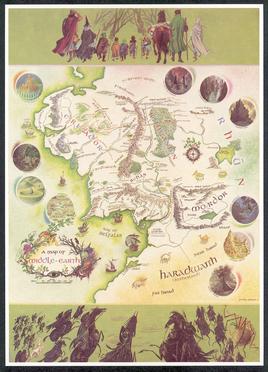
A map of Tolkien's Middle Earth featuring important scenes from the saga
A map of Bethesda's Tamriel, featuring the settings of several TES games
  
The immense popularity of The Elder Scrolls over the past eighteen years and the internal complexity of the games’ storylines (five main titles and twelve subsidiary titles) have generated an extensive back story for the entire series, patched together by the combined efforts of the games’ designers and fans.  Most of the action in all of the titles in the series takes place on the continent of Tamriel, although other geographical and mythological locations are part of the copious lore of the games. After Arena, which allows the player to tour all of Tamriel, the subsequent titles tend to limit themselves to one nation or another. Skyrim, the focal point of this study, is located in the northernmost part of the Tamriel landmass.  Its topography, climate, and native population is most reminiscent of Iron Age Scandinavia, and its predominate culture is a barely-fictionalized version of the Viking civilization (e.g. the Norse Valhalla becomes the Nordic Sovngarde), but with much greater overlap with other Tamrielic cultures.

The most obvious difference between our world and that of LOTR/TES is the presence of magic.  Although every culture, story, and game that includes magic has its own set of rules and motifs, magic itself is a nearly universal concept and does not require a lengthy explanation.  Some of the more detailed issues that arise from the use of magic in the TES universe, such as the presence of magical creatures and divine entities, are addressed in other parts of this study.