Please read this first.

Welcome! This blog is devoted to considerations of morality in the The Elder Scrolls V: Skyrim by Bethesda. Rather than a fansite, review, or walkthrough, it is a serious attempt to examine the game through a moral lens. Please note that the purpose of this blog is to discuss morality within the context of the game, not to determine whether playing the game is immoral in and of itself; the latter type of "discussion" tends toward tedium and inhibits, rather than promotes, a meaningful conversation.

If you have not visited this blog before, it might be helpful to read the posts labeled "Orientation," most of which are the first few entries in the blog archive (see right). These posts include a short introduction to this project, a content-specific author bio, and a few other pieces that explain key concepts relevant to this study. These posts are of particular use to those readers less familiar with Skyrim (or video games in general).

PLEASE NOTE: HERE BE SPOILERS!

If you have visited this blog before, thanks and welcome back!
Showing posts with label Windhelm. Show all posts

Friday, February 14, 2014

Civil War, Part 1 (Katnys)


Reconnecting with the Alik’r in Whiterun really helped Katnys place the whole “Dovahkiin” thing in its proper perspective.  Being Dragonborn was only of value to the degree it could help her take down the Empire that had abandoned Hammerfell, betrayed her parents, and killed her sister; the Greybeards and all of their “Way of the Voice” business could wait.  Right now, she needed to get to Windhelm and join up with the Stormcloaks.

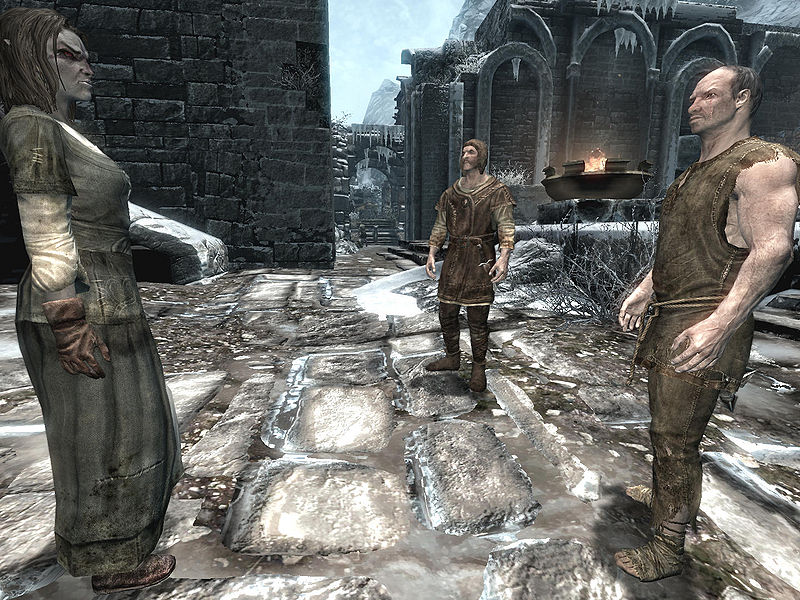
Upon arriving in the capitol of Eastmarch, Katnys and Jenassa were treated to the sight of two Nords (Rolff Stone-Fist and Angrenor Once-Honored) harassing a Dunmer woman (Survaris Atheron).  At first, she was too dumbstruck to intervene; while her parents had often talked of their life in Windhelm, actually seeing one of her own as a.) an established citizen of Skyrim and b.) a victim of racism was a little too much to process all at once. 

The welcome wagon
Eventually, she pulled her wits together and beat some respect into Rolff (not that it lasted -- she would later encounter him drunkenly shouting in the Grey Quarter), then made her way to the Palace of the Kings for her audience with Ulfric.

Having lived most of her life outside of Skyrim, Katnys had been unnaware of Ulfric before the events at Helgen, so she approached him with neither awe nor ire.  She cared little for the intricacies of Nord politics, and even less about Talos, so she expected to express her desire to join the rebellion, grab her bow, and start killing Imperials.  But when Ulfric began talking about missing his father's funeral and about the obligation he had to the men in his command -- those who fell and those who still fought for him -- she found herself moved far more than she had anticipated.  Surely, a man who cared so deeply for his brothers-in-arms deserved her respect.  She still had no strong feelings about Talos, but her hated of the Empire only grew as she listened to Ulfric's story.  Therefore, when Galmar asked her why an elf would join the Stormcloaks,  she could proudly exclaim her thirst for Legionnaire blood.

The first task -- killing an ice wraith -- seemed like a pointless Nord test of courage, but she had grown used to that kind of requirement among the Alik'r.  Looking for the Jagged Crown felt silly as well, but once she got a chance to pick off some Imperial soldiers, Katnys finally felt like she was on the right path.  Under Ulfric's leadership, the Stormcloaks would drive the Empire out of Skyrim and, who knows, perhaps out of existence entirely.

It was this last thought -- that Ulfric might be the one to bring down the Empire -- that allowed Katnys to stomach the racism she encountered from certain residents of Windhelm.  Sure, one beggar and the town drunk (whom everyone tolerates because he's Galmar's brother) liked to toss epithets around, but that kind of impotent bigotry did little to dampen her spirits as she explored the Gray Quarter; after all, it was hard to be upset when she was in her parents' adopted hometown, surrounded by more Dunmer than she had even seen in one place.  In fact, even as she and Jenassa sipped Argonian Bloodwine and listened to Ambarys Rendar complain of the Nords' maltreatment of the Dark Elves, she couldn't help but think that some of these Windhelm Dunmer lacked perspective.  Sure, the Gray Quarter was a bit of a dump, and some of the Nords were less than hospitable, but what did Ambarys and his ilk expect?  From her time with the Alik'r, Katnys well understood that mercy and kinship are not the same.  The Alik'r took her and Prim in -- fed them, protected them, shared knowledge with them -- but they were never really part of the clan...and why should they be?  They weren't Redguards, after all.  People prefer their own kin, their own kind, and there's nothing wrong with that.  You can be generous to a stranger, but you only really love your own. 

It is precisely that generosity -- the kind shown by the Alik'r to the Evyrdene girls -- that Katnys saw in the Nords.  After the Red Mountain erupted, the High King of Skyrim gave entire portions of Solstheim to the Dunmer refugees, and the Jarl of Windhelm opened the Snow Quarter to them.  The Nords' magnanimity, however, was that of a powerful ally, not an adopted family.  The Sons and Daughters of Skyrim have helped the refugees of Morrowind, and that is enough.  For a Dunmer like Ambarys to expect the Nords to treat him like one of their own was not only foolish, but borderline ungrateful in Katnys's eyes.  It is natural to favor one's own, even as it is valorous to help an ally.

In fact, this history of Nord generosity throws a harsh light on the duplicity of the Empire.  Even as the Nords were opening their borders during the Red Year, the East Empire Company was pulling up stakes to avoid the ash.  The events of the Great War further demonstrated that the Empire exists solely for the benefit of Cyrodiil -- which would be fine if the Empire consisted only of Cyrodiil.  The Emperor had no problem abandoning Hammerfell to the Dominion, and then slapped Skyrim in the face by agreeing to the Concordat.  While the Nords might call you names and start a fight with you, they will also open their homes and keep their promises.  The Empire, on the other hand, calls you "citizen" while it sells you to your enemy.  Tamriel would be better served by an alliance of strong, independent nations than this shame of an Empire.  The Dominion would never be able to stand up against the cunning of Cyrodiil, the brawn of Skyrim, the skill of Hammerfell, and the sorcery of High Rock acting in concert as equals, rather than as thralls to a dying Empire.

Now that she held Balgruuf's axe, Katnys was poised to speed that process along.
Friday, December 6, 2013

Main Quest (Katnyss): Before the Storm to Dragon Rising

Having survived the chaos of Helgen and Pinewatch, Katnyss took stock of her situation.  She was alone in an unfamiliar place and on the run from the Legion.  While she had certainly been in some tough situations before, this time was different.  Until now, Katnyss had focused her efforts on providing for her little sister and keeping her safe.  With Prym gone, all Katnyss had left was a rage that was as aimless as it was intense.  Of course she wanted revenge on the Empire, but she had barely managed to handle a gang of thugs.  Although Katnyss was not exactly a "people person," she had learned the value of allies from her time with the Alik'r. She needed to make some friends, and fast.


Upon reaching Riverwood, Katnyss made her way over to Gerdur and Hod’s house.  There, she caught up with Ralof and finally got some clarity on the Imperial ambush that killed her sister and led her to the executioner’s block.  During her conversations with Ralof and Gerdur, Katnyss began to feel a new sense of purpose – more accurately, her vengeance began to find a shape.  While she could care less about Talos and the cultural identity of the Nords, she certainly identified with the Stormcloaks’ sense of betrayal.  Joining the Rebellion would give her the opportunity to avenge, at least in some way, her sister’s murder at the hands of the Legion.  She decided to set out for Windhelm as soon as she feasibly could.

Katnyss’s experience at Pinewatch had taught her that Skyrim was going to be a dangerous place to travel alone, so she decided to spend a day or two in Riverwood in order to get some supplies and make some friends.  She took an immediate liking to Faendal, owing to his status as an archery trainer and fellow “fish out of water” in the Nord homeland.  She agreed to help him out-maneuver Sven in A Lovely Letter; Katnyss had no qualms about deceiving a Nord “bro,” nor did she really care that they were fooling Camilla – if Faendal wanted this Imperial girl for himself, so be it.

Now that she had a friend and follower in Faendal, Katnyss set about seeing how she could be useful to the people of Riverwood.  One of the many important lessons she had learned during her time in Hammerfell was that proving one’s usefulness could be the difference between life and death.  The Alik’r warriors were not about to play nursemaid to two Dunmer girls, but Katnyss demonstrated a willingness to do whatever they asked in exchange for their protection and provision.  As a result, she had not only saved herself and Prym from the abuse they suffered at the orphanage, but had also learned a little bit about alchemy, destruction magic, and combat - -especially archery.

Gerdur had already provided one important task: go to Whiterun to inform the Jarl of the dragon menace.  Katnyss would certainly do that as she travelled to Windhelm.  She was also smart enough to learn some basic smithing from Alvor, which gave her a little extra money to work with as well.  Furthermore, she agreed to assist Lucan by retrieving his golden claw from the bandits.  She had already managed to take out an entire gang by herself; with Faendal’s help, she could surely handle this job and thereby gain the favor of the owner of the general store. 

Getting the golden claw back proved to be more eventful than Katnyss had anticipated.  Aside from encountering her first draugr, she had no idea what to make of the word wall and her obvious connection to it.  How could she know a word in a language she’d never seen before?  Why didn’t anything happen to Faendal, who was standing right next her, looking at the very same thing she was looking at?  Prior to her adventure in Bleak Falls Barrow, Katnyss saw the dragon attack at Helgen as a happy (though dangerous) accident, of which she was going to take full advantage.  But it now began to dawn on her that there might be some kind of link between the events at Helgen and the word wall.

It was with these thoughts in her head that she returned to Riverwood, collected her reward from Lucan, and decided to spend the night at the Sleeping Giant Inn before heading to Whiterun in the morning.  While relaxing at the bar, the keep let slip some gossip about an orphan in Windhelm who was trying to employ the Dark Brotherhood, and another piece fell into place for Katnyss.  Her parents had told her stories about the Morag Tong and the Brotherhood to keep her in line while they lived in Hammerfell, and hearing the name again – in connection with an orphan like herself – inspired the next step in her plan.  She would report to Whiterun as promised, then make a bee line to Windhelm to join up with the rebellion and to see if she could learn more about the Dark Brotherhood.  The Stormcloaks and the Brotherhood were going to help her avenge her sister one way or another.

Katnyss and Faendal set out for Whiterun the next morning.  Along the way, just before the bridge outside the city, they encountered a small band of Thalmor Justiciars transporting a prisoner.  While she certainly hated the Thalmor for killing her parents, she had little trouble holding her tongue while the leader of the group condescendingly described his duties to her.  As awful as the Thalmor were, they hadn’t betrayed or abandoned their people the way the Empire had.  With the Thalmor, you knew what you were getting.  This particular group, however, had no idea what they getting in return.  Katnyss managed to slip the prisoner a weapon, then all hell broke loose.  When the dust cleared, the Justiciars were dead, the prisoner had bolted, and Katnyss was now in possession of the perfect disguise to fool any Legionnaires whom they might encounter.

Upon entering the city, Katnyss decided to stop off at The Drunken Huntsman to buy arrows and maybe sell off some Thalmor loot.  After transacting her business, she turned around to see something she had not expected in this Nord stronghold: a fellow Dunmer relaxing in the alcove.  Katnyss approached her, introduced herself, and within a few minutes became smitten by Jenassa’s dark, almost nihilistic banter, which made a refreshing contrast to the hale and hearty conversational habits of the Nords.  Talking with Jenassa felt good in way that Katnyss had not felt before – almost like being with her sister again, but different in some way she couldn’t put her finger on just yet.

Excusing herself for a moment, Katnyss turned to Faendal and realized that she would have to let him go home.  Faendal was a good guy – he had taught her a lot about archery and had even gone along with her foolhardy attack on the Justiciars – but things were about to get a lot darker, and Katnyss needed someone by her side who would be at home in the shadows.  Promising that she would return to Riverwood someday, she bid Faendal farewell and hired Jenassa on the spot.

The irony, of course, is that once Katnyss and Jenassa paid Jarl Balgruuf a visit, they met yet another Dunmer – Irileth, the Jarl’s housecarl.  The fact that this accomplished Dark Elf warrior had placed herself in Balgruuf’s service out of a sense of loyalty spoke volumes about this Jarl, and immediately placed him in Katnyss’s good graces.  He continued to impress her by being more concerned about the safety of his own people than about the politics swirling around him, but the fact that he seemed to favor the Empire a bit troubled her greatly.  Putting aside the latter misgiving, she agreed to join Irileth in defending the Western Watchtower; she had fulfilled her promise to Gerdur and was eager to get to Windhelm, but deserting these people just as a dragon was attacking their city seemed wrong.  And, if Katnyss was being completely honest with herself, she was curious about the dragon after her experience at Bleak Falls Barrow.

The battle with Mirmulnir thrilled Katnyss.  Fighting alongside her kinswomen inspired her to take risks she would never have before.  Knowing that her strength was in her bow, she ran to the top of tower to get more clear shots at the dragon.  While this position exposed her to attack far more than she liked, the danger was a fair exchange for the clearer vantage point.  When the combined efforts of the Whiterun guards and the trio of dark elves brought the dragon down, Katnyss raced down to get a close-up look at her first dragon.  Needless to say, she was prepared for neither the dragon's soul entering her body nor the thunderous call of the Greybeards.

Strange things were afoot, and Katnyss needed answers. Windhelm would have to wait a little longer.

Saturday, August 3, 2013

The Dark Brotherhood


NOTE: As I have pointed out a number of times, my writing is far behind my playing – a fact that I present at the beginning of this post by way of disclaimer.  I know that many readers will most likely be put off by my handling of the Dark Brotherhood questline, and will protest that by choosing to destroy the Dark Brotherhood, I missed out on one of the most well-written questlines in the game.  Please rest assured that I actually did play through the DB line with a different character -- one that I created a couple of months ago as a counterpoint to Lothar.  I'll detail her moral profile in later posts, but for now, please rest assured that I have not missed out on this fascinating and dramatic series of quests.

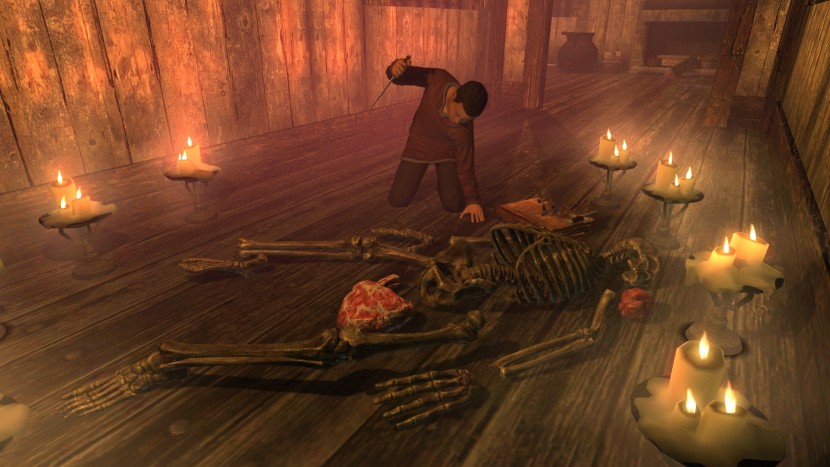
After I became a Nightingale and completed the Thieves' Guild questline, I turned my attention to the quest I had been dreading: Innocence Lost. I had heard about Aventus Aretino during my early days in Riverwood, but didn't visit him until I traveled to Windhelm during the Civil War questline.  When I entered the house, I was treated to the most disturbing scene I had witnessed since Helgen: a young boy performing the Black Sacrament:
I don't want to think about how he got that stuff.

Mistaking me for the assassin he was praying for (perhaps because i was still wearing my Krosis mask), Aventus begged me to kill the headmistress of Riften's Honorhall Orphanage, Grelod the Kind.  He related the tragic tale of his mother's death, Jarl Ulfric's decision to send him away, and his subsequent abuse at the hand of Grelod.  When I protested that I was in no way an assassin, Aventus completely ignored my objections and sent me on my way.

Not surprisingly, I procrastinated for a long time before actually visiting Honorhall.  The first dilemma was whether to believe Aventus.  The child is clearly traumatized, but what if he is projecting his grief over his mother's death onto Grelod?  If Aventus' story is not entirely accurate, then killing Grelod would clearly be murder.  On the other hand, I'm not sure I want to run the risk of not believing a child who says that he is being abused.  But even if Grelod is as bad as the boy says and I decide to kill her, I would be tacitly granting approval to a child ordering a hit.  After much deliberation, I decided to find out the real story for myself.

The first time I entered the orphanage, I was treated to a scene straight out of Annie:
"We love you, Miss Hannigan!"

Ok, so the headmistress really is an awful old crone, but I still don't see anything that would warrant...
...oh...well,uh...never mind.
So, Aventus was, in fact, telling the terrible truth.  Given my response to the mistreatment of children in Laid to Rest and Ill Met by Moonlight, it should come as no surprise that I resolved to kill Grelod.  Not wanting to traumatize the kids any further, I decided to sneak in after everyone was in bed.  It was an easy kill, but a few things bothered me about it in the immediate aftermath:
  • As I said before, I was really uncomfortable legitimizing Aventus' use of the Black Sacrament.
  • When the kids discovered Grelod's body, they were overjoyed.  Understandable, I suppose, but pretty sick.
  • Constance Michel became hysterical.  I had no intention of causing her grief, but she really took Grelod's death hard.
The deed done, I returned to Windhelm to report the news to Aventus.  As I feared, he took the incident as affirmation that assassination was a perfectly legitimate way to handle a bad situation, even going so far as to express a desire to join the Dark Brotherhood himself when he grows up -- in order to help other children like him!  I was deep in the grey zone now.

Not long after our conversation, I received a note from a courier which contained a black handprint and the cryptic message "We know."  Having received mysterious letters before (from "a friend" and from Delphine), I assumed that its meaning would be made clear soon enough.  I got my answer when I went to bed, only to wake up in an abandoned shack.

With me in the shack was my apparent abductor, Astrid, who was clad in an identity-obscuring set of leather armor.  She informed me that by killing Grelod, I had robbed the Dark Brotherhood of a death that rightly belonged to them, and that the Night Mother (whoever or whatever that was) demanded another death to settle the score.  I now had my choice of three other abductees whom I could kill in order to fulfill my debt.  Despite the fact that they were all bound and hooded, I had the opportunity to interview each of them:
  • Alea Quintus is a housewife and mother who comes off as an utter shrew.  She has no idea why she's there, but her combative and insulting demeanor suggests that she may have irked the wrong person at some point.
  • Fultheim the Fearless is a mercenary, and is well aware that his profession may have led him to this predicament.  He vacillates between abject begging and stammering rationalization -- "war is war, right?"
  • Vasha is a Khajiit scoundrel who has been "bagged and dragged" before.  He admits to all sorts of shady activities, and smirkingly attempts to bargain his way out his captivity -- sometimes even employing vague threats about what "his people" might do to me in return.
I was now faced with a multilayered dilemma.  The first question was whether I was going to kill someone at the behest of the Dark Brotherhood.  Aside from the fact that I had been attacked by one of their number early in my travels through Whiterun Hold, I had no desire to do the bidding of a bunch of contract killers.  The Thieves' Guild might technically be a criminal organization, but at least they restricted themselves to nonviolent crime -- one of the main selling points for some of the ex-bandits in the group.  I had to do some real moral gymnastics to rationalize joining the Guild, but there was no way I could justify joining a clan of assassins-for-hire.  I decided to kill no one and just leave.
So much for that idea.
Once I discovered that I could not leave, I was forced to deal with the second question: whom to kill?  I had no quarrel with any of the captives, so I had to base my decision on their apparent traits.  Alea was insufferable, but simply being a shrieking harpy was not enough to warrant a death sentence. Fultheim, by his own admission, had done some bad things as a mercenary, and so might deserve to die, but killing him like this did not feel right; if he was going to die for crimes committed as a soldier, then he should die as a soldier -- in face-to-face battle, which was not an option here.  Vasha was by far the most likely choice, especially if you interpret his claim of being a "defiler of daughters" in the darkest way possible.  Still, I couldn't shake the idea that Vasha, as a Khajiit, might be attempting to talk his way out of a jam by exaggerating his status as a scoundrel -- a sort of refuge in audacity.  After all, I had no proof for any of his claims, which is something I would need if I were going to execute a bound "criminal."
There was, of course, one other person I could kill in order to escape: Astrid.  That choice made the most sense to me; she's part of a murderous criminal organization that had already tried to kill me once, plus she kidnapped three other people and tried to force me to kill one or all of them in order to settle some weird assassin debt.  Of the five people in that shack, Astrid clearly deserved to die.  In fact, as dealt the final blow, she whispered, "Well done."  Even she knew she deserved her end.
After I killed Astrid, freed the prisoners, and escaped the shack, I reported the incident to the first guard I saw, who directed me to Commander Maro of the Penitus Oculatus (the Emperor's personal security force after the downfall of the Blades), currently stationed in Dragon Bridge.  Maro gave me the password to the Dark Brotherhood Sanctuary and tasked me with eliminating the rest of the clan of contract killers.  I gladly accepted.

Compared to the dilemmas I faced in the shack, destroying the Dark Brotherhood was fairly easy.  I decided to give them a taste of their own medicine by sneaking in and assassinating each of the members one by one.  I probably enjoyed killing them more than I should have, but I think I deserved it after what they put me through, to say nothing of the three other people they kidnapped.
As I often do, I perused the wikis after completing this questline and came away feeling even more justified in my actions.  Had I chosen to kill Vasha (my most likely choice), I would have had to kill a number of other innocent people in order to advance -- people like Narfi, the poor, grief-addled beggar of Ivarstead.   Ultimately, I would have had to kill the Emperor himself -- truly an awkward situation for the man who helped win Skyrim for the Empire. Besides, a Dragonborn like me would probably have inspired many more contracts had I let the Brotherhood live.

I also feel the need to point out the fascinating predicament Bethesda puts the player in.  Note that the introductory murder is of someone who clearly deserves to die.  Had the initial victim been, say, one of the people in With Friends Like These..., I doubt I would have even started this quest.