Please read this first.

Welcome! This blog is devoted to considerations of morality in the The Elder Scrolls V: Skyrim by Bethesda. Rather than a fansite, review, or walkthrough, it is a serious attempt to examine the game through a moral lens. Please note that the purpose of this blog is to discuss morality within the context of the game, not to determine whether playing the game is immoral in and of itself; the latter type of "discussion" tends toward tedium and inhibits, rather than promotes, a meaningful conversation.

If you have not visited this blog before, it might be helpful to read the posts labeled "Orientation," most of which are the first few entries in the blog archive (see right). These posts include a short introduction to this project, a content-specific author bio, and a few other pieces that explain key concepts relevant to this study. These posts are of particular use to those readers less familiar with Skyrim (or video games in general).

PLEASE NOTE: HERE BE SPOILERS!

If you have visited this blog before, thanks and welcome back!
Showing posts with label Main Quest. Show all posts

Tuesday, July 23, 2013

The Main Quest: Finale

Special thanks to Kurt Kuhlmann for pointing out some factual errors in an earlier version of this post!


After Paarthurnax, the Main Quest provides very few opportunities for moral agency.  Capturing Odahviing, travelling to Skuldafn, visiting Sovngarde, and defeating Alduin are all dramatic and engaging quests, but they present no significant moral quandaries.  There are, however, some events that bear further examination.

The latter part of the Main Quest reveals that not all of the dragons share Alduin's views. During The Fallen, I learned the shout that summons Odahviing, thus providing me another opportunity to converse with a dragon.  Odahviing is an active ally of Alduin, but when we captured him, he agreed to help me track down the World-Eater in exchange for his own freedom.  Because of his dialogue, Odahviing comes off as an opportunist who betrays Alduin not on principle, but on the likelihood that the Dovahkiin will defeat him:

 
Once Alduin is defeated, Odahviing pledges to aid the Dragonborn whenever he calls; he is not, however, another Paarthurnax, who promises to teach the pacifist Way of the Voice to all of the dragons he can convince.

He might actually succeed, as Paarthurnax and Odahviing are not the only non-hostile dragons in the game.  Until Skuldafn, I had never encountered a non-NPC dragon that did not attack the moment it detected me (or anyone else for that matter).  At Skuldafn, however, I ran into a dragon who, despite being perched directly above the portal to Sovngarde and witnessing my defeat of his comrades, did not attack.  He watched me closely, but made no aggressive moves at all.  Given my experience with Paarthurnax and Odahviing, I decided to hold back, and it began to dawn on me that all of the dragons (not just the named ones) might be morally complex creatures who are as apt to choose "the high road" as their mortal counterparts.  Perhaps this moral range explains why, at the Throat of the World, dragons can be seen celebrating the World-Eater's fall. 

As it turns out, the complicated moral tableau presented at the portal to Sovngarde was reflected on the other side as well.  While the scenes inside the Hall of Valor are interesting from a cultural perspective (of course Nords brawl in Heaven!), the encounters before I met Tsun were the most enlightening:

  • Kodlak: It was satisfying to see Kodlak in his beloved Sovngarde.  Even though he had assured me that the purification was successful, I was happy to see the results for myself.

  • Torygg: The High King's dialogue suggests that the popular story that Ulfric "shouted him to pieces" is closer to the truth than Ulfric's account, but I'm not sure if this is an important distinction.

  • Ulfric: This was by far the most substantial encounter in Sovngarde.  First, it appears that Ulfric's ascent to the Nord Paradise has erased any animosity he might harbor for the man who killed him in battle.  Second, Ulfric expresses a profound and sincere regret for his part in Skyrim's strife.  He stops short of saying that he was wrong, but his sadness is undeniable.  I suspect that, if he had the opportunity to  do it all again, he would probably try harder to convince Torygg of the need for secession, rather than kill him.  This conversation confirmed both my decision to support the Empire and my respect for Jarl Ulfric.


As for the final battle with Alduin, there is little of moral significance to examine, with the possible exception of the emphasis on unified effort.  In order to defeat the World-Eater, I had to join forces with the heroes of old -- perhaps an object lesson on the necessity of community.  Now that I think about it, that may be the best moral for a war-torn Skyrim after all.

Tuesday, July 16, 2013

Paarthurnax: Further Considerations

The conflict at the core of the Dovahkiin's rise to power is analogous to that faced by Raskolnikov in Dostoyevsky's Crime and Punishment.   Raskolnikov considers himself to be an extraordinary man -- the creator of a "New Word" -- and therefore above the laws of ordinary men.  He finds himself torn between two models of this "extraordinary man": the Nietschzean Übermensch, who subjugates those beneath him by virtue of his greater power, and the Hegelian superman, who transcends the law in order to perform great and noble deeds.  Raskolnikov considers his murder of the evil pawnbroker as evidence of his superior nature; he breaks the law in order to rid the world of a great evil.  Once he does so, however, he finds himself becoming more Nietschzean, seeking power over others for its own sake.

While Raskolnikov only thinks of himself as extraordinary, the Dovahkiin is emperically superior to those around him, capable of supernatural feats beyond those of the most powerful NPCs and creatures in the game.  During the course of the game, the Dovahkiin can defeat Alduin the World-Eater, challenge the Daedra, decide the outcome of the Civil War, and simultaneously become the leader of the Companions, the Thieves' Guild, the Dark Brotherhood, and the College of Winterhold.  Furthermore, the Dovahkiin literally possesses a "new word" -- or, more accurately, several ancient words -- that denotes a unique role in Tamriel's history. The question is not whether the Dovahkiin is extraordinary; the question is whether he or she will take the Nietschzean or the Hegelian route.  Obviously, the player as moral agent ultimately decides which kind of superman the Dovahkiin will become, but the game provides several prominent models of the Nietschzean Übermensch against which the player can be defined.

The central Nietschzean character in the game is, as I mentioned in the previous post, Alduin.  The World-Eater seeks power over mortals and dragons alike, not for the benefit of his kind or the glory of some divine being, but for his own sake.  He conquers because it is his nature to do so.  He does not bother to justify his actions to anyone, because to do so would suggest that someone else has authority over him.  He enslaves or destroys the weak and commands the strong.  He is the lust for power personified.

Paarthurnax provides a useful Hegelian counterpoint to Alduin.  Here we have a being who, like his erstwhile ally, instinctively seeks to conquer, yet consciously chooses otherwise.  In helping the Tongues and the Greybeards, he betrays his own kind and violates his own innate nature to serve a noble cause: the Way of the Voice.  He creates a new law to supplant the Nietschzean rule of Alduin.

Paarthurnax, however, is not alone.  Brynjolf, Kodlak, Argenir, and even Ulfric Stormcloak demonstrate the power of "honorable transgression."  Each of these characters violates some law or taboo or tradition in order to serve, at least in their estimation, a greater good.  While one could argue against the particular motivation in each case (Jarl Ulfric's cause being the most obvious example), these characters are all motivated by something greater than and outside of their own individual selves.

What is noteworthy here is that each of the more Hegelian characters is presented as decidedly more heroic (or at least respectable) than their Nietschzean counterparts.  Paarthurnax's dialogue is eloquent and thought-provoking, while Alduin's is full of self-aggrandizement and menace.  Consider the conflict between Mercer and Brynjolf; the former amasses power and wealth for himself alone, while Brynjolf and Karliah seek to revitalize the Guild and to serve Nocturnal.  Dawnguard presents another example in the persons of Isran and Lord Harkon.  Despite the freedom of choice available to the PC, the game presents the Nietschzean Will to Power as something the Dovahkiin must overcome at every turn.


Perhaps the most prominent example of this bias occurs in the Dragonborn DLC.  During the Main Quest, the Greybeards warn the Dovahkiin not to abuse his power, but in Dragonborn, we are presented with an antagonist who did precisely that.  What separates Miraak from the other two "final bosses" is that he is a dark reflection of the PC: a Dovahkiin who uses his power for himself rather than for some higher purpose.  In other words, Miraak plays Svidrigaïlov to the PC's Raskolnikov.

While one may choose to play a Nietschzean Dovahkiin, the game clearly favors the Hegelian model.  The vast majority of the minor and side quests ask the player to do something for someone else's benefit.  The Nietschzean role-player has to work around that through cynicism: I am doing this favor for the sole purpose of getting a reward.  Of course, a player can wreak mayhem in the streets, but really, almost every scripted quest invites the player to help someone else.  Even the Dark Brotherhood quests are presented in the context of helping the "family."  Furthermore, each main quest (Skyrim, Dawnguard, Dragonborn) pits the PC against a Nietschzean adversary in order to save the world.  At no point can the player choose to join a Nietschzean NPC in his quest to destroy or enslave Tamriel.  Yes, one can join the Volkihar, but Lord Harkon is still the enemy because his insane plan puts all vampires at risk.  One could argue that joining a Nietschzean faction would be nearly impossible to script because a faction centered around an Übermensch would be a cult, an cults negate the agency of the member, which would run counter to the necessary agency of the PC in an RPG.  This objection merely pushes the question down the road: are all RPGs anti-Nietschzean?

In short, Paarthurnax underscores the Hegelian tilt of Skyrim.  How else to understand a game in which one of most beloved characters is essentially a Hegelian version of the Nietschzean villian?

Friday, June 28, 2013

A Cornered Rat

About halfway through the Thieves Guild questline, I returned to the main quest, now armed with the knowledge of Esbern's whereabouts.  I began my search of the Ratway by dispatching the Thalmor agents who were also looking for the elderly Blade loremaster.  I carefully advanced through the vaults and into the warrens, taking out a few thugs here and there.  I ran into nothing of moral significance until I reached the heart of the warrens, and as I review the events that unfolded there, I'm sure that the dilemma I faced was in no way scripted by the game.

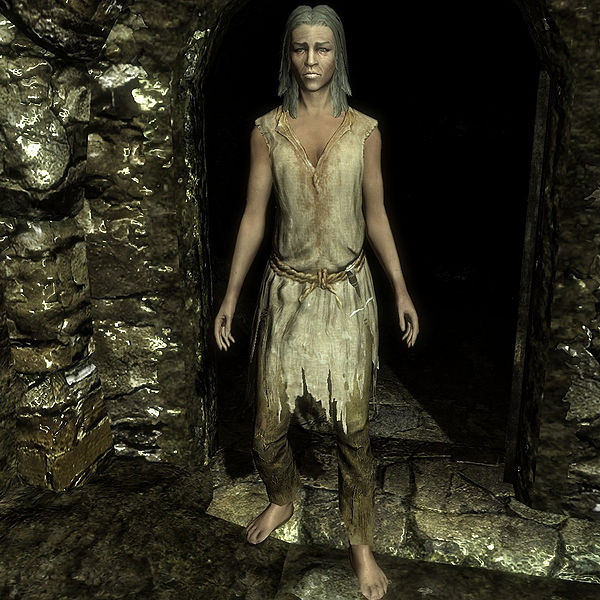
I found that the warrens were occupied by three madmen other than Esbern: Salvianus, the Imperial Legionnaire whom the Great War drove insane; Knjakr, the Sweeney Todd-like chef; and Hefid the Deaf, a poor beggar woman who mutters a kind of OCD litany.  Salvianus, while clearly insane, was a gentle soul who only wanted to try to explain the hopelessness he felt, so I listened to him as long as I could before moving on.  Knjakr attacked me the moment I tried to speak with him, so I had to kill him in self-defense.  Hefid, however, presented me with an unexpected challenge.

When I interrupted Hefid's incessant listing of common objects, she completely freaked out, drew a dagger, and ran away from me.  I would have been happy to let her go, but for one problem: she ran straight to Esbern's door and continued to brandish her weapon no matter what I did.  When I tried to talk, she didn't respond, preferring instead to throw herself at the heavily bolted door to Esbern's room.

I now had a real dilemma on my hands.  Opening Esbern's door (assuming I could do so), would send an armed madwoman into the deadbolted cell of a paranoid ex-Blade.  At best, he kills her, and probably attacks me as an accomplice.  At worst, she kills him, and the last remaining hope to defeat Alduin is gone.  Because I could not think of a scenario which didn't end with her death, I decided to kill her as quickly and mercifully as possible.

After gaining Esbern's trust and hearing his tale, we set out to find Delphine.  We didn't take two steps outside his door before we were set upon by more Thalmor agents.  We killed them, but poor Salvianus got caught in the crossfire -- his worst nightmare finally coming true.  I paid my respects, then escorted Esbern back to Riverwood.

I don't feel good about killing Hefid, but once I had spoken to her, I don't see how I could have avoided it.  A quick FUS might have pushed her aside, but would probably also have provoked her to attack me.  Furthermore, even if she had survived the initial encounter, what would have happened during the fight with the Thalmor?  And, if I'm being completely honest here, what kind of life did she have, tormented by her obsessive list in her dank, dark cell?  Might she be better off dead?
"Knife. Yes. Book. Yes. Bucket. Yes. Inkpot? No."  R.I.P. Hefid the Deaf