Welcome! This blog is devoted to considerations of morality in the The Elder Scrolls V: Skyrim by Bethesda. Rather than a fansite, review, or walkthrough, it is a serious attempt to examine the game through a moral lens. Please note that the purpose of this blog is to discuss morality within the context of the game, not to determine whether playing the game is immoral in and of itself; the latter type of "discussion" tends toward tedium and inhibits, rather than promotes, a meaningful conversation.
If you have not visited this blog before, it might be helpful to read the posts labeled "Orientation," most of which are the first few entries in the blog archive (see right). These posts include a short introduction to this project, a content-specific author bio, and a few other pieces that explain key concepts relevant to this study. These posts are of particular use to those readers less familiar with Skyrim (or video games in general).
PLEASE NOTE: HERE BE SPOILERS!
If you have visited this blog before, thanks and welcome back!
After the rush of consuming the dragon’s soul and letting
out her first shout, Katnys needed some answers, but she was eager to get to
Windhelm to continue her personal war against the Empire.This “dragonborn” stuff seemed like a lot of
Nord nonsense that would only distract her from her mission, but she couldn’t
deny what was happening to her.
In the midst of this internal debate, a new thought dawned
on Katnys: if she was going to take on the Empire, she would need all of the
power she could muster.She had a
dedicated, like-minded follower in Jenassa, and was earning friends wherever
she went, but what if all of that wasn’t enough?Her skills, her allies, and her rage were
strong, but could they alone make the Empire pay for its treachery?Perhaps this “dovahkiin” business could
provide the means for the destruction of the Empire.
With these thoughts in mind, Katnys and Jenassa reported
back to Balgruuf, followed his directions to Ivarstead, and then climbed the
7000 steps to High Hrothgar.While the
Greybeards and their monastery were impressive enough, Katnys could never
quite take their pious detachment seriously, and just wanted to get on with
it.After all, here was this group of
men who possessed immense power, but remained secluded and aloof from the world
around them.Their homeland was under
attack by both the Legion and the dragons, but they just wanted to meditate on
their mountaintop.Katnys resolved to
jump through their hoops, learn what she needed to learn, and move on.
It therefore came as a profound disappointment when she
found Delphine’s note instead of the Horn.Once again, she would be forced to delay her trip to Windhelm and go
down yet another rabbit hole.As it
turned out, however, she didn’t mind this detour quite so much.Like Katnys, Delphine was a woman of guile
and action, so following her to Kynesgrove seemed less pointless than delving
into the Greybeards’ dusty dungeons.Sure, Delphine tended to go on about the Dragonborn and all that, but if
what she was saying about the Blades was true, then Katnys needed to be a part
of that for two reasons: 1.) a cadre of dragonslayers would be a valuable tool,
and 2.) if the Blades had, indeed, protected the Emperor before the Great War,
Katnys needed to keep them from returning to that role.
All plotting aside, the encounter with Sahloknir and Alduin
at Kynesgrove unsettled Katnys.Once
the shock of seeing Alduin again wore off, she had to wrap her mind around a
few disconcerting facts:
Alduin was raising dragons from the dead with
his Thu’um, while Katnys could barely push people around with hers.Had she bitten off more than she could chew?
If Delphine was to be believed, the Thalmor were
behind all of this, and now Katnys would have to infiltrate the Thalmor
Embassy.Ambushing a small group of
Justiciars is one thing, but this might be more than she could handle.
A few days ago, Katnys was a lone Dunmer just
trying to spill some Imperial blood in memory of her sister. She now found
herself in the middle of a civil war, a political conspiracy, and some kind of
crazy prophesy – none of which she had in mind when she and Prym left
Hammerfell.
Hammerfell.It was
that last thought that drove her back to Whiterun.After returning the Horn to the Greybeards
and enduring their pompous (though admittedly impressive) Dovahkiin ceremony,
Katnys decided to return to Whiterun to talk to the Redguards she had seen
hanging around the front gate.Before, she
had been in too much of a hurry to speak with them, but now that she needed
some time to think, a conversation with some Alik’r warriors might help her
regain her footing.
As it was with Dawnguard, so it was with Dragonborn.While I really enjoyed the main questline, I
encountered very few moral dilemmas to speak of.This is not to say, however, that this DLC
lacked a moral dimension; some of the side quests presented tough ethical
quandaries, and the titular questline itself invited a kind of meditation on
the moral dangers that accompany the title of Dovahkiin.
In a previous post, I noted that the “bosses” of each
title’s main questline represents a kind of Nietzschean nightmare – a superior
being who uses his power to enslave others.Miraak’s iteration of this antagonist type is particularly compelling
because he embodies the shadow self of the player’s Dovahkiin (regardless of
the player’s actual alignment – more on that later).Whereas Alduin and Harkon represent species
who are more or less “other” (dragon and ancient vampire, respectively), Miraak
is the dark mirror of the protagonist; he is what the PC might become.
This unique connection between Miraak and the Dovahkiin is
foreshadowed in the words of the Greybeards:
...young Grasshopper...er, Padawan?
The player is here admonished to not allow the attendant
power of one’s Dragonborn status to become a stumbling block.While the Greybeards certainly intend this
warning to be an inducement to follow their own, aloof (read: neutral) path,
the moral agent who plays a “good” character is going to hear this as a version
of Uncle Ben’s “power and responsibility” speech, and the one who plays an
“evil” character is probably going to ignore the hoary warning and do as he
pleases.
Once Miraak is introduced, however, the Greybeards’ caveat
takes on new life. Miraak acts as an object lesson: a Dragonborn who sought to
use his Thu’um solely for the increase of his own power, was punished for it
before, and will be punished for it again.Even for an “evil” character, Miraak provides a cautionary tale; in his
bid for ultimate power, he was out-maneuvered by Hermaeus Mora, so a
self-serving Dovahkiin might see Miraak not only as a rival but also as warning
against relying too much on the promises of Daedric Princes.For a “good” Dovahkiin, however, the picture
is a bit more disturbing.
As I have said before, Lothar is not a paladin, but I have
attempted to keep him in the good sector of the alignment chart.While I have certainly missed the mark on
occasion, I feel as though I have mostly kept him on the Aragorn side of the equation.One area I have struggled with, as regular
readers might note, is the Daedric quest.More often than not, I allowed Lothar to do some dark things at the
behest of a Daedra in order to obtain powerful artifacts.At the core of my logic in most of these
cases was that Skyrim (and all of Tamriel, for that matter) would be better off
if I controlled these items; not only would I use them to vanquish evil, but
the items themselves would be far less likely to fall into the wrong
hands.Even beyond the Daedric quests, I
sometimes rationalized Lothar’s more treacherous and brutal actions in the name
of bringing peace and justice to Skyrim.What is it, therefore, that separates Lothar from Miraak?
The obvious answer, of course, is “noble intentions,” but is
that enough to maintain the wall between hero and villain?In both literature and history, we are often
presented with despots who originally wanted to free their people, leaders who
turned their loyal followers into slaves, and crusaders who unwittingly devolved
into thugs.
Is the Dovahkiin’s final showdown with a version of
himself?Perhaps this is the reason we
are not permitted to peer under Miraak’s mask – we would find only a mirror.
The conflict at the core of the Dovahkiin's rise to power is analogous to that faced by Raskolnikov in Dostoyevsky's Crime and Punishment. Raskolnikov considers himself to be an extraordinary man -- the creator of a "New Word" -- and therefore above the laws of ordinary men. He finds himself torn between two models of this "extraordinary man": the Nietschzean Übermensch, who subjugates those beneath him by virtue of his greater power, and the Hegelian superman, who transcends the law in order to perform great and noble deeds. Raskolnikov considers his murder of the evil pawnbroker as evidence of his superior nature; he breaks the law in order to rid the world of a great evil. Once he does so, however, he finds himself becoming more Nietschzean, seeking power over others for its own sake.
While Raskolnikov only thinks of himself as extraordinary, the Dovahkiin is emperically superior to those around him, capable of supernatural feats beyond those of the most powerful NPCs and creatures in the game. During the course of the game, the Dovahkiin can defeat Alduin the World-Eater, challenge the Daedra, decide the outcome of the Civil War, and simultaneously become the leader of the Companions, the Thieves' Guild, the Dark Brotherhood, and the College of Winterhold. Furthermore, the Dovahkiin literally possesses a "new word" -- or, more accurately, several ancient words -- that denotes a unique role in Tamriel's history. The question is not whether the Dovahkiin is extraordinary; the question is whether he or she will take the Nietschzean or the Hegelian route. Obviously, the player as moral agent ultimately decides which kind of superman the Dovahkiin will become, but the game provides several prominent models of the Nietschzean Übermensch against which the player can be defined.
The central Nietschzean character in the game is, as I mentioned in the previous post, Alduin. The World-Eater seeks power over mortals and dragons alike, not for the benefit of his kind or the glory of some divine being, but for his own sake. He conquers because it is his nature to do so. He does not bother to justify his actions to anyone, because to do so would suggest that someone else has authority over him. He enslaves or destroys the weak and commands the strong. He is the lust for power personified.
Paarthurnax provides a useful Hegelian counterpoint to Alduin. Here we have a being who, like his erstwhile ally, instinctively seeks to conquer, yet consciously chooses otherwise. In helping the Tongues and the Greybeards, he betrays his own kind and violates his own innate nature to serve a noble cause: the Way of the Voice. He creates a new law to supplant the Nietschzean rule of Alduin.
Paarthurnax, however, is not alone. Brynjolf, Kodlak, Argenir, and even Ulfric Stormcloak demonstrate the power of "honorable transgression." Each of these characters violates some law or taboo or tradition in order to serve, at least in their estimation, a greater good. While one could argue against the particular motivation in each case (Jarl Ulfric's cause being the most obvious example), these characters are all motivated by something greater than and outside of their own individual selves.
What is noteworthy here is that each of the more Hegelian characters is presented as decidedly more heroic (or at least respectable) than their Nietschzean counterparts. Paarthurnax's dialogue is eloquent and thought-provoking, while Alduin's is full of self-aggrandizement and menace. Consider the conflict between Mercer and Brynjolf; the former amasses power and wealth for himself alone, while Brynjolf and Karliah seek to revitalize the Guild and to serve Nocturnal. Dawnguard presents another example in the persons of Isran and Lord Harkon. Despite the freedom of choice available to the PC, the game presents the Nietschzean Will to Power as something the Dovahkiin must overcome at every turn. Perhaps the most prominent example of this bias occurs in the Dragonborn DLC. During the Main Quest, the Greybeards warn the Dovahkiin not to abuse his power, but in Dragonborn, we are presented with an antagonist who did precisely that. What separates Miraak from the other two "final bosses" is that he is a dark reflection of the PC: a Dovahkiin who uses his power for himself rather than for some higher purpose. In other words, Miraak plays Svidrigaïlov to the PC's Raskolnikov.
While one may choose to play a Nietschzean Dovahkiin, the game clearly favors the Hegelian model. The vast majority of the minor and side quests ask the player to do something for someone else's benefit. The Nietschzean role-player has to work around that through cynicism: I am doing this favor for the sole purpose of getting a reward. Of course, a player can wreak mayhem in the streets, but really, almost every scripted quest invites the player to help someone else. Even the Dark Brotherhood quests are presented in the context of helping the "family." Furthermore, each main quest (Skyrim, Dawnguard, Dragonborn) pits the PC against a Nietschzean adversary in order to save the world. At no point can the player choose to join a Nietschzean NPC in his quest to destroy or enslave Tamriel. Yes, one can join the Volkihar, but Lord Harkon is still the enemy because his insane plan puts all vampires at risk. One could argue that joining a Nietschzean faction would be nearly impossible to script because a faction centered around an Übermensch would be a cult, an cults negate the agency of the member, which would run counter to the necessary agency of the PC in an RPG. This objection merely pushes the question down the road: are all RPGs anti-Nietschzean? In short, Paarthurnax underscores the Hegelian tilt of Skyrim. How else to understand a game in which one of most beloved characters is essentially a Hegelian version of the Nietschzean villian?
As I pointed out in my Diplomatic Immunity post, the main quest of Skyrim does not offer a high number of moral dilemmas. Even if I were to accept the Greybeards' theory that Alduin's attacks presage the just and inevitable end of this world in preparation for the new world to come, my role as Dovahkiin draws me just as inexorably to a confrontation with the World Eater. Therefore, despite the high drama and plot tension extant in the main quest, there are only a handful of opportunities for true moral agency. The quest entitled Paarthurnax presents the fourth and final scripted moral dilemma.
After discovering Sky Haven Temple, Delphine tasked me with helping her to rebuild the Blades. I was to recruit three warriors whom I thought would be well-suited to the task of hunting dragons and, perhaps eventually, protecting a Dragonborn Emperor. I chose three followers whom I knew from experience could handle the job: Uthgerd the Unbroken and Lydia (my housecarl at Breezehome) had demonstrated impressive skills in Heavy Armor, One- and Two-Handed Combat, Blocking, and Archery, so they were natural choices; I also selected Brelyna Maryon from the College of Winterhold, whose formidable Conjuration and Destruction talents allowed me to round out a small army of dragon hunters that could bring both melee and ranged attacks into any situation. Having bolstered the ranks of the Blades to Delphine's satisfaction, we went out on a few successful dragon raids without incident. I then returned to the main quest, which took me back to High Hrothgar to finally meet Paarthurnax, the leader of the Greybeards...
[SPECIAL NOTE TO THE READER: While I have clearly indicated in the banner of this blog that spoilers abound, this particular post contains what is arguably the biggest spoiler in the game. Of course, the game has been out for almost two years now, so anyone reading this blog is probably already aware of the plot twist, but one never knows.]
...who is a dragon! The animosity between the Blades and the Greybeards now makes sense. The Blades see dragons merely as a threat to be vanquished, while the Greybeards see them as powerful, near-divine beings, capable of both profound good and cataclysmic evil.
My conversation with Paarthurnax was without a doubt one of the most enlightening in the entire game. I learned not only about the history of the Dragon War, but also about the conflict at the core of dragonkind: the will to power. According to Paarthurnax, it is in the nature of dragons to seek power, regardless of mortal notions of morality. He explains his own centuries of peaceful meditation as a constant struggle against his deepest instincts. For a full appreciation of Paarthurnax's story, I recommend the reader invest some time (about 20 minutes) watching the clip below from another player's YouTube video:
In my next post, I will delve more deeply into the Nietzschean/Hegelian conflict at the core of the Alduin/Dovahkiin battle, but for now, I am limiting myself to the events that occur immediately after this encounter with the "good" dragon.
Aside from teaching me how to use my Shout more effectively, Paarthurnax pointed me in the direction of the Elder Scroll that would enable me to go back in time and learn the Dragonrend Shout that defeated Alduin ages ago. After finding the Scroll, I returned to Paarthurnax, unfurled the Scroll, saw how a trio of my ancestors banished Alduin from their era, and learned the Shout; this action broadcast my location to Alduin, who showed up to kill me before I could have a chance to defeat him. Paarthurnax, despite his nature and his previous allegiance to Alduin, battled the World-Eater in the air while I attempted to use Dragonrend to ground him. Although we did not kill Alduin this time, we managed to drive him into hiding. Paarthurnax recommended that I find and interrogate one of Alduin's minions in order to learn where he fled -- no easy task. My next move was to report to Esbern to ask for some advice.
Esbern was more than happy to offer his insights on capturing a dragon, but then he presented me with a new problem; citing his oath as a Blade, he demanded that I kill Paarthurnax, and refused to provide any more assistance to me until I did so. Delphine seconded his ultimatum, and cut me off from the further services of the Blades. Once again, I would have to choose sides in a conflict when I'd really rather not.
Actually, Esbern and Delphine express slightly different reasons for demanding the dragon's death. Esbern points out that, during the first dragon crisis, Paarthurnax was one of Alduin’s lieutenants during
the first dragon crisis, and was personally responsible for a whole host of
atrocities against man.The fact he
eventually turned on Alduin and helped to defeat him both now and in the past
is utterly irrelevant to Esbern; the old dragon must pay for his crimes.Delphine agreed, but added that Paarthurnax’s
betrayal of Alduin indicates a dangerous disloyalty which could turn against me
at some point; after all, if he was willing to turn on one of his own, how much
more likely that he would turn on a mortal ally?
Of
the two objections, Delphine’s was the easier to counter.By my figuring, there are only two scenarios
in which her fears could come true.Perhaps, at some point in the future, Paarthurnax’s loyalty shifts
again, and he decides he was wrong to help me in the first place – or maybe he
never really turned on Alduin and was just waiting for his master to return in
order to draw the Dovahkiin out.Should
that happen, I am confident that I could dispatch him without too much risk.The second and more troubling scenario is
that Paarthurnax is actually looking to supplant Alduin, and is using me to do
it.What if Paarthurnax helped the
original Tongues as a means of getting his superior out of the way?When they succeeded in sending him into the
future (but not destroying him), Paarthurnax decided to wait patiently for
Alduin’s return, then teach the Dovahkiin how to destroy him, only to turn on
the Dragonborn once Alduin was out of the way.The problem with this second scenario is that, in order to believe that
he could defeat the man who killed Alduin the World-Eater (a dragon he himself
dared not attack directly), Paarthurnax would have to be both desperate and
foolish, and I doubt he is either.
Esbern’s
argument, on the other hand, gave me real pause.The central question is whether Paarthurnax’s
current assistance mitigates his past crimes.In each encounter with an NPC who has done wrong, I have relied on the
presence or absence of remorse as my barometer. To be more specific, I look for
remorse in the form of action rather than words.Sinding said he regretted killing the little
girl, but he was unwilling to face justice, so I killed him.Erandur rejected the Daedric Prince Vermina
whom he once served, became a priest of Mara, and risked life and limb to
save Dawnstar from its nightmares, so I chose to help him and refused to kill
him when Vermina commanded me to do so.Paarthurnax, as far as I can tell, is more like the latter than the
former.He betrayed Alduin at great personal
risk, then devoted the rest of his long existence to helping the Nords master
the Way of the Voice.Furthermore,
everyone affected by his previous actions is long dead, so there seems to be
little point in retribution.I fully
appreciate the magnitude of his crimes, but to kill him at this point seems
unjust.
Another point to consider: even though they began as an
elite squad of dragon-hunters, the Blades served the Emperor as a personal
guard, before the Thalmor eliminated them.I cannot help but be a little put off by the fact that they now refuse
to help me unless I follow their commands.I don’t normally pull rank, but to be fair, I
am Dovahkiin.If anything, the Blades should trust me and
follow my commands, not the other way around.One might argue that the Greybeards would have the similar reaction if I
did kill Paarthurnax, but then they never swore an oath to protect me, did
they?
Even taking Paarthurnax's crimes into account, I cannot bring myself to kill him. I may come to regret this decision for a number of reasons, but I believe it would be base ingratitude to kill the dragon who risked his own life to save ours.
One of the things that bothered me about the Civil War quest was the absence of a peaceful solution to the conflict. While I am well aware that Skyrim is a combat-oriented game, Bethesda does provide non-violent solutions to several other quests, so I was hoping for a non-partisan option for resolving the rebellion. Obviously, as I outlined in my previous post, that option did not exist in my playthrough.
During my post-quest research, however, I discovered that the two parties can be brought to the negotiating table in a quest called Season Unending, which is part of the Main quest line. Because I had decided it would be wiser to settle the civil war before attempting to deal with the dragon crisis, I had not advanced far enough along the Main questline to open Season Unending. Initially, I was disappointed that I had missed out on an opportunity to bring a peaceful end to the rebellion, but upon further reading, I realized that the truce afforded by Season Unending is, at best, temporary and at worst, completely illusory.
Jarl Balgruuf the Greater insists on a Greybeard-hosted and Dragonborn-mediated end to the hostilities before he will allow his castle (Dragonreach) to be used as an instrument to defeat Alduin. His logic is that, because Whiterun is both geographically and politically betwixt the Stormcloaks and the Legion, a risky adventure such as the one proposed by the Dragonborn could be seen as a opportunity by one of the sides to gain advantage by taking Whiterun while its Jarl is distracted. General Tullius and Jarl Ulfric Stormcloak sit down at the table and agree to the terms of the truce negotiated by the Dragonborn. Regardless of the specifics of the negotiation (and the combinations of possible interactions and outcomes is one of the most complex in the whole game), the quest ends successfully when everyone leaves the conference with a hard-won cease-fire.
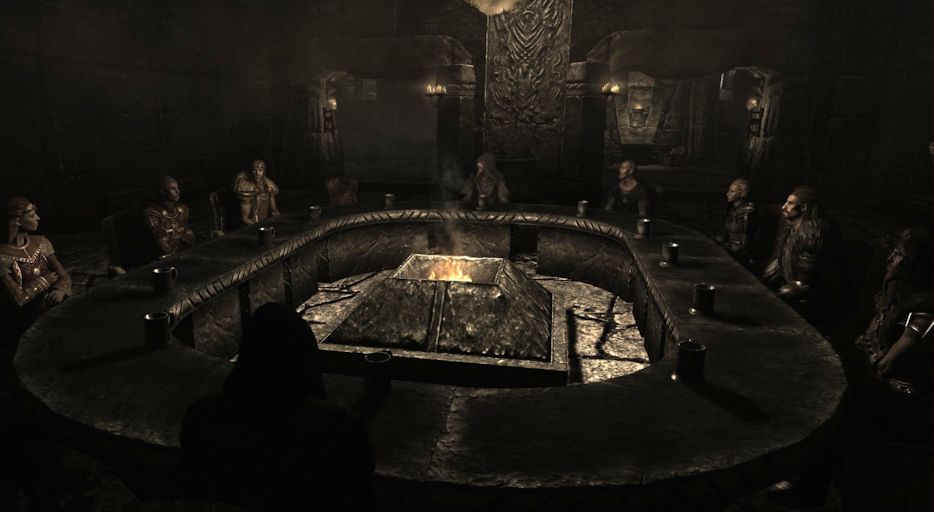
The negotiation table.
The problem is that, as soon as Season Unending is complete, the player can pick up the Civil War questline wherever he or she left off. In other words, both sides are willing to violate the terms of the truce to which they just agreed hours ago (in game time). If Bethesda really meant for the truce to last, the Civil War questline would have been complete (or perhaps failed) at the end of Season Unending. Furthermore, I learned that completing the Civil War quest for either side renders Season Unending not only unavailable, but automatically completed when the player reaches that stage of the Main quest. I am therefore left to conclude that the civil war was never meant to end peacefully.
From a moral role-playing perspective, the question of who to blame for the truce violation is vital. While this issue depends somewhat on the stage of the Civil War questline at which the player completes Season Unending, most scenarios suggest that the Stormcloaks are the aggressors. First, the Empire has nothing to gain by violating the cease-fire. The Legion is fighting a defensive battle against secessionists within an Imperial Province; if the rebellion stops fighting, then the Legion has no more reason to expend its already stretched forces to "punish" the rebels. Second, the Empire's major flaw is its adherence to the law, even when the law is unjust (such as the White-Gold Concordat), while the Stormcloaks have little interest in sticking to agreements that violate their ideology; if someone is going to break the treaty, its probably going to be the party that formed around the breaking of another treaty. Third, and most importantly, nearly every stage of the Civil War questline, regardless of the side chosen by the player, starts with an aggressive act by the Stormcloaks (finding the Jagged Crown in order to legitimize Ulfric's bid to replace Torygg as High King, taking a fort that legally belongs to the Empire, etc.). In fact, Ulfric's willingness to agree to the terms of the truce forged at High Hrothgar seems, in retrospect, to be a complete sham. As an ideologue, Ulfric has little to gain by holding to the terms of an agreement that is only slightly more palatable than the Concordat itself.
In my second playthough, I will be sure to complete Season Unending; the number of variables is impressive, and it is a rare moment of NPC communication in a combat-based game. Still, I wish that Bethesda had scripted a peaceful outcome to the civil war. While the player can certainly choose to not complete the Civil War quests, the hostilities do not resolve until the player, in effect, chooses a winner by fighting for either the Stormcloaks or the Legion. As it is currently written, Skyrim does not offer peace as a viable option.