Please read this first.

Welcome! This blog is devoted to considerations of morality in the The Elder Scrolls V: Skyrim by Bethesda. Rather than a fansite, review, or walkthrough, it is a serious attempt to examine the game through a moral lens. Please note that the purpose of this blog is to discuss morality within the context of the game, not to determine whether playing the game is immoral in and of itself; the latter type of "discussion" tends toward tedium and inhibits, rather than promotes, a meaningful conversation.

If you have not visited this blog before, it might be helpful to read the posts labeled "Orientation," most of which are the first few entries in the blog archive (see right). These posts include a short introduction to this project, a content-specific author bio, and a few other pieces that explain key concepts relevant to this study. These posts are of particular use to those readers less familiar with Skyrim (or video games in general).

PLEASE NOTE: HERE BE SPOILERS!

If you have visited this blog before, thanks and welcome back!
Showing posts with label Whiterun. Show all posts

Friday, December 13, 2013

The Way of the Voice/A Blade in the Dark (Katnys)


After the rush of consuming the dragon’s soul and letting out her first shout, Katnys needed some answers, but she was eager to get to Windhelm to continue her personal war against the Empire.  This “dragonborn” stuff seemed like a lot of Nord nonsense that would only distract her from her mission, but she couldn’t deny what was happening to her.  

In the midst of this internal debate, a new thought dawned on Katnys: if she was going to take on the Empire, she would need all of the power she could muster.  She had a dedicated, like-minded follower in Jenassa, and was earning friends wherever she went, but what if all of that wasn’t enough?  Her skills, her allies, and her rage were strong, but could they alone make the Empire pay for its treachery?  Perhaps this “dovahkiin” business could provide the means for the destruction of the Empire.

With these thoughts in mind, Katnys and Jenassa reported back to Balgruuf, followed his directions to Ivarstead, and then climbed the 7000 steps to High Hrothgar.  While the Greybeards and their monastery were impressive enough, Katnys could never quite take their pious detachment seriously, and just wanted to get on with it.  After all, here was this group of men who possessed immense power, but remained secluded and aloof from the world around them.  Their homeland was under attack by both the Legion and the dragons, but they just wanted to meditate on their mountaintop.  Katnys resolved to jump through their hoops, learn what she needed to learn, and move on.

It therefore came as a profound disappointment when she found Delphine’s note instead of the Horn.  Once again, she would be forced to delay her trip to Windhelm and go down yet another rabbit hole.  As it turned out, however, she didn’t mind this detour quite so much.  Like Katnys, Delphine was a woman of guile and action, so following her to Kynesgrove seemed less pointless than delving into the Greybeards’ dusty dungeons.  Sure, Delphine tended to go on about the Dragonborn and all that, but if what she was saying about the Blades was true, then Katnys needed to be a part of that for two reasons: 1.) a cadre of dragonslayers would be a valuable tool, and 2.) if the Blades had, indeed, protected the Emperor before the Great War, Katnys needed to keep them from returning to that role.

All plotting aside, the encounter with Sahloknir and Alduin at Kynesgrove unsettled Katnys.  Once the shock of seeing Alduin again wore off, she had to wrap her mind around a few disconcerting facts:

  • Alduin was raising dragons from the dead with his Thu’um, while Katnys could barely push people around with hers.  Had she bitten off more than she could chew?
  • If Delphine was to be believed, the Thalmor were behind all of this, and now Katnys would have to infiltrate the Thalmor Embassy.  Ambushing a small group of Justiciars is one thing, but this might be more than she could handle.
  • A few days ago, Katnys was a lone Dunmer just trying to spill some Imperial blood in memory of her sister. She now found herself in the middle of a civil war, a political conspiracy, and some kind of crazy prophesy – none of which she had in mind when she and Prym left Hammerfell.

Hammerfell.  It was that last thought that drove her back to Whiterun.  After returning the Horn to the Greybeards and enduring their pompous (though admittedly impressive) Dovahkiin ceremony, Katnys decided to return to Whiterun to talk to the Redguards she had seen hanging around the front gate.  Before, she had been in too much of a hurry to speak with them, but now that she needed some time to think, a conversation with some Alik’r warriors might help her regain her footing.

Friday, December 6, 2013

Main Quest (Katnyss): Before the Storm to Dragon Rising

Having survived the chaos of Helgen and Pinewatch, Katnyss took stock of her situation.  She was alone in an unfamiliar place and on the run from the Legion.  While she had certainly been in some tough situations before, this time was different.  Until now, Katnyss had focused her efforts on providing for her little sister and keeping her safe.  With Prym gone, all Katnyss had left was a rage that was as aimless as it was intense.  Of course she wanted revenge on the Empire, but she had barely managed to handle a gang of thugs.  Although Katnyss was not exactly a "people person," she had learned the value of allies from her time with the Alik'r. She needed to make some friends, and fast.


Upon reaching Riverwood, Katnyss made her way over to Gerdur and Hod’s house.  There, she caught up with Ralof and finally got some clarity on the Imperial ambush that killed her sister and led her to the executioner’s block.  During her conversations with Ralof and Gerdur, Katnyss began to feel a new sense of purpose – more accurately, her vengeance began to find a shape.  While she could care less about Talos and the cultural identity of the Nords, she certainly identified with the Stormcloaks’ sense of betrayal.  Joining the Rebellion would give her the opportunity to avenge, at least in some way, her sister’s murder at the hands of the Legion.  She decided to set out for Windhelm as soon as she feasibly could.

Katnyss’s experience at Pinewatch had taught her that Skyrim was going to be a dangerous place to travel alone, so she decided to spend a day or two in Riverwood in order to get some supplies and make some friends.  She took an immediate liking to Faendal, owing to his status as an archery trainer and fellow “fish out of water” in the Nord homeland.  She agreed to help him out-maneuver Sven in A Lovely Letter; Katnyss had no qualms about deceiving a Nord “bro,” nor did she really care that they were fooling Camilla – if Faendal wanted this Imperial girl for himself, so be it.

Now that she had a friend and follower in Faendal, Katnyss set about seeing how she could be useful to the people of Riverwood.  One of the many important lessons she had learned during her time in Hammerfell was that proving one’s usefulness could be the difference between life and death.  The Alik’r warriors were not about to play nursemaid to two Dunmer girls, but Katnyss demonstrated a willingness to do whatever they asked in exchange for their protection and provision.  As a result, she had not only saved herself and Prym from the abuse they suffered at the orphanage, but had also learned a little bit about alchemy, destruction magic, and combat - -especially archery.

Gerdur had already provided one important task: go to Whiterun to inform the Jarl of the dragon menace.  Katnyss would certainly do that as she travelled to Windhelm.  She was also smart enough to learn some basic smithing from Alvor, which gave her a little extra money to work with as well.  Furthermore, she agreed to assist Lucan by retrieving his golden claw from the bandits.  She had already managed to take out an entire gang by herself; with Faendal’s help, she could surely handle this job and thereby gain the favor of the owner of the general store. 

Getting the golden claw back proved to be more eventful than Katnyss had anticipated.  Aside from encountering her first draugr, she had no idea what to make of the word wall and her obvious connection to it.  How could she know a word in a language she’d never seen before?  Why didn’t anything happen to Faendal, who was standing right next her, looking at the very same thing she was looking at?  Prior to her adventure in Bleak Falls Barrow, Katnyss saw the dragon attack at Helgen as a happy (though dangerous) accident, of which she was going to take full advantage.  But it now began to dawn on her that there might be some kind of link between the events at Helgen and the word wall.

It was with these thoughts in her head that she returned to Riverwood, collected her reward from Lucan, and decided to spend the night at the Sleeping Giant Inn before heading to Whiterun in the morning.  While relaxing at the bar, the keep let slip some gossip about an orphan in Windhelm who was trying to employ the Dark Brotherhood, and another piece fell into place for Katnyss.  Her parents had told her stories about the Morag Tong and the Brotherhood to keep her in line while they lived in Hammerfell, and hearing the name again – in connection with an orphan like herself – inspired the next step in her plan.  She would report to Whiterun as promised, then make a bee line to Windhelm to join up with the rebellion and to see if she could learn more about the Dark Brotherhood.  The Stormcloaks and the Brotherhood were going to help her avenge her sister one way or another.

Katnyss and Faendal set out for Whiterun the next morning.  Along the way, just before the bridge outside the city, they encountered a small band of Thalmor Justiciars transporting a prisoner.  While she certainly hated the Thalmor for killing her parents, she had little trouble holding her tongue while the leader of the group condescendingly described his duties to her.  As awful as the Thalmor were, they hadn’t betrayed or abandoned their people the way the Empire had.  With the Thalmor, you knew what you were getting.  This particular group, however, had no idea what they getting in return.  Katnyss managed to slip the prisoner a weapon, then all hell broke loose.  When the dust cleared, the Justiciars were dead, the prisoner had bolted, and Katnyss was now in possession of the perfect disguise to fool any Legionnaires whom they might encounter.

Upon entering the city, Katnyss decided to stop off at The Drunken Huntsman to buy arrows and maybe sell off some Thalmor loot.  After transacting her business, she turned around to see something she had not expected in this Nord stronghold: a fellow Dunmer relaxing in the alcove.  Katnyss approached her, introduced herself, and within a few minutes became smitten by Jenassa’s dark, almost nihilistic banter, which made a refreshing contrast to the hale and hearty conversational habits of the Nords.  Talking with Jenassa felt good in way that Katnyss had not felt before – almost like being with her sister again, but different in some way she couldn’t put her finger on just yet.

Excusing herself for a moment, Katnyss turned to Faendal and realized that she would have to let him go home.  Faendal was a good guy – he had taught her a lot about archery and had even gone along with her foolhardy attack on the Justiciars – but things were about to get a lot darker, and Katnyss needed someone by her side who would be at home in the shadows.  Promising that she would return to Riverwood someday, she bid Faendal farewell and hired Jenassa on the spot.

The irony, of course, is that once Katnyss and Jenassa paid Jarl Balgruuf a visit, they met yet another Dunmer – Irileth, the Jarl’s housecarl.  The fact that this accomplished Dark Elf warrior had placed herself in Balgruuf’s service out of a sense of loyalty spoke volumes about this Jarl, and immediately placed him in Katnyss’s good graces.  He continued to impress her by being more concerned about the safety of his own people than about the politics swirling around him, but the fact that he seemed to favor the Empire a bit troubled her greatly.  Putting aside the latter misgiving, she agreed to join Irileth in defending the Western Watchtower; she had fulfilled her promise to Gerdur and was eager to get to Windhelm, but deserting these people just as a dragon was attacking their city seemed wrong.  And, if Katnyss was being completely honest with herself, she was curious about the dragon after her experience at Bleak Falls Barrow.

The battle with Mirmulnir thrilled Katnyss.  Fighting alongside her kinswomen inspired her to take risks she would never have before.  Knowing that her strength was in her bow, she ran to the top of tower to get more clear shots at the dragon.  While this position exposed her to attack far more than she liked, the danger was a fair exchange for the clearer vantage point.  When the combined efforts of the Whiterun guards and the trio of dark elves brought the dragon down, Katnyss raced down to get a close-up look at her first dragon.  Needless to say, she was prepared for neither the dragon's soul entering her body nor the thunderous call of the Greybeards.

Strange things were afoot, and Katnyss needed answers. Windhelm would have to wait a little longer.

Saturday, November 10, 2012

Civil War Epilogue: Season Unending

One of the things that bothered me about the Civil War quest was the absence of a peaceful solution to the conflict.  While I am well aware that Skyrim is a combat-oriented game, Bethesda does provide non-violent solutions to several other quests, so I was hoping for a non-partisan option for resolving the rebellion.  Obviously, as I outlined in my previous post, that option did not exist in my playthrough.

During my post-quest research, however, I discovered that the two parties can be brought to the negotiating table in a quest called Season Unending, which is part of the Main quest line.  Because I had decided it would be wiser to settle the civil war before attempting to deal with the dragon crisis, I had not advanced far enough along the Main questline to open Season Unending.  Initially, I was disappointed that I had missed out on an opportunity to bring a peaceful end to the rebellion, but upon further reading, I realized that the truce afforded by Season Unending is, at best, temporary and at worst, completely illusory. 

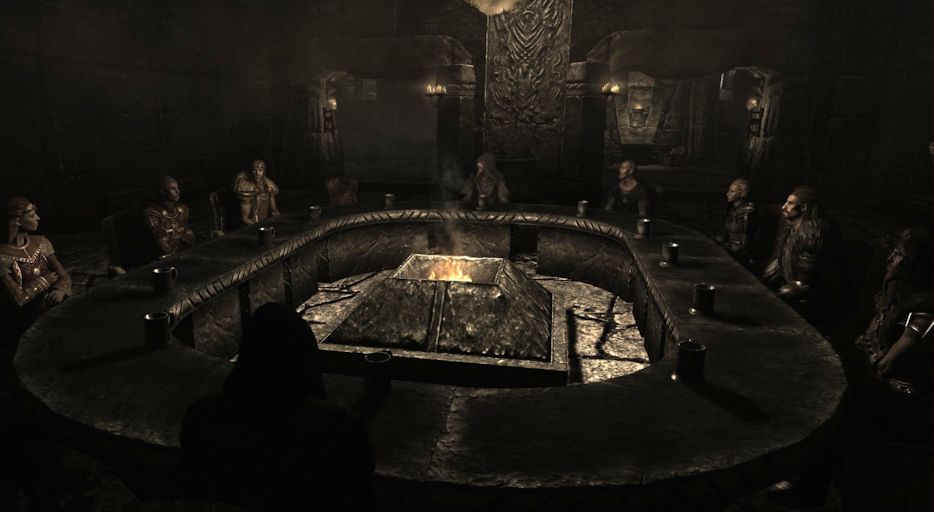
Jarl Balgruuf the Greater insists on a Greybeard-hosted and Dragonborn-mediated end to the hostilities before he will allow his castle (Dragonreach) to be used as an instrument to defeat Alduin.  His logic is that, because Whiterun is both geographically and politically betwixt the Stormcloaks and the Legion, a risky adventure such as the one proposed by the Dragonborn could be seen as a opportunity by one of the sides to gain advantage by taking Whiterun while its Jarl is distracted. General Tullius and Jarl Ulfric Stormcloak sit down at the table and agree to the terms of the truce negotiated by the Dragonborn.  Regardless of the specifics of the negotiation (and the combinations of possible interactions and outcomes is one of the most complex in the whole game), the quest ends successfully when everyone leaves the conference with a hard-won cease-fire.

The negotiation table.
The problem is that, as soon as Season Unending is complete, the player can pick up the Civil War questline wherever he or she left off.  In other words, both sides are willing to violate the terms of the truce to which they just agreed hours ago (in game time).  If Bethesda really meant for the truce to last, the Civil War questline would have been complete (or perhaps failed) at the end of Season Unending. Furthermore, I learned that completing the Civil War quest for either side renders Season Unending not only unavailable, but automatically completed when the player reaches that stage of the Main quest.  I am therefore left to conclude that the civil war was never meant to end peacefully.

From a moral role-playing perspective, the question of who to blame for the truce violation is vital.  While this issue depends somewhat on the stage of the Civil War questline at which the player completes Season Unending, most scenarios suggest that the Stormcloaks are the aggressors.  First, the Empire has nothing to gain by violating the cease-fire.  The Legion is fighting a defensive battle against secessionists within an Imperial Province; if the rebellion stops fighting, then the Legion has no more reason to expend its already stretched forces to "punish" the rebels.  Second, the Empire's major flaw is its adherence to the law, even when the law is unjust (such as the White-Gold Concordat), while the Stormcloaks have little interest in sticking to agreements that violate their ideology; if someone is going to break the treaty, its probably going to be the party that formed around the breaking of another treaty.  Third, and most importantly, nearly every stage of the Civil War questline, regardless of the side chosen by the player, starts with an aggressive act by the Stormcloaks (finding the Jagged Crown in order to legitimize Ulfric's bid to replace Torygg as High King, taking a fort that legally belongs to the Empire, etc.).  In fact, Ulfric's willingness to agree to the terms of the truce forged at High Hrothgar seems, in retrospect, to be a complete sham.  As an ideologue, Ulfric has little to gain by holding to the terms of an agreement that is only slightly more palatable than the Concordat itself.

In my second playthough, I will be sure to complete Season Unending; the number of variables is impressive, and it is a rare moment of NPC communication in a combat-based game.  Still, I wish that Bethesda had scripted a peaceful outcome to the civil war.  While the player can certainly choose to not complete the Civil War quests, the hostilities do not resolve until the player, in effect, chooses a winner by fighting for either the Stormcloaks or the Legion.  As it is currently written, Skyrim does not offer peace as a viable option.

Saturday, August 4, 2012

Missing in Action

Although Missing in Action is technically a side quest, it has ramifications for the Civil War questline.  The quest focuses the player's attention on the feud between the Battle-Born and Gray-Mane families of Whiterun.  As with the Hadvar-Ralof conflict in Riverwood, the tension between the two clans is a microcosm of the civil strife between the Imperial Legion and the Stormcloaks.

For me, the quest started when I overheard an argument between Fralia Gray-Mane and some of the Battle-Born clan in the Whiterun marketplace.  Fralia's son, Thorald, was captured by the Imperial Legion because of his association with the Stormcloaks.  The Battle-Borns, staunch supporters of the Empire, cruelly claimed that Thorald died as a traitor in Imperial custody, but Fralia insisted that he was still alive, and she asked me to investigate the matter for her.  She claimed that the Battle-Borns knew more than they were letting on, so I visited their house, exchanged pleasantries with the family (I had helped little Lars with a bullying problem earlier), then Lockpicked my way into a bedroom, where I found an Imperial missive:
The Thalmor are involved?  Shocking.
When I returned to the Gray-Manes with my findings, Thorald's brother Avulstein wanted to get a rescue squad together, but I suggested that it would be better for me to go alone.  At the gate to Northwatch Keep, I tried to convince the guards that I was there on official business:
It did not work.
Having tried the peaceful option and failed, I then began a steath assault on the Keep.  I defeated wave after wave of Thalmor soldiers until I found the Thalmor Interrogator, killed him, then spoke with Thorald as I released him:

So, it had even less to do with the Imperial Legion than I originally thought.

After arming Thorald, I led him out of the Keep.  When we were safely outside, he asked me to deliver a message to his mother, then left to find the nearest Stormcloak camp.  I did as he asked, and his mother gave me her bittersweet thanks.

Ironically, it was this quest, undertaken on behalf of a Stormcloak family, that solidified my decision to join the Imperial Legion.  Stormcloak or not, Thorald did not deserve torture, and certainly not at the hands of the Thalmor.  I felt genuine sympathy for the Gray-Manes, as well as legitimate dissatisfaction with the Empire's willingness to roll over (however begrudgingly) for the Thalmor.  Ideologically, I agree with the Stormcloaks, but their naivete and single-mindedness actually work to the Aldmeri Dominion's advantage; the White-Gold Concordat is an odious treaty, but by agreeing to it, the Empire bought time to rebuild and prepare for the nigh-inevitable next war.  In starting a civil war over the ban on Talos worship, the Stormcloaks have unintentionally strengthened the Thalmor's position.  Prior to the Concordat, there were no calls to for Skyrim to secede from the Empire, mainly because the Empire allowed each province to govern itself as it saw fit, as long as it continued to provide economic and military support to the Empire.  The Concordat splintered Skyrim, which was probably the Thalmor's intent, but it was the only move the Empire had left.

Jarl Ulfric Stormcloak seems like a good man with a bad idea.  Instead of trying to reclaim the Province for the "true sons of Skyrim," he ought to be investing his admirable faith in his men into creating a formidable commando unit in order to take down the Thalmor when the Empire is strong enough to wage another war.  Missing in Action not only demonstrated the magnitude of Thalmor treachery, but also taught me that taking out a Thalmor stronghold isn't all that difficult.  Jarl Ulfric's inability to see the bigger picture forces me to side with the Imperial Legion, even if that means I will eventually have to spill Stormcloak blood -- something I would really rather not do.

Thursday, July 26, 2012

Laid to Rest


After A Lovely Letter and the ensuing Faendal fiasco, I completed a number of quests that, while important, offered few moral conflicts apart from the standard issues – accepting versus refusing a quest to help someone, or fighting a monster versus allowing others to do the work.  I traveled to Whiterun, meet Jarl Balgruuf, fought my first dragon, and learned that I was the Dragonborn.  I cleared out a few bandit camps and even ran a few errands for the good people of Whiterun; one of my favorites involved my housecarl Lydia and I hunting mammoths in order to get some tusks for the merchant Ysolda.  I even managed to become a Thane of Whiterun and purchase a house – worthwhile endeavors all, but very few moral dilemmas.

I then travelled to the miasmic town of Morthal in Hjaalmarch Hold on my way to complete the quest The Horn of Jurgen Windcaller for the Greybeards.  As I nosed around the town, I met several townspeople who eagerly shared the gossip about Hroggar shacking up with Alva after the mysterious house fire that killed Hroggar's wife and their daughter, Helgi.  When I approached Jarl Idgrod Ravencrone about the matter (as the townsfolk suggested), she confessed that she suspected Alva of wrongdoing, but could do nothing without solid evidence, so she tasked me with investigating the burned-out house.  Shortly after I got there, Helgi's ghost appeared and asked me to come back to play hide and seek with her after dark, my reward being the identity of the arsonist.
This moment both broke my heart and signed the arsonist's death warrant.
I complied, explored the hillside behind the house, and ended up surprising and killing a vampire at Helgi's exhumed shallow grave.  The vampire, Helgi informed me, was Laelette, a former townsperson.  Apparently, Laelette set the fire intending to kill Helgi and her mother, but at the last minute, decided to try to turn Helgi instead, as a kind of surrogate daughter; she failed, but kept trying anyway -- hence the open grave.  Laelette's husband, Thonnir, showed up almost immediately, but instead of attacking me for killing his wife, he tearfully filled me in on another part of the story; when Alva came to town, she struck up an overbearing relationship with Laelette, who grew more distant from her husband, eventually disappearing to "join the resistance" one night, when she said she was going to meet up with Alva. 

As it turned out, I had already met Alva outside the inn earlier in the evening, as I was waiting to "play hide and seek" with Helgi.  She had initially struck me as a heartless golddigger who felt little more than disdain for the people of this small town; needless to say, I didn't like her.
Alva becomes the prime suspect.
After I heard Thonnir's story, I walked back to town, snuck up on Alva (who was still wandering around in the moonlight) and pickpocketed her house key.  Fortunately, Hroggar was asleep; if Alva was indeed a vampire, Hroggar was most likely enthralled, and I didn't want to have to fight him.  Once in her house, I found her cellar, which featured an unoccupied coffin containing Alva's journal:
Looks like Alva was as much a pawn as Laelette.

I now had the evidence the Jarl needed.  As I was ransacking the rest of the basement lair, Alva returned.  Killing her was a foregone conclusion; she caught me in her lair stealing her journal, so she was hostile, but I would have killed her anyway for what she had done.  The rest of the quest proceeded as one would expect.  I delivered the journal to the Jarl, who then asked me to track down and kill Movarth.  The townspeople wanted to help, but I assured them that my partner Uthgerd and I could handle it ourselves.  In a short raid, we killed Movarth and his little vampire clan.


At first blush, the moral element to this quest seems obvious.  Anyone who murders a child needs to die as soon as possible; someone who would turn that child into a vampire is even more deserving of death, although the fact that all of the vampires in this quest were immediately hostile makes that latter point moot.  Another potential conflict could have been the Jarl's insistence on hard evidence -- a policy I certainly agreed with.  Had the evidence not satisfied her, however, I still would have killed those responsible.

The troubling figure for me in this quest was Hroggar.  While he played a significant role in the death of his family, he was clearly under the influence of something far more powerful than simple lust.  I suppose I would have killed him if he had got in the way of dispatching Alva, but I was happy that I could avoid that circumstance.  He wasn't happy with me after I killed his "girlfriend," but I'm not sure if a full realization of his role in this tragic episode would be the best thing for him to carry in his head.  It's probably best that I didn't have the option of telling him.

This quest also represents my first encounters with vampires.  This point is significant because vampires, unlike other undead, are NPCs; vampirism is treated as a disease, so characters, including the PC, can contract it.  Because vampires are NPCs, they may or may not be hostile at any given time.  Alva, for example, only attacked when I discovered her secret.  The question, therefore, is: what should I do with non-hostile vampires?  They have to feed on NPCs regularly in order to survive, but the feeding process does not kill nor does it transmit the disease.  Some vampires are actively hostile and live in hideouts strewn with dead bodies and other carrion, while some appear to be functional citizens who simply mutter "Get out of my way, meat" when you approach them.

I have decided to adopt a non-aggression policy with vampires; I do not attack them unless they are hostile (unlike the Thalmor), but I also do not step in to save them from peril (unlike other NPCs).  I don't like vampires, and I have yet to encounter a vampire that wasn't "up to something," but I also can't justify wiping them out at every turn.  Perhaps my stance will change with the Dawnguard add-on.

ADDENDUM: Other players have reported that if Alva is not killed before the raid on Movarth, she will show up in Movarth's lair and might actually join the PC in fighting the other vampires.  Another scenario has Alva's body being found with Movarth, presumably killed by him and his clan.  These "alternate endings" for Alva's story might initially seem to have an impact on the moral validity of killing her -- perhaps she is as unwitting a dupe as Hroggar was -- but on closer consideration, my original assessment stands:
  1. If Alva was indeed enthralled, she would not have turned on Movarth.
  2. Alva's dialogue indicates clear, cold calculation, as opposed to Hroggar's, which is bewildered and dazed.
  3. Alternate motives for Alva to turn on Movarth include, but are not limited to, a desire to take over Morthal for herself instead of turning it over to Movarth.
  4. If Alva survives the entire quest, she reportedly goes back to her original pattern of sleeping in the coffin and roaming at night; were she truly remorseful, I would expect her to cure her vampirism (which is relatively easy to do).
Therefore, Alva still deserves to die for suborning the murders of Hroggar's wife and child.