During my post-quest research, however, I discovered that the two parties can be brought to the negotiating table in a quest called Season Unending, which is part of the Main quest line. Because I had decided it would be wiser to settle the civil war before attempting to deal with the dragon crisis, I had not advanced far enough along the Main questline to open Season Unending. Initially, I was disappointed that I had missed out on an opportunity to bring a peaceful end to the rebellion, but upon further reading, I realized that the truce afforded by Season Unending is, at best, temporary and at worst, completely illusory.
Jarl Balgruuf the Greater insists on a Greybeard-hosted and Dragonborn-mediated end to the hostilities before he will allow his castle (Dragonreach) to be used as an instrument to defeat Alduin. His logic is that, because Whiterun is both geographically and politically betwixt the Stormcloaks and the Legion, a risky adventure such as the one proposed by the Dragonborn could be seen as a opportunity by one of the sides to gain advantage by taking Whiterun while its Jarl is distracted. General Tullius and Jarl Ulfric Stormcloak sit down at the table and agree to the terms of the truce negotiated by the Dragonborn. Regardless of the specifics of the negotiation (and the combinations of possible interactions and outcomes is one of the most complex in the whole game), the quest ends successfully when everyone leaves the conference with a hard-won cease-fire.
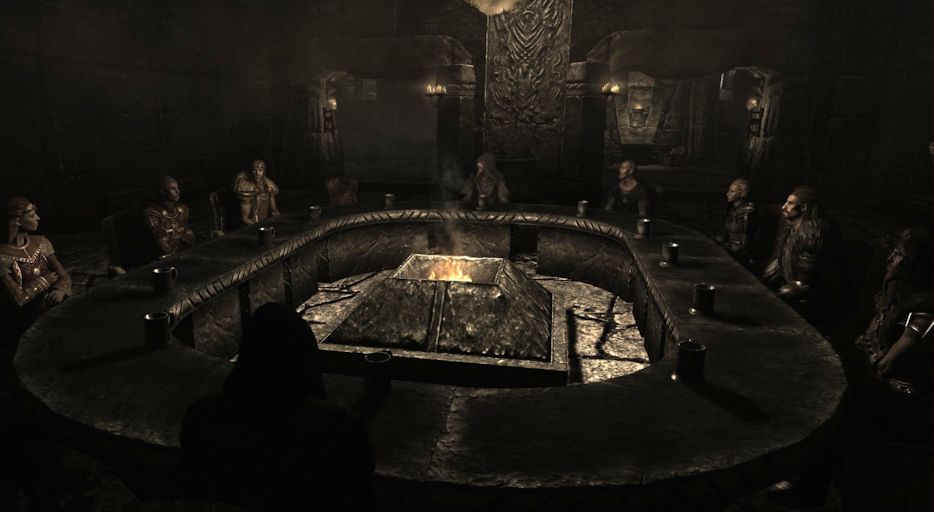 |
| The negotiation table. |
From a moral role-playing perspective, the question of who to blame for the truce violation is vital. While this issue depends somewhat on the stage of the Civil War questline at which the player completes Season Unending, most scenarios suggest that the Stormcloaks are the aggressors. First, the Empire has nothing to gain by violating the cease-fire. The Legion is fighting a defensive battle against secessionists within an Imperial Province; if the rebellion stops fighting, then the Legion has no more reason to expend its already stretched forces to "punish" the rebels. Second, the Empire's major flaw is its adherence to the law, even when the law is unjust (such as the White-Gold Concordat), while the Stormcloaks have little interest in sticking to agreements that violate their ideology; if someone is going to break the treaty, its probably going to be the party that formed around the breaking of another treaty. Third, and most importantly, nearly every stage of the Civil War questline, regardless of the side chosen by the player, starts with an aggressive act by the Stormcloaks (finding the Jagged Crown in order to legitimize Ulfric's bid to replace Torygg as High King, taking a fort that legally belongs to the Empire, etc.). In fact, Ulfric's willingness to agree to the terms of the truce forged at High Hrothgar seems, in retrospect, to be a complete sham. As an ideologue, Ulfric has little to gain by holding to the terms of an agreement that is only slightly more palatable than the Concordat itself.
In my second playthough, I will be sure to complete Season Unending; the number of variables is impressive, and it is a rare moment of NPC communication in a combat-based game. Still, I wish that Bethesda had scripted a peaceful outcome to the civil war. While the player can certainly choose to not complete the Civil War quests, the hostilities do not resolve until the player, in effect, chooses a winner by fighting for either the Stormcloaks or the Legion. As it is currently written, Skyrim does not offer peace as a viable option.
