Please read this first.

Welcome! This blog is devoted to considerations of morality in the The Elder Scrolls V: Skyrim by Bethesda. Rather than a fansite, review, or walkthrough, it is a serious attempt to examine the game through a moral lens. Please note that the purpose of this blog is to discuss morality within the context of the game, not to determine whether playing the game is immoral in and of itself; the latter type of "discussion" tends toward tedium and inhibits, rather than promotes, a meaningful conversation.

If you have not visited this blog before, it might be helpful to read the posts labeled "Orientation," most of which are the first few entries in the blog archive (see right). These posts include a short introduction to this project, a content-specific author bio, and a few other pieces that explain key concepts relevant to this study. These posts are of particular use to those readers less familiar with Skyrim (or video games in general).

PLEASE NOTE: HERE BE SPOILERS!

If you have visited this blog before, thanks and welcome back!
Showing posts with label Kodlak Whitemane. Show all posts

Tuesday, July 23, 2013

The Main Quest: Finale

Special thanks to Kurt Kuhlmann for pointing out some factual errors in an earlier version of this post!


After Paarthurnax, the Main Quest provides very few opportunities for moral agency.  Capturing Odahviing, travelling to Skuldafn, visiting Sovngarde, and defeating Alduin are all dramatic and engaging quests, but they present no significant moral quandaries.  There are, however, some events that bear further examination.

The latter part of the Main Quest reveals that not all of the dragons share Alduin's views. During The Fallen, I learned the shout that summons Odahviing, thus providing me another opportunity to converse with a dragon.  Odahviing is an active ally of Alduin, but when we captured him, he agreed to help me track down the World-Eater in exchange for his own freedom.  Because of his dialogue, Odahviing comes off as an opportunist who betrays Alduin not on principle, but on the likelihood that the Dovahkiin will defeat him:

 
Once Alduin is defeated, Odahviing pledges to aid the Dragonborn whenever he calls; he is not, however, another Paarthurnax, who promises to teach the pacifist Way of the Voice to all of the dragons he can convince.

He might actually succeed, as Paarthurnax and Odahviing are not the only non-hostile dragons in the game.  Until Skuldafn, I had never encountered a non-NPC dragon that did not attack the moment it detected me (or anyone else for that matter).  At Skuldafn, however, I ran into a dragon who, despite being perched directly above the portal to Sovngarde and witnessing my defeat of his comrades, did not attack.  He watched me closely, but made no aggressive moves at all.  Given my experience with Paarthurnax and Odahviing, I decided to hold back, and it began to dawn on me that all of the dragons (not just the named ones) might be morally complex creatures who are as apt to choose "the high road" as their mortal counterparts.  Perhaps this moral range explains why, at the Throat of the World, dragons can be seen celebrating the World-Eater's fall. 

As it turns out, the complicated moral tableau presented at the portal to Sovngarde was reflected on the other side as well.  While the scenes inside the Hall of Valor are interesting from a cultural perspective (of course Nords brawl in Heaven!), the encounters before I met Tsun were the most enlightening:

  • Kodlak: It was satisfying to see Kodlak in his beloved Sovngarde.  Even though he had assured me that the purification was successful, I was happy to see the results for myself.

  • Torygg: The High King's dialogue suggests that the popular story that Ulfric "shouted him to pieces" is closer to the truth than Ulfric's account, but I'm not sure if this is an important distinction.

  • Ulfric: This was by far the most substantial encounter in Sovngarde.  First, it appears that Ulfric's ascent to the Nord Paradise has erased any animosity he might harbor for the man who killed him in battle.  Second, Ulfric expresses a profound and sincere regret for his part in Skyrim's strife.  He stops short of saying that he was wrong, but his sadness is undeniable.  I suspect that, if he had the opportunity to  do it all again, he would probably try harder to convince Torygg of the need for secession, rather than kill him.  This conversation confirmed both my decision to support the Empire and my respect for Jarl Ulfric.


As for the final battle with Alduin, there is little of moral significance to examine, with the possible exception of the emphasis on unified effort.  In order to defeat the World-Eater, I had to join forces with the heroes of old -- perhaps an object lesson on the necessity of community.  Now that I think about it, that may be the best moral for a war-torn Skyrim after all.

Wednesday, November 21, 2012

The Companions (after The Silver Hand)


After the completion of The Silver Hand, I went out on two more simple radiant quests as a Companion.  Eventually, Kodlak Whitemane took me aside and expressed his concern about our actions against the Silver Hand.  He then revealed the origin of the Circle’s lycanthropy and its potential cure.  Unlike Aela, Kodlak viewed the Beast Form as a generational curse that consigned the afflicted to an eternity in the Hunting Grounds of the Daedric Prince Hircine, rather than in Sovngarde (the Skyrim version of Vanhalla).  Because the curse/gift had originally been brought on by a pact a former Harbinger had made with the Glenmoril Witches, Kodlak asked me to obtain one of their heads to use in a purification ceremony.  I agreed to help, and set out for the Glenmoril Coven.

The first and easiest moral facet of this quest (called Blood’s Honor) is the killing of the witches.  As it turns out, the witches are, in fact, very hostile Hagravens, and therefore fair game.  While collecting their heads may seem macabre, it is a necessary act to fulfill Kodlak’s wish, which engages the other moral issue in the quest.  

Kodlak’s desire to rid himself of lycanthropy arises more from a longing for Sovngarde than from any compunctions about his own actions during transformation.  Hircine’s Hunting Grounds is not a Hell of tormented souls; rather, it is a plane of constant struggle between predator and prey.  For someone like Aela, whose fondness for hunting borders on obsession, an eternity in Hircine’s realm would be a just and welcome reward.  Kodlak, however, is a true Nord son of Skyrim, and as such, aspires to a place among the honored dead in Sovngarde.  He believes that his status makes him ineligible for his rightful place, and the thought of an eternal hunt depresses him.  Even though I had enjoyed being a werewolf so far, I sympathized with Kodlak’s plight, and agreed to help him cure himself.  The salient point is that lycanthropy is a gift to those who welcome it and a curse to those who don’t, which makes it a morally neutral state.

Unfortunately, I did not get to inform Kodlak of my success; I returned to Jorrvaskr to find that the Silver Hand had retaliated against the Companions for our earlier raid.  Not only had Kodlak been killed in the attack, but all of the fragments of Wuuthrad had been stolen…thus began The Purity of Revenge.  This next quest was ethically simple; we were avenging our fallen Harbinger and reclaiming our rightful property.  Once again, I felt it fitting to kill the Silver Hand leader while in Beast Form.  Viklas didn’t seem to mind.
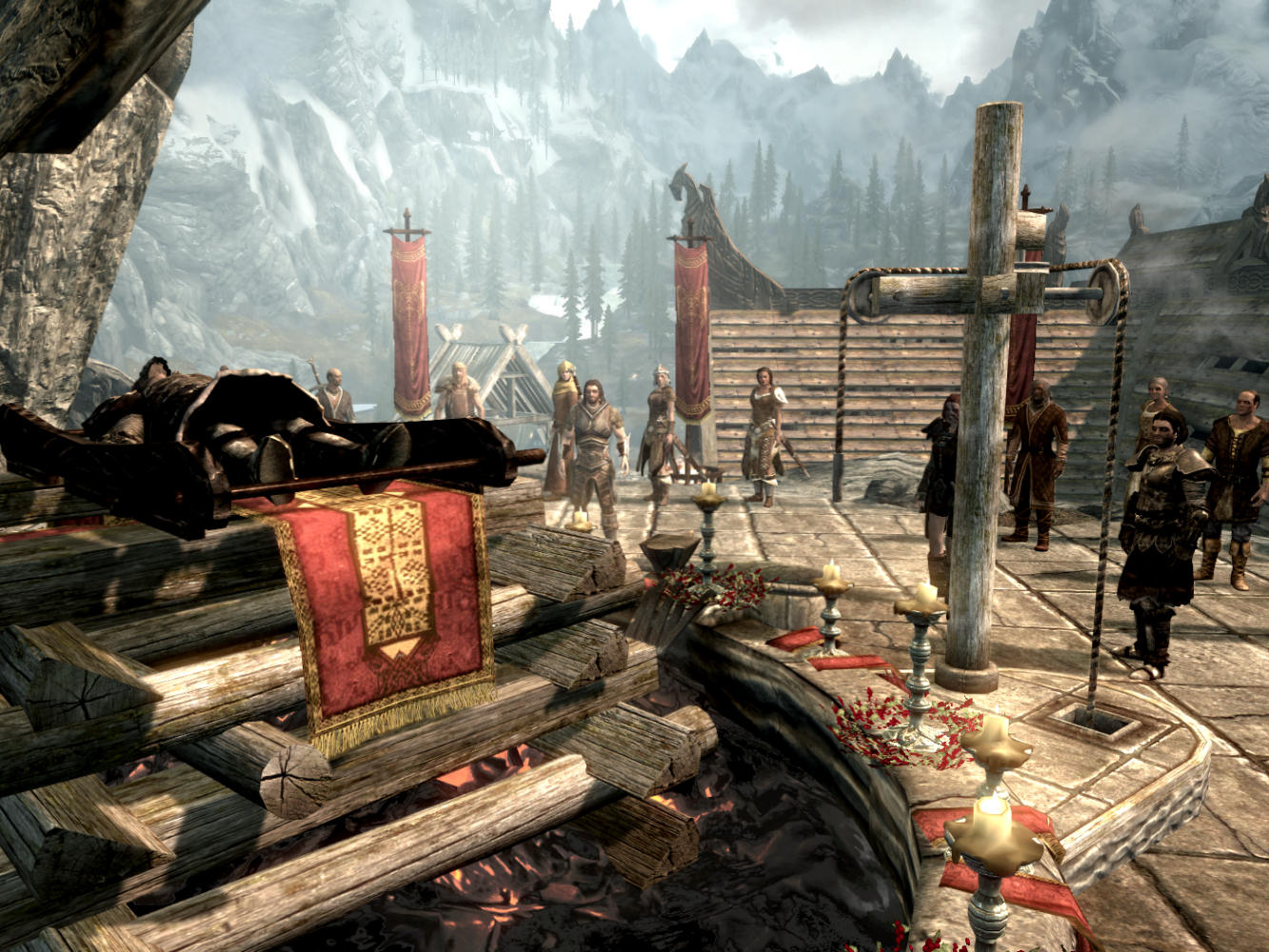
After completing The Purity of Revenge, The Companions gathered at the Skyforge for Kodlak’s funeral.  I have to say, this was one of the most moving moments in the game so far.  Aside from the pathos of the funeral itself, I was struck by the tragedy of Kodlak’s eternal fate; just when I had made it possible for him to be cured of his “curse,” he was struck down and therefore prevented from entering Sovngarde. Still, I hoped against hope that Kodlak’s assumptions about the afterlife were mistaken; after all, he had no real proof that he would automatically be consigned to Hircine’s Hunting Grounds.

Manly tears were shed.
Following the funeral, Eorland White-mane used the Skyforge, which had just been used to cremate Kodlak’s remains, to re-forge Wuuthrad.  The Circle (of which I was now a part) gathered in the Underforge to mourn Kodlak’s fate.   Of note is the fact that, even though many of them did not agree with “the old man’s” stance on lycanthropy, they truly lamented the possibility that he had missed out on Sovngarde.  This sympathy really impressed me; even Aela was able to put aside her enthusiasm for “hunting” and observe that Kodlak deserved better.  Fortunately, Eorland appeared and informed the Circle that it was not too late.  If we took the re-forged Wuuthrad to Ysgramor’s Tomb, we would be able to perform a purification ritual that would cleanse Kodlak’s spirit, even after death.  Once more, it should be noted that the Circle immediately agreed to risk their own lives in order to fulfill Kodlak’s final wish – a wish they themselves rejected.

This quest, Glory of the Dead, posed a few minor ethical issues.  Ysgramor’s Tomb contains the ghosts of former Companions who, according to Viklas, are there to test the courage of anyone who would dare enter.  Because the ghosts were “in the family” and the battles were part of a warrior’s test, I was able to overcome my misgivings about fighting the spirits of fellow Companions.  Once we reached the burial chamber, we encountered Kodlak’s spirit, warming his hands at the Flame of the Harbinger.  Sadly, Kodlak had been right all along; he was indeed trapped in Hircine’s realm, constantly pursued by the Daedric Lord of the Hunt.  According to his wishes, I threw the head of a Glenmoril Witch into the Flame, which sundered the wolf spirit from Kodlak.  A brief fight ensued, and after I defeated the wolf, Kodlak thanked me for freeing him.  Before he passed on to Sovngarde, Kodlak named me his successor as Harbinger of the Companions, which the rest of the Circle accepted.

Even though the quest was complete, I had a few decisions to make.  First, because I still had four Glenmoril Witch heads, I could have cured myself of the curse that had tormented my predecessor.  I decided that, since I had suffered no ill effects and that I was no more inclined to immoral behavior than I was before, I would remain a werewolf, at least for the time being.  Second, as I left the tomb, I had the option of taking Wuuthrad, which had already served its function of opening the burial chamber, back from Ysgramor’s Tomb.  On the one hand, it rightfully belongs to Ysgramor and should be left with him as a prized possession in accordance with Nord burial traditions.  On the other hand, it is a powerful weapon designed to be used against elves, not to sit forever as a decoration.  As the new Harbinger, and therefore a successor to Ysgramor himself, I felt justified in keeping the battleaxe in order to continue my private war against the Thalmor.

When I returned to Jorrvaskr as the new Harbinger, I explored Kodlak’s bedchamber further (I had been in the room earlier to retrieve a Wuuthrad fragment for Eorland).  In it, I found and read Kodlak’s journal, in which he described not only his sadness over his condition, but also his increasing admiration for me and his confidence that I would be the new Harbinger.  For the second time in this questline, I cried.

Sunday, November 11, 2012

The Companions (up to The Silver Hand)

I began writing about the Companions in an earlier post, but the full questline requires its own article. Poignant and morally complex, this quest has lasting consequences for the PC and all subsequent quests.

The opening quests of this line followed what one might expect for a group of mercenaries -- bandit raids and enforcement, all for profit. The main moral issue of the questline, however, was revealed when I agreed to act as backup for Farkas, the Companions' Heavy Armor expert, on a more important quest (Proving Honor). While hunting for the fragments of Wuuthrad, the legendary battleaxe of Ysgramor himself, I got myself trapped behind a iron gate. Before Farkas could free me, he was set upon by a group of thugs who revealed themselves to be members of the Silver Hand -- a band of warriors committed to the extermination of werewolves. The reason for this ambush became clear when Farkas transformed before my very eyes and dispatched his attackers with fang and claw.

After killing the last Silver Hand, Farkas reverted to his more familiar state and freed me from the trap. He explained that the inner circle of the Companions was, in fact, a small pack of werewolves. Some of them, like Aela the Huntress, accepted the lycanthropy as a gift from the daedric prince Hircine, while others, such as the Harbinger (as close to a leader as the Companions will admit to having) Kodlak Whitemane, viewed it as a curse that precluded their proper destiny in Sovngarde. Farkas's revelation shed light on several interesting aspects of the Companions: the tight-knit nature of the group, Aela's fascination with hunting, and the wolf-themed armor of the Companions. We completed the quest (killing several more Silver Hand and draugr in the process) and returned to Jorrvaskr, where, after becoming a full member of the companions and completing another radiant quest, I was eventually given the opportunity to join the Circle, and thereby become a werewolf myself.


The ritual in the Underforge

Some explanation of Skyrim's approach to lycanthropy is in order here. Unlike traditional werewolves, who are bitten and then involuntarily transform during the full moon (or some other external condition), Skyrim's werewolves can assume the Beast Form once a day, and can choose to extend their "beast time" by feeding on their kills. In addition, lycanthropy can only be transmitted through a voluntary ritual in which the initiate drinks the blood of another werewolf. In other words, my becoming "the monster" would be entirely voluntary -- the only negative effects would be the loss of any rest-based bonuses (Rested, Well-Rested, Lover's Comfort). While werewolf NPCs sometimes talk about how addictive the Beast Blood power is, the werewolf PC suffers no downside from refusing to transform. This condition contrasts with Skyrim's approach to vampirism, in which the PC, who typically is infected involuntarily, suffers attribute penalties for refusing to feed.

Given the level of choice available to the Skyrim werewolf, I decided to partake in the ritual. Lycanthropy seemed like an additional power that could be used for good or for ill. Furthermore, I was interested in becoming a member of the Circle, and thus part of the leadership of the Companions. I submitted to the ritual, took on my Beast Form for the first time, killed a few deer, and blacked out.

When I came to in the woods, Aela was with me to "talk me down." We immediately began an attack on the Silver Hand in their hideout at Gallows Rock. During the assault, I learned a few things about the Silver Hand that reinforced my decision to eradicate them. Not only had they been capturing and torturing werewolves, but they were in the habit of skinning them and mounting their heads as trophies. When we encountered their leader, Krev the Skinner, I transformed again and slaughtered her in a manner befitting her crimes. Unfortunately, we arrived too late; Skjor, who had been scouting ahead of us, had already been captured and killed. The quest ended with Aela in mourning, and me left to return to Jorrvaskr alone.

Several moral issues arise in these quests. After the unprovoked attack on my friend Farkas, killing the Silver Hand felt justified, and my discoveries in the later quest only served to confirm my stance. While the Silver Hand might see themselves in the same light as the Vigilants of Stendaar -- that is, righteous warriors ridding the land of an evil abomination -- I could not ignore certain key differences. Daedric cultists tend to commit random acts of violence against innocent people, whereas the Circle appears to be very selective in its use of the Beast Blood power. Given the presence of hostile werewolves in Gallows Rock, I can only conclude that lycanthropy is similar to many other powers, such as magicka or the Thu'um, in that it is a powerful tool that can wreck havoc in the wrong hands. Therefore, the Silver Hand wiping out all werewolves would be on par with killing all mages because some of them misuse their magicka. Furthermore, the obvious delight the Silver Hand takes in fashioning trophies out of their kills, who are basically human, separates them from the businesslike Vigilants. In short, the Silver Hand seems more like a band of thugs with a cause than a noble troop of monster hunters, and killing them seems in line with my character's moral profile.

Another moral dilemma concerns one of the features of the Beast Form itself; the PC can extend his time in wolf form by feeding on the bodies of those he slays. This is not the first time I have confronted the issue of cannibalism in Skyrim, but I would argue that feeding the werewolf is subtly different from the Namiric cannibalism at the center of A Taste of Death. Worshippers of Namira look at their fellow citizens as cattle to be slaughtered and consumed, which they do in their normal, human form. The werewolf, on the other hand, is a beast, and therefore feeds as a beast. The complication, from a role-playing perspective, is that the werewolf form is under the direct control of the character, as evidenced by Aela's behavior during the ritual. Despite being in Beast Form, she is completely in control of her actions. The question, then, is whether feeding on fallen victims while in Beast Form is morally equivalent to cannibalism. The two actions feel different, perhaps because of the usual dissociative implications of lycanthropy, but I cannot yet provide a well-reasoned, empirical distinction.

I can, however, say that feeding on Krev the Skinner felt right. It seemed a just end for the woman who delighted in the slaughter of werewolves and who killed my Shield-Brother Skjor.