Please read this first.

Welcome! This blog is devoted to considerations of morality in the The Elder Scrolls V: Skyrim by Bethesda. Rather than a fansite, review, or walkthrough, it is a serious attempt to examine the game through a moral lens. Please note that the purpose of this blog is to discuss morality within the context of the game, not to determine whether playing the game is immoral in and of itself; the latter type of "discussion" tends toward tedium and inhibits, rather than promotes, a meaningful conversation.

If you have not visited this blog before, it might be helpful to read the posts labeled "Orientation," most of which are the first few entries in the blog archive (see right). These posts include a short introduction to this project, a content-specific author bio, and a few other pieces that explain key concepts relevant to this study. These posts are of particular use to those readers less familiar with Skyrim (or video games in general).

PLEASE NOTE: HERE BE SPOILERS!

If you have visited this blog before, thanks and welcome back!
Showing posts with label Balgruuf the Greater. Show all posts

Friday, December 6, 2013

Main Quest (Katnyss): Before the Storm to Dragon Rising

Having survived the chaos of Helgen and Pinewatch, Katnyss took stock of her situation.  She was alone in an unfamiliar place and on the run from the Legion.  While she had certainly been in some tough situations before, this time was different.  Until now, Katnyss had focused her efforts on providing for her little sister and keeping her safe.  With Prym gone, all Katnyss had left was a rage that was as aimless as it was intense.  Of course she wanted revenge on the Empire, but she had barely managed to handle a gang of thugs.  Although Katnyss was not exactly a "people person," she had learned the value of allies from her time with the Alik'r. She needed to make some friends, and fast.


Upon reaching Riverwood, Katnyss made her way over to Gerdur and Hod’s house.  There, she caught up with Ralof and finally got some clarity on the Imperial ambush that killed her sister and led her to the executioner’s block.  During her conversations with Ralof and Gerdur, Katnyss began to feel a new sense of purpose – more accurately, her vengeance began to find a shape.  While she could care less about Talos and the cultural identity of the Nords, she certainly identified with the Stormcloaks’ sense of betrayal.  Joining the Rebellion would give her the opportunity to avenge, at least in some way, her sister’s murder at the hands of the Legion.  She decided to set out for Windhelm as soon as she feasibly could.

Katnyss’s experience at Pinewatch had taught her that Skyrim was going to be a dangerous place to travel alone, so she decided to spend a day or two in Riverwood in order to get some supplies and make some friends.  She took an immediate liking to Faendal, owing to his status as an archery trainer and fellow “fish out of water” in the Nord homeland.  She agreed to help him out-maneuver Sven in A Lovely Letter; Katnyss had no qualms about deceiving a Nord “bro,” nor did she really care that they were fooling Camilla – if Faendal wanted this Imperial girl for himself, so be it.

Now that she had a friend and follower in Faendal, Katnyss set about seeing how she could be useful to the people of Riverwood.  One of the many important lessons she had learned during her time in Hammerfell was that proving one’s usefulness could be the difference between life and death.  The Alik’r warriors were not about to play nursemaid to two Dunmer girls, but Katnyss demonstrated a willingness to do whatever they asked in exchange for their protection and provision.  As a result, she had not only saved herself and Prym from the abuse they suffered at the orphanage, but had also learned a little bit about alchemy, destruction magic, and combat - -especially archery.

Gerdur had already provided one important task: go to Whiterun to inform the Jarl of the dragon menace.  Katnyss would certainly do that as she travelled to Windhelm.  She was also smart enough to learn some basic smithing from Alvor, which gave her a little extra money to work with as well.  Furthermore, she agreed to assist Lucan by retrieving his golden claw from the bandits.  She had already managed to take out an entire gang by herself; with Faendal’s help, she could surely handle this job and thereby gain the favor of the owner of the general store. 

Getting the golden claw back proved to be more eventful than Katnyss had anticipated.  Aside from encountering her first draugr, she had no idea what to make of the word wall and her obvious connection to it.  How could she know a word in a language she’d never seen before?  Why didn’t anything happen to Faendal, who was standing right next her, looking at the very same thing she was looking at?  Prior to her adventure in Bleak Falls Barrow, Katnyss saw the dragon attack at Helgen as a happy (though dangerous) accident, of which she was going to take full advantage.  But it now began to dawn on her that there might be some kind of link between the events at Helgen and the word wall.

It was with these thoughts in her head that she returned to Riverwood, collected her reward from Lucan, and decided to spend the night at the Sleeping Giant Inn before heading to Whiterun in the morning.  While relaxing at the bar, the keep let slip some gossip about an orphan in Windhelm who was trying to employ the Dark Brotherhood, and another piece fell into place for Katnyss.  Her parents had told her stories about the Morag Tong and the Brotherhood to keep her in line while they lived in Hammerfell, and hearing the name again – in connection with an orphan like herself – inspired the next step in her plan.  She would report to Whiterun as promised, then make a bee line to Windhelm to join up with the rebellion and to see if she could learn more about the Dark Brotherhood.  The Stormcloaks and the Brotherhood were going to help her avenge her sister one way or another.

Katnyss and Faendal set out for Whiterun the next morning.  Along the way, just before the bridge outside the city, they encountered a small band of Thalmor Justiciars transporting a prisoner.  While she certainly hated the Thalmor for killing her parents, she had little trouble holding her tongue while the leader of the group condescendingly described his duties to her.  As awful as the Thalmor were, they hadn’t betrayed or abandoned their people the way the Empire had.  With the Thalmor, you knew what you were getting.  This particular group, however, had no idea what they getting in return.  Katnyss managed to slip the prisoner a weapon, then all hell broke loose.  When the dust cleared, the Justiciars were dead, the prisoner had bolted, and Katnyss was now in possession of the perfect disguise to fool any Legionnaires whom they might encounter.

Upon entering the city, Katnyss decided to stop off at The Drunken Huntsman to buy arrows and maybe sell off some Thalmor loot.  After transacting her business, she turned around to see something she had not expected in this Nord stronghold: a fellow Dunmer relaxing in the alcove.  Katnyss approached her, introduced herself, and within a few minutes became smitten by Jenassa’s dark, almost nihilistic banter, which made a refreshing contrast to the hale and hearty conversational habits of the Nords.  Talking with Jenassa felt good in way that Katnyss had not felt before – almost like being with her sister again, but different in some way she couldn’t put her finger on just yet.

Excusing herself for a moment, Katnyss turned to Faendal and realized that she would have to let him go home.  Faendal was a good guy – he had taught her a lot about archery and had even gone along with her foolhardy attack on the Justiciars – but things were about to get a lot darker, and Katnyss needed someone by her side who would be at home in the shadows.  Promising that she would return to Riverwood someday, she bid Faendal farewell and hired Jenassa on the spot.

The irony, of course, is that once Katnyss and Jenassa paid Jarl Balgruuf a visit, they met yet another Dunmer – Irileth, the Jarl’s housecarl.  The fact that this accomplished Dark Elf warrior had placed herself in Balgruuf’s service out of a sense of loyalty spoke volumes about this Jarl, and immediately placed him in Katnyss’s good graces.  He continued to impress her by being more concerned about the safety of his own people than about the politics swirling around him, but the fact that he seemed to favor the Empire a bit troubled her greatly.  Putting aside the latter misgiving, she agreed to join Irileth in defending the Western Watchtower; she had fulfilled her promise to Gerdur and was eager to get to Windhelm, but deserting these people just as a dragon was attacking their city seemed wrong.  And, if Katnyss was being completely honest with herself, she was curious about the dragon after her experience at Bleak Falls Barrow.

The battle with Mirmulnir thrilled Katnyss.  Fighting alongside her kinswomen inspired her to take risks she would never have before.  Knowing that her strength was in her bow, she ran to the top of tower to get more clear shots at the dragon.  While this position exposed her to attack far more than she liked, the danger was a fair exchange for the clearer vantage point.  When the combined efforts of the Whiterun guards and the trio of dark elves brought the dragon down, Katnyss raced down to get a close-up look at her first dragon.  Needless to say, she was prepared for neither the dragon's soul entering her body nor the thunderous call of the Greybeards.

Strange things were afoot, and Katnyss needed answers. Windhelm would have to wait a little longer.

Saturday, November 2, 2013

The Whispering Door


While visiting the Bannered Mare between quests, I heard a rumor about Jarl Balgruuf’s son – something about his behavior becoming rather dark, especially for a child.  Given my fondness for Balgruuf and my disturbing encounter with Aventus Aretino, I was eager to see if I could help.  Balgruuf was, as usual, very candid with me about his son Nelkir; he blamed himself for the boy’s distress, which he believed originated from the fact that he has a different mother than his other kids.  He then invited me to talk to him myself.

Being the issue of the Jarl’s dalliance may have accounted for some of Nelikir’s insolence, but when I spoke with him in depth, it became clear that something much darker was at work.  He eventually admitted to speaking with the “Whispering Lady” in the basement, which suggested some kind of Daedric entanglement.

Finally...a daedra who's pickin' up what I'm puttin' down!
My suspicions were confirmed when I spoke to the “Lady” herself.  Nothing good was going to come from a manipulative voice behind a locked door, so I resolved to pickpocket the key from Farengar and open the door.  I was pleasantly surprised to find no immediate threat inside the room, so I listened to what the “Lady” – who, as it turns out, is Mephala, Daedric Prince of Secrets and Betrayal – had to say, and set about examining the Ebony Blade and its accompanying book, thus completing the quest.

Given Lothar’s moral profile, there was no way I was going to use the Ebony Blade for its intended purpose.  I had a hard enough time finding someoneworthy of selling out to Boethiah, so there was precious little chance that I would be able to justify the use of this particular Daedric artifact. 

There remains, however, the moral compromise involved in picking an ally’s pocket.  I would argue that that the petty crime in this case is far outweighed by the greater good.  Despite Balgruuf’s and Farengar’s noble intentions, Mephala was still able to secure an unhealthy influence on Nelkir.  Furthermore, like Mehrune’s Razor, the Ebony Blade is far too dangerous to simply lock in a storeroom.  Better that it be guarded by the Dragonborn himself.

As a side note, I should point out that this is the easiest Daedric quest in the game.  I have to assume that any potential challenge comes after one decides to use the Ebony Blade on one’s allies.  In order to use this artifact with any sort of moral agency, one would have to construct a moral system that can justify not only murder, but wholesale treachery as well.  An evil or amoral character could certainly use it, but I’m not sure how a character whose actions are driven by moral compass of any kind could bring the ‘Blade to full power.  Perhaps one could construct a genocidal Dovahkiin who has pronounced judgment on the entire Altmer (or Dunmer or Nord or whatever) race could use it, but the question of deception versus honorable battle would remain.

If only the Forsworn were a joinable faction.

Saturday, November 10, 2012

Civil War Epilogue: Season Unending

One of the things that bothered me about the Civil War quest was the absence of a peaceful solution to the conflict.  While I am well aware that Skyrim is a combat-oriented game, Bethesda does provide non-violent solutions to several other quests, so I was hoping for a non-partisan option for resolving the rebellion.  Obviously, as I outlined in my previous post, that option did not exist in my playthrough.

During my post-quest research, however, I discovered that the two parties can be brought to the negotiating table in a quest called Season Unending, which is part of the Main quest line.  Because I had decided it would be wiser to settle the civil war before attempting to deal with the dragon crisis, I had not advanced far enough along the Main questline to open Season Unending.  Initially, I was disappointed that I had missed out on an opportunity to bring a peaceful end to the rebellion, but upon further reading, I realized that the truce afforded by Season Unending is, at best, temporary and at worst, completely illusory. 

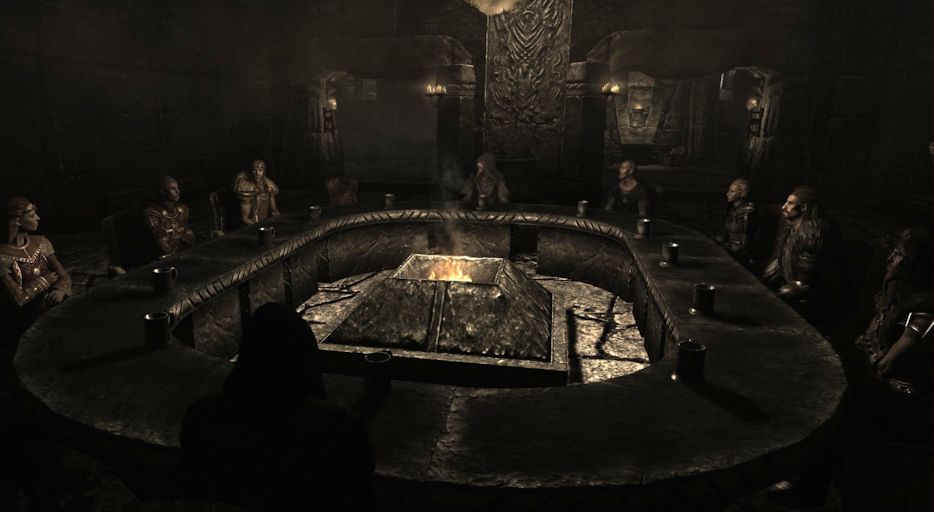
Jarl Balgruuf the Greater insists on a Greybeard-hosted and Dragonborn-mediated end to the hostilities before he will allow his castle (Dragonreach) to be used as an instrument to defeat Alduin.  His logic is that, because Whiterun is both geographically and politically betwixt the Stormcloaks and the Legion, a risky adventure such as the one proposed by the Dragonborn could be seen as a opportunity by one of the sides to gain advantage by taking Whiterun while its Jarl is distracted. General Tullius and Jarl Ulfric Stormcloak sit down at the table and agree to the terms of the truce negotiated by the Dragonborn.  Regardless of the specifics of the negotiation (and the combinations of possible interactions and outcomes is one of the most complex in the whole game), the quest ends successfully when everyone leaves the conference with a hard-won cease-fire.

The negotiation table.
The problem is that, as soon as Season Unending is complete, the player can pick up the Civil War questline wherever he or she left off.  In other words, both sides are willing to violate the terms of the truce to which they just agreed hours ago (in game time).  If Bethesda really meant for the truce to last, the Civil War questline would have been complete (or perhaps failed) at the end of Season Unending. Furthermore, I learned that completing the Civil War quest for either side renders Season Unending not only unavailable, but automatically completed when the player reaches that stage of the Main quest.  I am therefore left to conclude that the civil war was never meant to end peacefully.

From a moral role-playing perspective, the question of who to blame for the truce violation is vital.  While this issue depends somewhat on the stage of the Civil War questline at which the player completes Season Unending, most scenarios suggest that the Stormcloaks are the aggressors.  First, the Empire has nothing to gain by violating the cease-fire.  The Legion is fighting a defensive battle against secessionists within an Imperial Province; if the rebellion stops fighting, then the Legion has no more reason to expend its already stretched forces to "punish" the rebels.  Second, the Empire's major flaw is its adherence to the law, even when the law is unjust (such as the White-Gold Concordat), while the Stormcloaks have little interest in sticking to agreements that violate their ideology; if someone is going to break the treaty, its probably going to be the party that formed around the breaking of another treaty.  Third, and most importantly, nearly every stage of the Civil War questline, regardless of the side chosen by the player, starts with an aggressive act by the Stormcloaks (finding the Jagged Crown in order to legitimize Ulfric's bid to replace Torygg as High King, taking a fort that legally belongs to the Empire, etc.).  In fact, Ulfric's willingness to agree to the terms of the truce forged at High Hrothgar seems, in retrospect, to be a complete sham.  As an ideologue, Ulfric has little to gain by holding to the terms of an agreement that is only slightly more palatable than the Concordat itself.

In my second playthough, I will be sure to complete Season Unending; the number of variables is impressive, and it is a rare moment of NPC communication in a combat-based game.  Still, I wish that Bethesda had scripted a peaceful outcome to the civil war.  While the player can certainly choose to not complete the Civil War quests, the hostilities do not resolve until the player, in effect, chooses a winner by fighting for either the Stormcloaks or the Legion.  As it is currently written, Skyrim does not offer peace as a viable option.