Welcome! This blog is devoted to considerations of morality in the The Elder Scrolls V: Skyrim by Bethesda. Rather than a fansite, review, or walkthrough, it is a serious attempt to examine the game through a moral lens. Please note that the purpose of this blog is to discuss morality within the context of the game, not to determine whether playing the game is immoral in and of itself; the latter type of "discussion" tends toward tedium and inhibits, rather than promotes, a meaningful conversation.
If you have not visited this blog before, it might be helpful to read the posts labeled "Orientation," most of which are the first few entries in the blog archive (see right). These posts include a short introduction to this project, a content-specific author bio, and a few other pieces that explain key concepts relevant to this study. These posts are of particular use to those readers less familiar with Skyrim (or video games in general).
PLEASE NOTE: HERE BE SPOILERS!
If you have visited this blog before, thanks and welcome back!
After the rush of consuming the dragon’s soul and letting
out her first shout, Katnys needed some answers, but she was eager to get to
Windhelm to continue her personal war against the Empire.This “dragonborn” stuff seemed like a lot of
Nord nonsense that would only distract her from her mission, but she couldn’t
deny what was happening to her.
In the midst of this internal debate, a new thought dawned
on Katnys: if she was going to take on the Empire, she would need all of the
power she could muster.She had a
dedicated, like-minded follower in Jenassa, and was earning friends wherever
she went, but what if all of that wasn’t enough?Her skills, her allies, and her rage were
strong, but could they alone make the Empire pay for its treachery?Perhaps this “dovahkiin” business could
provide the means for the destruction of the Empire.
With these thoughts in mind, Katnys and Jenassa reported
back to Balgruuf, followed his directions to Ivarstead, and then climbed the
7000 steps to High Hrothgar.While the
Greybeards and their monastery were impressive enough, Katnys could never
quite take their pious detachment seriously, and just wanted to get on with
it.After all, here was this group of
men who possessed immense power, but remained secluded and aloof from the world
around them.Their homeland was under
attack by both the Legion and the dragons, but they just wanted to meditate on
their mountaintop.Katnys resolved to
jump through their hoops, learn what she needed to learn, and move on.
It therefore came as a profound disappointment when she
found Delphine’s note instead of the Horn.Once again, she would be forced to delay her trip to Windhelm and go
down yet another rabbit hole.As it
turned out, however, she didn’t mind this detour quite so much.Like Katnys, Delphine was a woman of guile
and action, so following her to Kynesgrove seemed less pointless than delving
into the Greybeards’ dusty dungeons.Sure, Delphine tended to go on about the Dragonborn and all that, but if
what she was saying about the Blades was true, then Katnys needed to be a part
of that for two reasons: 1.) a cadre of dragonslayers would be a valuable tool,
and 2.) if the Blades had, indeed, protected the Emperor before the Great War,
Katnys needed to keep them from returning to that role.
All plotting aside, the encounter with Sahloknir and Alduin
at Kynesgrove unsettled Katnys.Once
the shock of seeing Alduin again wore off, she had to wrap her mind around a
few disconcerting facts:
Alduin was raising dragons from the dead with
his Thu’um, while Katnys could barely push people around with hers.Had she bitten off more than she could chew?
If Delphine was to be believed, the Thalmor were
behind all of this, and now Katnys would have to infiltrate the Thalmor
Embassy.Ambushing a small group of
Justiciars is one thing, but this might be more than she could handle.
A few days ago, Katnys was a lone Dunmer just
trying to spill some Imperial blood in memory of her sister. She now found
herself in the middle of a civil war, a political conspiracy, and some kind of
crazy prophesy – none of which she had in mind when she and Prym left
Hammerfell.
Hammerfell.It was
that last thought that drove her back to Whiterun.After returning the Horn to the Greybeards
and enduring their pompous (though admittedly impressive) Dovahkiin ceremony,
Katnys decided to return to Whiterun to talk to the Redguards she had seen
hanging around the front gate.Before, she
had been in too much of a hurry to speak with them, but now that she needed
some time to think, a conversation with some Alik’r warriors might help her
regain her footing.
As I pointed out in my Diplomatic Immunity post, the main quest of Skyrim does not offer a high number of moral dilemmas. Even if I were to accept the Greybeards' theory that Alduin's attacks presage the just and inevitable end of this world in preparation for the new world to come, my role as Dovahkiin draws me just as inexorably to a confrontation with the World Eater. Therefore, despite the high drama and plot tension extant in the main quest, there are only a handful of opportunities for true moral agency. The quest entitled Paarthurnax presents the fourth and final scripted moral dilemma.
After discovering Sky Haven Temple, Delphine tasked me with helping her to rebuild the Blades. I was to recruit three warriors whom I thought would be well-suited to the task of hunting dragons and, perhaps eventually, protecting a Dragonborn Emperor. I chose three followers whom I knew from experience could handle the job: Uthgerd the Unbroken and Lydia (my housecarl at Breezehome) had demonstrated impressive skills in Heavy Armor, One- and Two-Handed Combat, Blocking, and Archery, so they were natural choices; I also selected Brelyna Maryon from the College of Winterhold, whose formidable Conjuration and Destruction talents allowed me to round out a small army of dragon hunters that could bring both melee and ranged attacks into any situation. Having bolstered the ranks of the Blades to Delphine's satisfaction, we went out on a few successful dragon raids without incident. I then returned to the main quest, which took me back to High Hrothgar to finally meet Paarthurnax, the leader of the Greybeards...
[SPECIAL NOTE TO THE READER: While I have clearly indicated in the banner of this blog that spoilers abound, this particular post contains what is arguably the biggest spoiler in the game. Of course, the game has been out for almost two years now, so anyone reading this blog is probably already aware of the plot twist, but one never knows.]
...who is a dragon! The animosity between the Blades and the Greybeards now makes sense. The Blades see dragons merely as a threat to be vanquished, while the Greybeards see them as powerful, near-divine beings, capable of both profound good and cataclysmic evil.
My conversation with Paarthurnax was without a doubt one of the most enlightening in the entire game. I learned not only about the history of the Dragon War, but also about the conflict at the core of dragonkind: the will to power. According to Paarthurnax, it is in the nature of dragons to seek power, regardless of mortal notions of morality. He explains his own centuries of peaceful meditation as a constant struggle against his deepest instincts. For a full appreciation of Paarthurnax's story, I recommend the reader invest some time (about 20 minutes) watching the clip below from another player's YouTube video:
In my next post, I will delve more deeply into the Nietzschean/Hegelian conflict at the core of the Alduin/Dovahkiin battle, but for now, I am limiting myself to the events that occur immediately after this encounter with the "good" dragon.
Aside from teaching me how to use my Shout more effectively, Paarthurnax pointed me in the direction of the Elder Scroll that would enable me to go back in time and learn the Dragonrend Shout that defeated Alduin ages ago. After finding the Scroll, I returned to Paarthurnax, unfurled the Scroll, saw how a trio of my ancestors banished Alduin from their era, and learned the Shout; this action broadcast my location to Alduin, who showed up to kill me before I could have a chance to defeat him. Paarthurnax, despite his nature and his previous allegiance to Alduin, battled the World-Eater in the air while I attempted to use Dragonrend to ground him. Although we did not kill Alduin this time, we managed to drive him into hiding. Paarthurnax recommended that I find and interrogate one of Alduin's minions in order to learn where he fled -- no easy task. My next move was to report to Esbern to ask for some advice.
Esbern was more than happy to offer his insights on capturing a dragon, but then he presented me with a new problem; citing his oath as a Blade, he demanded that I kill Paarthurnax, and refused to provide any more assistance to me until I did so. Delphine seconded his ultimatum, and cut me off from the further services of the Blades. Once again, I would have to choose sides in a conflict when I'd really rather not.
Actually, Esbern and Delphine express slightly different reasons for demanding the dragon's death. Esbern points out that, during the first dragon crisis, Paarthurnax was one of Alduin’s lieutenants during
the first dragon crisis, and was personally responsible for a whole host of
atrocities against man.The fact he
eventually turned on Alduin and helped to defeat him both now and in the past
is utterly irrelevant to Esbern; the old dragon must pay for his crimes.Delphine agreed, but added that Paarthurnax’s
betrayal of Alduin indicates a dangerous disloyalty which could turn against me
at some point; after all, if he was willing to turn on one of his own, how much
more likely that he would turn on a mortal ally?
Of
the two objections, Delphine’s was the easier to counter.By my figuring, there are only two scenarios
in which her fears could come true.Perhaps, at some point in the future, Paarthurnax’s loyalty shifts
again, and he decides he was wrong to help me in the first place – or maybe he
never really turned on Alduin and was just waiting for his master to return in
order to draw the Dovahkiin out.Should
that happen, I am confident that I could dispatch him without too much risk.The second and more troubling scenario is
that Paarthurnax is actually looking to supplant Alduin, and is using me to do
it.What if Paarthurnax helped the
original Tongues as a means of getting his superior out of the way?When they succeeded in sending him into the
future (but not destroying him), Paarthurnax decided to wait patiently for
Alduin’s return, then teach the Dovahkiin how to destroy him, only to turn on
the Dragonborn once Alduin was out of the way.The problem with this second scenario is that, in order to believe that
he could defeat the man who killed Alduin the World-Eater (a dragon he himself
dared not attack directly), Paarthurnax would have to be both desperate and
foolish, and I doubt he is either.
Esbern’s
argument, on the other hand, gave me real pause.The central question is whether Paarthurnax’s
current assistance mitigates his past crimes.In each encounter with an NPC who has done wrong, I have relied on the
presence or absence of remorse as my barometer. To be more specific, I look for
remorse in the form of action rather than words.Sinding said he regretted killing the little
girl, but he was unwilling to face justice, so I killed him.Erandur rejected the Daedric Prince Vermina
whom he once served, became a priest of Mara, and risked life and limb to
save Dawnstar from its nightmares, so I chose to help him and refused to kill
him when Vermina commanded me to do so.Paarthurnax, as far as I can tell, is more like the latter than the
former.He betrayed Alduin at great personal
risk, then devoted the rest of his long existence to helping the Nords master
the Way of the Voice.Furthermore,
everyone affected by his previous actions is long dead, so there seems to be
little point in retribution.I fully
appreciate the magnitude of his crimes, but to kill him at this point seems
unjust.
Another point to consider: even though they began as an
elite squad of dragon-hunters, the Blades served the Emperor as a personal
guard, before the Thalmor eliminated them.I cannot help but be a little put off by the fact that they now refuse
to help me unless I follow their commands.I don’t normally pull rank, but to be fair, I
am Dovahkiin.If anything, the Blades should trust me and
follow my commands, not the other way around.One might argue that the Greybeards would have the similar reaction if I
did kill Paarthurnax, but then they never swore an oath to protect me, did
they?
Even taking Paarthurnax's crimes into account, I cannot bring myself to kill him. I may come to regret this decision for a number of reasons, but I believe it would be base ingratitude to kill the dragon who risked his own life to save ours.
About halfway through the Thieves Guild questline, I returned to the main quest, now armed with the knowledge of Esbern's whereabouts. I began my search of the Ratway by dispatching the Thalmor agents who were also looking for the elderly Blade loremaster. I carefully advanced through the vaults and into the warrens, taking out a few thugs here and there. I ran into nothing of moral significance until I reached the heart of the warrens, and as I review the events that unfolded there, I'm sure that the dilemma I faced was in no way scripted by the game.
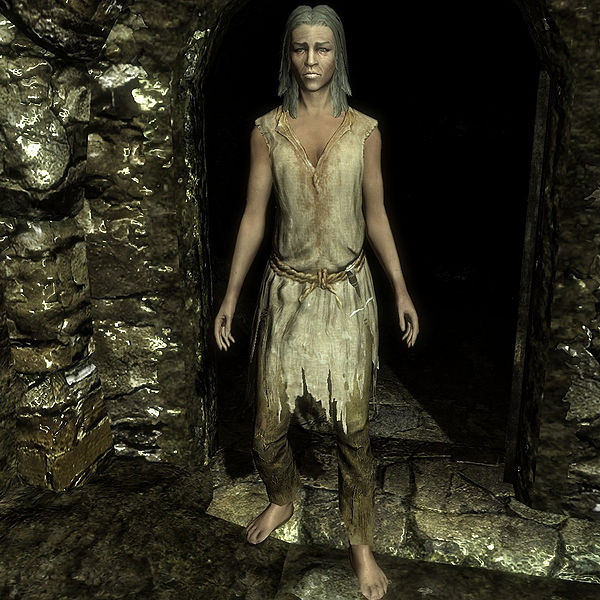
I found that the warrens were occupied by three madmen other than Esbern: Salvianus, the Imperial Legionnaire whom the Great War drove insane; Knjakr, the Sweeney Todd-like chef; and Hefid the Deaf, a poor beggar woman who mutters a kind of OCD litany. Salvianus, while clearly insane, was a gentle soul who only wanted to try to explain the hopelessness he felt, so I listened to him as long as I could before moving on. Knjakr attacked me the moment I tried to speak with him, so I had to kill him in self-defense. Hefid, however, presented me with an unexpected challenge.
When I interrupted Hefid's incessant listing of common objects, she completely freaked out, drew a dagger, and ran away from me. I would have been happy to let her go, but for one problem: she ran straight to Esbern's door and continued to brandish her weapon no matter what I did. When I tried to talk, she didn't respond, preferring instead to throw herself at the heavily bolted door to Esbern's room.
I now had a real dilemma on my hands. Opening Esbern's door (assuming I could do so), would send an armed madwoman into the deadbolted cell of a paranoid ex-Blade. At best, he kills her, and probably attacks me as an accomplice. At worst, she kills him, and the last remaining hope to defeat Alduin is gone. Because I could not think of a scenario which didn't end with her death, I decided to kill her as quickly and mercifully as possible.
After gaining Esbern's trust and hearing his tale, we set out to find Delphine. We didn't take two steps outside his door before we were set upon by more Thalmor agents. We killed them, but poor Salvianus got caught in the crossfire -- his worst nightmare finally coming true. I paid my respects, then escorted Esbern back to Riverwood.
I don't feel good about killing Hefid, but once I had spoken to her, I don't see how I could have avoided it. A quick FUS might have pushed her aside, but would probably also have provoked her to attack me. Furthermore, even if she had survived the initial encounter, what would have happened during the fight with the Thalmor? And, if I'm being completely honest here, what kind of life did she have, tormented by her obsessive list in her dank, dark cell? Might she be better off dead?
After Unbound, the next several quests in the main questline (Before the Storm, Bleak Falls Barrow, Dragon Rising, The Way of the Voice, The Horn of Jurgen Windcaller, and A Blade in the Dark) may be challenging, but are, for the most part, morally simple. Diplomatic Immunity, however, presents a few situations that demand real moral agency from the player.
By the time this quest was opened, I had visited the Greybeards and learned how to use the Thu'um (Dreagon Shout), I had demonstrated to Delphine (the barmaid at the Sleeping Giant Inn in Riverwood who, as it turned out, was a member of the Blades, the now-defunct band of elite warriors that had been decimated by the Aldmeri Dominion) that I was indeed Dragonborn, and I had begun to unravel the mystery surrounding the return of the dragons. To that end, Delphine suggested that I should infiltrate the Thalmor Embassy near Solitude in order to find some secret documents that might shed some light on the crisis.
The plan was for me to use a forged invitation to attend one of the Thalmor Ambassador's parties, then slip away to find the documents in question. I met with Malborn, Delphine's Bosmer "inside man," who promised to smuggle my gear inside (I would be searched before entering the party) and to allow me to sneak out of the party and into the Embassy offices. All went according to plan; I met Ambassador Elenwen, conversed with a few guests...
Confirmation that the Thalmor are trying to influence Skyrim's internal politics.
Confirmation that the Thalmor are just biding their time.
...then noticed Malborn serving drinks at the bar. He said that as soon as everyone was distracted, he would let me in through the kitchen. I convinced one of the guests, a pleasant drunkard named Razelan, to create a diversion, and Malborn guided me behind the bar and to my stashed equipment as promised. It was at this point that things became interesting from a moral perspective.
Once inside the Embassy's offices, I wanted to rely on stealth to avoid contact with the Thalmor guards. While I had no moral compunctions about killing them (especially after the things I learned while engaging in "small talk" with the party guests), I thought it best to avoid causing an incident. Unfortunately, I didn't get far before I found myself in pitched battle with several Thalmor soldiers. Nevertheless, I made my way to Elenwen's private residence, found some of the documents, then proceeded downstairs into an interrogation chamber to find the remaining document. Once in the interrogation chamber, I killed the Thalmor Interrogator and his guard, then freed the prisoner they were torturing. When I found the remaining dossier, two more guards entered, Malborn in tow; apparently, his cover had been blown and he was under arrest.
Malborn risked his life for this mission; while I was aware that not all Bosmer supported the Aldmeri Dominion, I had no idea that some were actually willing to undermine it. Even if Malborn was no longer essential to the mission, I owed it to him to take out the guards and lead him to safety. Afterwards, Malborn, the prisoner (Etienne Rarnis, a thief with possible connections to the Blades), and I escaped through an underground passage, where I once again had to save Malborn, this time from a troll lying in wait.
The moral dimension of this quest is twofold. First, I have drawn some very clear lines about who deserves death and who deserves redemption. I already hated the smug fascist racism of the Thalmor, but the dossiers I recovered proved that my suspicions were right: although the Thalmor were as perplexed by the dragons as we were, they considered Ulfric Stormcloak an "asset" to be exploited for their own ends, encouraging the Nords to spill their own blood in preparation for a renewed offensive against a weakened Empire. Secondly, while I could have left Malborn and Etienne behind, and it probably would have been easier for me to do so, I felt obligated to save both of them. Malborn in particular weighed heavily on me because as a Bosmer (and therefore a claimant to the Aldmeri Dominion) he was throwing everything away in order to save the Empire. Furthermore, the memory of my fatal conflict with Faendal made me especially sensitive to my treatment of his brethren.
Epilogue:
Later, after completing a few more quests, I decided to return to the Embassy to loot the bodies of the Thalmor I was too encumbered to loot the first time. I had to kill a few more Thalmor outside the Embassy (the checkpoint I passed through as a "party guest"), but once I got inside, I found the place deserted. I snooped around and found Elenwen all by herself; I suppose she never bothered to replace the soldiers I killed. I considered klling her right then and there, but thought she might be important later.