Please read this first.

Welcome! This blog is devoted to considerations of morality in the The Elder Scrolls V: Skyrim by Bethesda. Rather than a fansite, review, or walkthrough, it is a serious attempt to examine the game through a moral lens. Please note that the purpose of this blog is to discuss morality within the context of the game, not to determine whether playing the game is immoral in and of itself; the latter type of "discussion" tends toward tedium and inhibits, rather than promotes, a meaningful conversation.

If you have not visited this blog before, it might be helpful to read the posts labeled "Orientation," most of which are the first few entries in the blog archive (see right). These posts include a short introduction to this project, a content-specific author bio, and a few other pieces that explain key concepts relevant to this study. These posts are of particular use to those readers less familiar with Skyrim (or video games in general).

PLEASE NOTE: HERE BE SPOILERS!

If you have visited this blog before, thanks and welcome back!
Showing posts with label Esbern. Show all posts

Sunday, July 7, 2013

Paarthurnax

As I pointed out in my Diplomatic Immunity post, the main quest of Skyrim does not offer a high number of moral dilemmas.  Even if I were to accept the Greybeards' theory that Alduin's attacks presage the just and inevitable end of this world in preparation for the new world to come, my role as Dovahkiin draws me just as inexorably to a confrontation with the World Eater.  Therefore, despite the high drama and plot tension extant in the main quest, there are only a handful of opportunities for true moral agency.  The quest entitled Paarthurnax presents the fourth and final scripted moral dilemma.

After discovering Sky Haven Temple, Delphine tasked me with helping her to rebuild the Blades.  I was to recruit three warriors whom I thought would be well-suited to the task of hunting dragons and, perhaps eventually, protecting a Dragonborn Emperor.  I chose three followers whom I knew from experience could handle the job: Uthgerd the Unbroken and Lydia (my housecarl at Breezehome) had demonstrated impressive skills in Heavy Armor, One- and Two-Handed Combat, Blocking, and Archery, so they were natural choices; I also selected Brelyna Maryon from the College of Winterhold, whose formidable Conjuration and Destruction talents allowed me to round out a small army of dragon hunters that could bring both melee and ranged attacks into any situation.  Having bolstered the ranks of the Blades to Delphine's satisfaction, we went out on a few successful dragon raids without incident.  I then returned to the main quest, which took me back to High Hrothgar to finally meet Paarthurnax, the leader of the Greybeards... 

[SPECIAL NOTE TO THE READER: While I have clearly indicated in the banner of this blog that spoilers abound, this particular post contains what is arguably the biggest spoiler in the game.  Of course, the game has been out for almost two years now, so anyone reading this blog is probably already aware of the plot twist, but one never knows.]

...who is a dragon!  The animosity between the Blades and the Greybeards now makes sense.  The Blades see dragons merely as a threat to be vanquished, while the Greybeards see them as powerful, near-divine beings, capable of both profound good and cataclysmic evil.

My conversation with Paarthurnax was without a doubt one of the most enlightening in the entire game.  I learned not only about the history of the Dragon War, but also about the conflict at the core of dragonkind: the will to power.  According to Paarthurnax, it is in the nature of dragons to seek power, regardless of mortal notions of morality. He explains his own centuries of peaceful meditation as a constant struggle against his deepest instincts.  For a full appreciation of Paarthurnax's story, I recommend the reader invest some time (about 20 minutes) watching the clip below from another player's YouTube video:


In my next post, I will delve more deeply into the Nietzschean/Hegelian conflict at the core of the Alduin/Dovahkiin battle, but for now, I am limiting myself to the events that occur immediately after this encounter with the "good" dragon.

Aside from teaching me how to use my Shout more effectively, Paarthurnax pointed me in the direction of the Elder Scroll that would enable me to go back in time and learn the Dragonrend Shout that defeated Alduin ages ago.  After finding the Scroll, I returned to Paarthurnax, unfurled the Scroll, saw how a trio of my ancestors banished Alduin from their era, and learned the Shout; this action broadcast my location to Alduin, who showed up to kill me before I could have a chance to defeat him.  Paarthurnax, despite his nature and his previous allegiance to Alduin, battled the World-Eater in the air while I attempted to use Dragonrend to ground him.  Although we did not kill Alduin this time, we managed to drive him into hiding.  Paarthurnax recommended that I find and interrogate one of Alduin's minions in order to learn where he fled -- no easy task.  My next move was to report to Esbern to ask for some advice.

Esbern was more than happy to offer his insights on capturing a dragon, but then he presented me with a new problem; citing his oath as a Blade, he demanded that I kill Paarthurnax, and refused to provide any more assistance to me until I did so.  Delphine seconded his ultimatum, and cut me off from the further services of the Blades.  Once again, I would have to choose sides in a conflict when I'd really rather not.

Actually, Esbern and Delphine express slightly different reasons for demanding the dragon's death.  Esbern points out that, during the first dragon crisis, Paarthurnax was one of Alduin’s lieutenants during the first dragon crisis, and was personally responsible for a whole host of atrocities against man.  The fact he eventually turned on Alduin and helped to defeat him both now and in the past is utterly irrelevant to Esbern; the old dragon must pay for his crimes.  Delphine agreed, but added that Paarthurnax’s betrayal of Alduin indicates a dangerous disloyalty which could turn against me at some point; after all, if he was willing to turn on one of his own, how much more likely that he would turn on a mortal ally?


Of the two objections, Delphine’s was the easier to counter.  By my figuring, there are only two scenarios in which her fears could come true.  Perhaps, at some point in the future, Paarthurnax’s loyalty shifts again, and he decides he was wrong to help me in the first place – or maybe he never really turned on Alduin and was just waiting for his master to return in order to draw the Dovahkiin out.  Should that happen, I am confident that I could dispatch him without too much risk.  The second and more troubling scenario is that Paarthurnax is actually looking to supplant Alduin, and is using me to do it.  What if Paarthurnax helped the original Tongues as a means of getting his superior out of the way?  When they succeeded in sending him into the future (but not destroying him), Paarthurnax decided to wait patiently for Alduin’s return, then teach the Dovahkiin how to destroy him, only to turn on the Dragonborn once Alduin was out of the way.  The problem with this second scenario is that, in order to believe that he could defeat the man who killed Alduin the World-Eater (a dragon he himself dared not attack directly), Paarthurnax would have to be both desperate and foolish, and I doubt he is either.

Esbern’s argument, on the other hand, gave me real pause.  The central question is whether Paarthurnax’s current assistance mitigates his past crimes.  In each encounter with an NPC who has done wrong, I have relied on the presence or absence of remorse as my barometer. To be more specific, I look for remorse in the form of action rather than words.  Sinding said he regretted killing the little girl, but he was unwilling to face justice, so I killed him.  Erandur rejected the Daedric Prince Vermina whom he once served, became a priest of Mara, and risked life and limb to save Dawnstar from its nightmares, so I chose to help him and refused to kill him when Vermina commanded me to do so.  Paarthurnax, as far as I can tell, is more like the latter than the former.  He betrayed Alduin at great personal risk, then devoted the rest of his long existence to helping the Nords master the Way of the Voice.  Furthermore, everyone affected by his previous actions is long dead, so there seems to be little point in retribution.  I fully appreciate the magnitude of his crimes, but to kill him at this point seems unjust. 

Another point to consider: even though they began as an elite squad of dragon-hunters, the Blades served the Emperor as a personal guard, before the Thalmor eliminated them.  I cannot help but be a little put off by the fact that they now refuse to help me unless I follow their commands.  I don’t normally pull rank, but to be fair, I am Dovahkiin.  If anything, the Blades should trust me and follow my commands, not the other way around.  One might argue that the Greybeards would have the similar reaction if I did kill Paarthurnax, but then they never swore an oath to protect me, did they?

Even taking Paarthurnax's crimes into account, I cannot bring myself to kill him.  I may come to regret this decision for a number of reasons, but I believe it would be base ingratitude to kill the dragon who risked his own life to save ours.

Friday, June 28, 2013

A Cornered Rat

About halfway through the Thieves Guild questline, I returned to the main quest, now armed with the knowledge of Esbern's whereabouts.  I began my search of the Ratway by dispatching the Thalmor agents who were also looking for the elderly Blade loremaster.  I carefully advanced through the vaults and into the warrens, taking out a few thugs here and there.  I ran into nothing of moral significance until I reached the heart of the warrens, and as I review the events that unfolded there, I'm sure that the dilemma I faced was in no way scripted by the game.

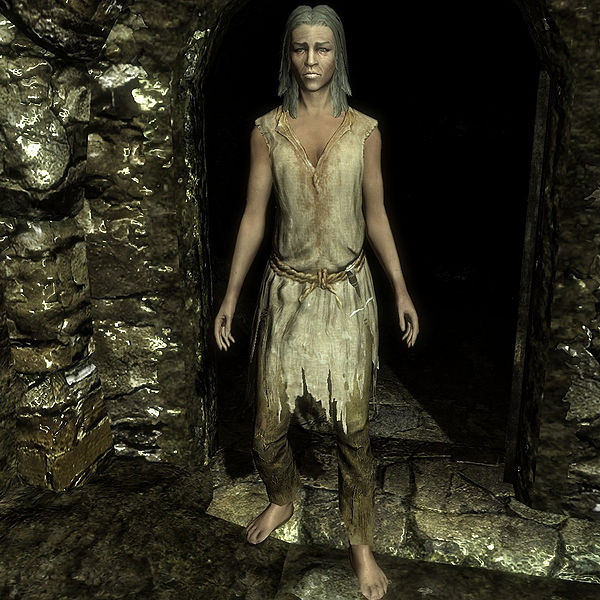
I found that the warrens were occupied by three madmen other than Esbern: Salvianus, the Imperial Legionnaire whom the Great War drove insane; Knjakr, the Sweeney Todd-like chef; and Hefid the Deaf, a poor beggar woman who mutters a kind of OCD litany.  Salvianus, while clearly insane, was a gentle soul who only wanted to try to explain the hopelessness he felt, so I listened to him as long as I could before moving on.  Knjakr attacked me the moment I tried to speak with him, so I had to kill him in self-defense.  Hefid, however, presented me with an unexpected challenge.

When I interrupted Hefid's incessant listing of common objects, she completely freaked out, drew a dagger, and ran away from me.  I would have been happy to let her go, but for one problem: she ran straight to Esbern's door and continued to brandish her weapon no matter what I did.  When I tried to talk, she didn't respond, preferring instead to throw herself at the heavily bolted door to Esbern's room.

I now had a real dilemma on my hands.  Opening Esbern's door (assuming I could do so), would send an armed madwoman into the deadbolted cell of a paranoid ex-Blade.  At best, he kills her, and probably attacks me as an accomplice.  At worst, she kills him, and the last remaining hope to defeat Alduin is gone.  Because I could not think of a scenario which didn't end with her death, I decided to kill her as quickly and mercifully as possible.

After gaining Esbern's trust and hearing his tale, we set out to find Delphine.  We didn't take two steps outside his door before we were set upon by more Thalmor agents.  We killed them, but poor Salvianus got caught in the crossfire -- his worst nightmare finally coming true.  I paid my respects, then escorted Esbern back to Riverwood.

I don't feel good about killing Hefid, but once I had spoken to her, I don't see how I could have avoided it.  A quick FUS might have pushed her aside, but would probably also have provoked her to attack me.  Furthermore, even if she had survived the initial encounter, what would have happened during the fight with the Thalmor?  And, if I'm being completely honest here, what kind of life did she have, tormented by her obsessive list in her dank, dark cell?  Might she be better off dead?
"Knife. Yes. Book. Yes. Bucket. Yes. Inkpot? No."  R.I.P. Hefid the Deaf


Saturday, February 23, 2013

Thieves’ Guild (Taking Care of Business)


After my impressive display of thieving skills in the marketplace, Brynjolf invited me to the Ragged Flagon, the Guild’s hangout underneath the city.  There, he finally gave me all of the information I was looking for; he directed me to where Esbern was hiding and he introduced me to Vex, the Guild member who knew about the Stones of Berenziah.  Eager to advance my progress in the main quest, I spoke to Vex quickly, then set about finding Esbern deep in the Ratways under Riften.  I will detail that adventure in another post.  For now, it is enough to note the delay itself; as I pointed out earlier, my ambivalence led me to postpone the next quest in the Thieves’ Guild line until I finally concluded that leading this third crucial faction was necessary.
In order to become I full-fledged member of the Guild, I would have to complete several jobs, the first of which was to collect three debts from local business owners.  Brynjolf made it clear that he preferred non-violent methods (my first hint that there was more to the Guild than crime), but that I was free to do whatever was necessary.   

The biggest hurdle for me here was the nature of the debts.  If the Guild was shaking down local shopkeepers for protection money, then I really couldn’t justify collecting the “debts.”  If, on the other hand, these were voluntary loans (albeit to a loan shark), I could probably manage to collect the money in a morally palatable way.  Unfortunately, the game provides little clarification on this issue.  Like most of the citizens of Riften, all three business owners seem a little on the shady side.  On the other hand, their complaints about the Guild could be read as an indicator of extortion.  I decided to give Brynjolf the benefit of the doubt.

The first debt I collected came from Keevara, the Argonian innkeeper.  In my pre-Guild procrastination, I had helped her boyfriend, Talen-Jei, assemble an engagement ring, so I felt bad about having to lean on her.  Still, Keevara is not a very pleasant woman, and I had a sure-fire, non-violent method to get the money.  Talen-Jei had told me how worried she was about her family, who lived on a farm just beyond the Morrowind border.  As soon as I mentioned them to her, she handed over the money right away.  I suppose that what I did was technically a threat, but I never went beyond implying that I knew of her family’s whereabouts nor did I have any intention of doing anything to these people, so I think I remained in the grey on this one.  She fulfilled her obligation without anyone being harmed in any way.  I must admit, however, that Talen-Jei’s habit of alternately thanking me for helping me with the ring, then berating me for what I did to Keevara is rather distressing.

The second debt was easier on my conscience.  Bersi Honey-Hand, the owner of the Pawned Prawn, caved as soon as I destroyed his prized Dwemer urn.  I have a much higher tolerance for destruction of property than I do for other kinds of violence; things are merely things and can be replaced, and if this thing was so important, I would think that Bersi would have stopped me well before I destroyed it.  I threatened to break it, then I hit it several times, thus giving him every opportunity to pay up before I shattered it.  

The final debt was easier still.  Haelga, owner of Haelga’s Bunkhouse, is pretty clearly a madam and/or a prostitute, and, as I found out by talking to some of the girls in her employ (including her niece!), not a very nice one at that.  Threatening to drop her statue of Dibella down a well was all it took to get her to cough up the money.  Given Haelga's profession and disposition, I had no qualms about collecting from her.

In case you missed the "pretty clearly a madam and/or a prostitute" part.
Without a doubt, my behavior in this quest was the most "grey" it has been so far in this playthrough.  While I had certainly done some questionable and even some bad things, this quest presented a very murky picture for me.  Unlike previous quests in which I had to decide whether or whom to kill, this quest asked whether I would commit nonviolent acts of a potentially criminal nature against people with whom I had no real quarrel.  Were it not for my desire to join the Thieves' Guild, I doubt that I would have engaged in these actions.  While I could dismiss Riften as a "wretched hive of scum and villainy" (with apologies to Star Wars fans everywhere), I feared that I might have to commit more serious crimes in places that I actually loved, such as Whiterun.

Not surprisingly, the next few quests pushed my boundaries a little further.


Monday, February 4, 2013

The Thieves' Guild (A Chance Arrangement)


For the moral agent, the Thieves’ Guild questline provides a veritable minefield of ethical problems.  I almost did not join the Guild for precisely that reason, but as I revealed in a previous post, I thought that joining was necessary for completing the main quest and that the Dragonborn should tie together as many factions as possible; while I was mistaken about the first point, I still stand firmly by the second.

Joining the Thieves’ Guild involved going to Riften – a town so rife with corruption that the first guard I met tried (unsuccessfully) to shake me down before I even passed the gates.  Once inside, I met a proud warrior name Mjoll the Lioness who lamented the dissolute influence of the Guild on the town, and vowed to bring the thieves to justice.  Eventually, I asked the right person the right question, and learned where I could find Brynjolf -- a friendly, high-ranking thief who could lead me to Esbern (the former Blade who would help me defeat Alduin) and who could provide the information I needed in order to solve the mystery of the Stones of Barenziah I kept finding all across Skyrim.   Brynjolf’s help, however, came at a price: I needed to help him frame a Dunmer merchant named Brand-Shei who had been making trouble for the Guild – the same Dunmer merchant whom I had helped with a personal matter just the other day.

The task was designed to not only eliminate a potential threat, but also to test my Sneak, Lockpicking, and Pickpocket skills.  While Brynjolf distracted the shoppers in the marketplace, I was to break into a jeweler’s strong box, steal a necklace, then plant the necklace on Brand-Shei – all in broad daylight.  When I completed the task, the town guard arrested Brand-Shei and Brynjolf gave me the information I needed, and then invited me to join the Guild.

The moral ramifications here are obvious.  I committed a crime and sent an innocent man – one whom I had befriended earlier – to jail. What follows is a list of rationalizations:
  1. I (mistakenly) believed that I needed to join the Guild in order to complete the main quest.
  2. I (mistakenly) believed that I needed to complete the crime successfully in order to join the Guild.
  3. I figured that Brand-Shei would eventually be found innocent or simply allowed to serve a short sentence and be released.  I was wrong, but this appears to be a bug; he is scripted to leave the jail after 10 days, but he has not left to date (several in-game weeks later).
  4. I figured that, if the above turned about to be incorrect, I could break him out of jail.  Wrong again; even when I open the door, he won’t leave.
Sorry, dude.
All four rationalizations are troubling. The first is a purely utilitarian argument: sacrificing one man’s freedom for the greater good.  The second points to a desire to please that trumps conscience: assuming that Brynjolf would reject me if I didn’t succeed.  The third softens the first: Brand-Shei would only suffer a minor inconvenience relative to the greater good.  The fourth suggests that I would be willing to break another law in order to “undo” a previous crime.  The most galling aspect of the whole affair is that all four rationalizations were based on faulty information.  I other words, if I had paid attention better, I could have avoided the Guild entirely, and if I had chosen to fail Brynjolf’s task (as I had already done in several Daedric quests), I could have joined the Guild without framing poor old Brand-Shei.

Not surprisingly, the next few quests further complicated matters.

Thursday, December 27, 2012

Dovahkiin Leadership Models: The Unifier


After I had been playing Skyrim for about six months, I began to notice a pattern in the major questlines.  I began the Civil War line as a recruit, but finished as a Legate in the Imperial Legion. I began the Companions line as a "whelp," but finished as the Harbinger. I began the College of Winterhold line as a student, but finished as the Arch-Mage.  By completing each questline, I became the leader of the relevant faction. Even though my suspension of disbelief is sufficient to allow for dragons and magic, I was having a hard time understanding how I, a stranger in Skyrim just a few short months ago, could be rising to leadership roles within all of the major factions in the province. Each of the people I had replaced had spent years climbing to his position, and each of them held only one position, but I had garnered three in less than an in-game year. Furthermore, I could not help but notice that leading one group did not preclude membership in others. I therefore began to look for meaning in this strange situation.

When I looked at the Tamriel presented in Skyrim, I found a possible answer.  In the aftermath of the Great War, the Emperor's hold on Tamriel was slipping. Having abandoned Hammerfell and narrowly surviving an uprising in Skyrim (thanks, in no small part, to Yours Truly), the Septim dynasty was reeling.  The current Emperor seemed to have little of the qualities that defined the progenitor of the Third Empire, Tiber Septim.  When I reflected that Tiber Septim had himself mastered the Thu'um as I had, I realized that there was a distinct possibility that the Dovahkiin was destined to be the next Emperor.

Further support for this hypothesis comes from the aforementioned amassing of diverse leadership roles. The current Emperor had seen his Empire not only assaulted from the outside by the Aldmeri Dominion, but torn apart from the inside by conflicts between among factions and races.  It would make sense for the successor to be a unifier -- one who ended the Civil War, one who leads both warrior and wizard, one who is both a true Nord and a friend to other races.

This realization led me to one of my most difficult decisions in this game: whether to join the Thieves' Guild.  My original intent had been to avoid the Guild entirely; I was trying to play a morally conscious character, and associating with known criminals seemed to run counter to that playstyle. But then I found myself in a quandary. In order to find Esbern (the next step in the main quest), I had to talk to Brynjolf, a member of the Guild. Furthermore, in order to complete No Stone Unturned, I had to speak to Vex, who, according to Thieves’ Guild lookout Maul, would not talk be willing to speak to me unless I were a member of the Guild.  I procrastinated on this decision for a long time, but when I realized the need for a unifying leader in Skyrim (and eventually all of Tamriel), I concluded that I would indeed join the Guild, regardless of my misgivings.

Another factor leading me to Guild membership was the structure of the game itself.  In accordance with its fantasy RPG heritage, The Elder Scrolls develops characters within a triangulation of archetypes: Warrior, Mage, and Rogue.  This triad hearkens back to the pencil-and-dice Advanced Dungeons and Dragons, in which the three main character classes depend primarily on the distribution of six attributes: Fighter (Strength and Constitution), Magic-User (Intelligence and Wisdom), and Thief (Dexterity and Charisma); other classes arise from combinations of these archetypes.  Since AD&D, fantasy games have been dominated to one degree or another by the holy trinity of combat, magic, and stealth, and Skyrim is no exception; even the main skill trees are structured in this three-faceted arrangement.

The three fantasy archetypes have been apotheosized in thecelestial background graphic for the eighteen skill trees available in the game. 
In other words, the game seems to invite the development of a leader who embodies the best of all three archetypes, and the in-game world seems to require a leader who can bring disparate factions together.  Becoming the Master of the Thieves Guild would therefore be (for me, at least) less of an exercise in criminal ambition and more of an attempt to bring together the most powerful forces in Skyrim in preparation for the inevitable fight against the Aldmeri Dominion.