Please read this first.

Welcome! This blog is devoted to considerations of morality in the The Elder Scrolls V: Skyrim by Bethesda. Rather than a fansite, review, or walkthrough, it is a serious attempt to examine the game through a moral lens. Please note that the purpose of this blog is to discuss morality within the context of the game, not to determine whether playing the game is immoral in and of itself; the latter type of "discussion" tends toward tedium and inhibits, rather than promotes, a meaningful conversation.

If you have not visited this blog before, it might be helpful to read the posts labeled "Orientation," most of which are the first few entries in the blog archive (see right). These posts include a short introduction to this project, a content-specific author bio, and a few other pieces that explain key concepts relevant to this study. These posts are of particular use to those readers less familiar with Skyrim (or video games in general).

PLEASE NOTE: HERE BE SPOILERS!

If you have visited this blog before, thanks and welcome back!
Showing posts with label Dragonborn. Show all posts

Saturday, November 16, 2013

Bend Will

During The Fallen, I learned the shout that calls Odahviing, thus allowing me to summon that particular dragon as an ally in battle.  Although the original exchange between the Dovahkiin and Odahviing involves a certain degree of trickery, the Call Dragon shout does not actually subvert the will of the dragon.  Odahviing responds to the call first out of curiosity and hubris, and after Dragonslayer he responds out of respect for the power of the Dovahkiin's superior Thu'um.  In other words, Odahviing's response to Call Dragon is (from a role-playing perspective) voluntary.  
 The Dragonborn DLC adds a wrinkle to the Call Dragon shout with the introduction of the Bend Will shout.  Using Bend Will allows me to force any dragon, hostile or otherwise, not only to fight alongside me, but also to allow me to ride it as my temporary steed.

The use of this shout evokes a minor ethical question: is it morally acceptable to compel an enemy to fight on your side? On the surface, the question might seem frivolous; after all, if killing a dragon is acceptable, why wouldn't bending its will be as well?  This question, however, pits the value of autonomy against the value of life.  In a warrior culture such as Skyrim's, is it more honorable to kill an enemy than to rob him of his will?   Additionally, is it acceptable to force a dragon, even a hostile one, to let you ride him like a horsey?
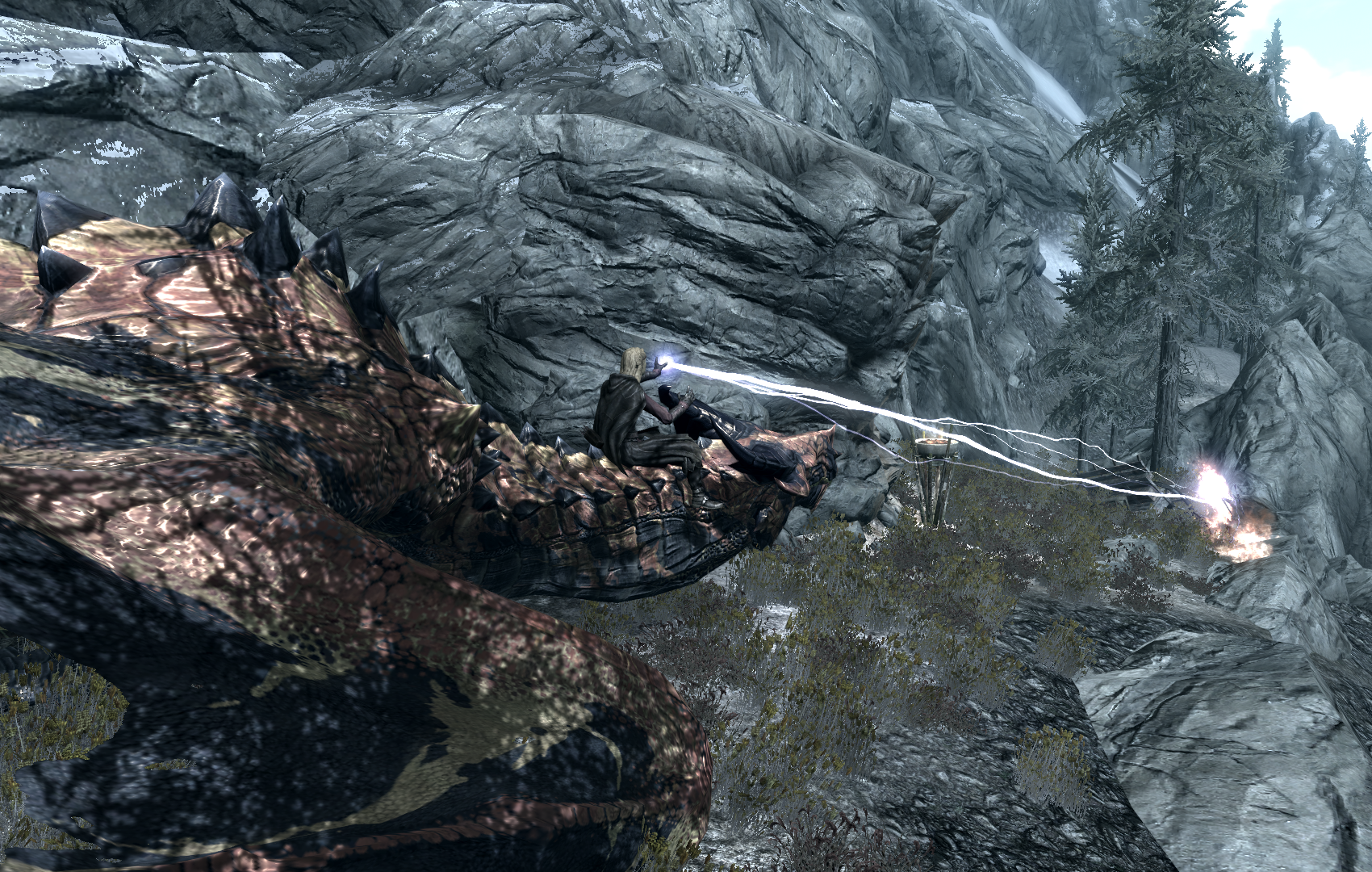
WHEEEE!!!
As it relates to The Fallen, the question is moot; one cannot defeat Alduin without Odahviing's help.  After this quest, however, the question becomes more active because the Dragonborn can use the same shout at will to summon Odahviing, then use Bend Will to ride him.  Odahviing, it seems, volunteers to fight alongside me, but must be forced to act as a steed; one is the act of an ally, the other is that of chattel. Odahviing's ride to Skuldafn is a one-time offer born of his desire to be rid of Alduin, not an open-ended invitation.

Furthermore, the end of the Main Quest reveals that not all of the dragons share Alduin's views; once Alduin is defeated, Paarthurnax promises to teach the pacifist Way of the Voice to all of the dragons he can convince, and in fact, at the Throat of the World, dragons can be seen celebrating the World-Eater's fall.  Therefore, compelling Odahviing or any other non-hostile dragon to fight for me or give me a ride seems unjust.

For Lothar, I decided that the most appropriate route would be to avoid using Bend Will unless absolutely necessary.  As for what constitutes necessity, I offer the following checklist:
  • I will not use Bend Will on Odahviing.
  • I will not use Bend Will on a dragon that is not attacking me or any other "good" NPC.  In other words, I won't interfere if a dragon is battling a giant, a bandit gang, or a cluster of mudcrabs.
  • I will not use Bend Will if a dragon attacks only me while I'm outside of a populated area. In that case, I will simply fight.
  • I will use Bend Will if a dragon attacks a populated area.  I will use Bend Will, mount the dragon, then fly to a remote location.  If, after I release the dragon, he simply flies off, then so be it.  If he continues to be hostile, then I will fight him.
This arrangement allows me to use Bend Will as a means to save lives, rather than a way to dominate my enemy.  After all, riding dragons as steeds was the trademark of Miraak -- not someone I really want to emulate.

Tuesday, November 12, 2013

Thirsk Hall


After dispatching Miraak, I decided to explore Solsthiem more freely and see what else I could do to help Skyrim’s northern neighbor.  It was during one of these quests that I first encountered the Rieklings.  I was helping Glover Mallory retrieve his Bonemold formula when I trespassed into a Riekling cave.  Because I was Sneaking (I was trespassing, after all), they didn’t notice me, so I was able to loot the formula off Esmond Tyne's body and just observe the little creatures.  They did not attack, so without any further intelligence on them, I let them go on with their lives.  I did not encounter them again until I stumbled on to Thirsk Hall.

Thirsk was obviously a Nord-style mead hall, but it had been overrun by Rieklings.  Even though the Riekling Chief was more articulate than his subjects, I still couldn’t get a clear picture of why they were living there instead of the Nords.  Given the Chief’s story and the size of the Rieklings relative to the native Nords, I surmised that the little blue scavengers had stumbled upon an abandoned mead hall and began squatting, which was no crime, as far as I was concerned.  I therefore agreed to help the Chief with his requests.

Pictured: The Riekling State of the Union Address

The Chief’s fetch quests were simple and amusing at first, but then he asked me to help him fight the “bad nords” that wanted Thirsk for themselves.  This favor was a bit much; bringing back a lost boar is one thing, but fighting my fellow Nords?  I needed to investigate.

As I approached Bujold’s Retreat, I expected to find a gang of bandits that I could dispatch handily.  What I found instead was a sorry band of washed-up warriors who had been kicked out of their ancestral hall but the pesky little Rieklings.  After listening to their sob stories, I agreed to help – not out of love for Bujold the Unworthy and her pathetic crew, but out of fury that the Riekling Chief had tricked me so easily.  We retook Thirsk Hall with extreme prejudice.

But the story didn’t end there.  After we cleaned and spruced up the hall, Bujold asked me to be her second at her ritual leadership audience with Hrothmund, the long-dead founder of Thirsk. I agreed, eager to meet another ancient Nord hero.  The trek itself was uneventful, but when we entered into communion with Hrothmund, it became clear that Bujold’s incompetence had cost her his blessing. 


A Nord Excalibur?

Given Bujold’s track record, I should have seen the next step coming.  She wanted me to lie, to say that she had received the blessing after all, or at least to say nothing.  I refused; I wasn’t going to spit in the face of a Nord legend on behalf of a lazy coward.  Not satisfied with my response, she foolishly attacked me, and I killed her.

When I returned to Thirsk Hall, I was given the option of lying to Bujold’s husband Kuvar, and I have to admit that I was tempted.  Aside from marrying this disappointment, he had done nothing wrong, so I wanted to do right by him.  I was afraid that telling him that she got lost would not only give him false hope, but might also prompt him to go on a dangerous and pointless search.  Instead, I told the hard truth; he accepted it grimly, but warned me to stay far away from him.  After what he’d been through, I agreed to honor his request.

With the Thirsk chapter closed, I turned my attention to the Rieklings.  Never before had my feeling changed so radically about a faction or race.  Prior to Thirsk, I looked at them in what I guess could best be called a patronizing manner.  In a world in which every sentient being speaks a common language, I took their inarticulate babbling as an indicator of low intelligence.  In a world in which every sentient race has its own distinct culture, I took their scavenging and appropriation as an absence of culture.  They were amusing and no more dangerous than bears, horkers, spriggans, or any other creatures that just wanted to be left alone.

After Thrisk, I found that my condescension had soured into contempt.  If I was disconcerted by the possibility that I might have been manipulated by powerful, immortal beings in previous quests, I was enraged that I definitely had been played by a bunch of cartoonish gremlins in this one.  Later, during other quests on Solsthiem, I found myself indefensibly vicious in fighting any Rieklings I encountered.  While my brutality could be rationalized to a degree – it was now clear, after all, that they operated more like bandits and less like scavengers – I have to admit that I executed all subsequent Riekling raids with a little more prejudice than I can honestly justify.

Most of all, I am troubled by the role of language in my approach to the Rieklings.  In stark counterpoint to my dealings with the Forsworn, in which Madanach’s eloquence persuaded me to see them less as “wild men” and more as disenfranchised outsiders who had been radicalized by Ulfric Stormcloak’s brutal quelling of their rebellion, my encounters with the Rieklings were heavily influenced by the lack of discernable communication.  In my life outside of the game I am an English teacher and a father and a special needs soccer coach, so I know full well that language is only one of many indicators of intelligence and sophistication.  And yet, inside the game, I treat the “funny-looking little people who talk weird” first with patronizing humor, then with deadly contempt.  I’m not entirely certain I want to know what’s at work here.

Sunday, November 10, 2013

Dragonborn: Main Quest


As it was with Dawnguard, so it was with Dragonborn.  While I really enjoyed the main questline, I encountered very few moral dilemmas to speak of.  This is not to say, however, that this DLC lacked a moral dimension; some of the side quests presented tough ethical quandaries, and the titular questline itself invited a kind of meditation on the moral dangers that accompany the title of Dovahkiin.

In a previous post, I noted that the “bosses” of each title’s main questline represents a kind of Nietzschean nightmare – a superior being who uses his power to enslave others.  Miraak’s iteration of this antagonist type is particularly compelling because he embodies the shadow self of the player’s Dovahkiin (regardless of the player’s actual alignment – more on that later).  Whereas Alduin and Harkon represent species who are more or less “other” (dragon and ancient vampire, respectively), Miraak is the dark mirror of the protagonist; he is what the PC might become.

This unique connection between Miraak and the Dovahkiin is foreshadowed in the words of the Greybeards:

...young Grasshopper...er, Padawan?
The player is here admonished to not allow the attendant power of one’s Dragonborn status to become a stumbling block.  While the Greybeards certainly intend this warning to be an inducement to follow their own, aloof (read: neutral) path, the moral agent who plays a “good” character is going to hear this as a version of Uncle Ben’s “power and responsibility” speech, and the one who plays an “evil” character is probably going to ignore the hoary warning and do as he pleases.

Once Miraak is introduced, however, the Greybeards’ caveat takes on new life. Miraak acts as an object lesson: a Dragonborn who sought to use his Thu’um solely for the increase of his own power, was punished for it before, and will be punished for it again.  Even for an “evil” character, Miraak provides a cautionary tale; in his bid for ultimate power, he was out-maneuvered by Hermaeus Mora, so a self-serving Dovahkiin might see Miraak not only as a rival but also as warning against relying too much on the promises of Daedric Princes.  For a “good” Dovahkiin, however, the picture is a bit more disturbing.

As I have said before, Lothar is not a paladin, but I have attempted to keep him in the good sector of the alignment chart.  While I have certainly missed the mark on occasion, I feel as though I have mostly kept him on the Aragorn side of the equation.  One area I have struggled with, as regular readers might note, is the Daedric quest.  More often than not, I allowed Lothar to do some dark things at the behest of a Daedra in order to obtain powerful artifacts.  At the core of my logic in most of these cases was that Skyrim (and all of Tamriel, for that matter) would be better off if I controlled these items; not only would I use them to vanquish evil, but the items themselves would be far less likely to fall into the wrong hands.  Even beyond the Daedric quests, I sometimes rationalized Lothar’s more treacherous and brutal actions in the name of bringing peace and justice to Skyrim.  What is it, therefore, that separates Lothar from Miraak? 

The obvious answer, of course, is “noble intentions,” but is that enough to maintain the wall between hero and villain?  In both literature and history, we are often presented with despots who originally wanted to free their people, leaders who turned their loyal followers into slaves, and crusaders who unwittingly devolved into thugs. 

Is the Dovahkiin’s final showdown with a version of himself?  Perhaps this is the reason we are not permitted to peer under Miraak’s mask – we would find only a mirror.