Please read this first.

Welcome! This blog is devoted to considerations of morality in the The Elder Scrolls V: Skyrim by Bethesda. Rather than a fansite, review, or walkthrough, it is a serious attempt to examine the game through a moral lens. Please note that the purpose of this blog is to discuss morality within the context of the game, not to determine whether playing the game is immoral in and of itself; the latter type of "discussion" tends toward tedium and inhibits, rather than promotes, a meaningful conversation.

If you have not visited this blog before, it might be helpful to read the posts labeled "Orientation," most of which are the first few entries in the blog archive (see right). These posts include a short introduction to this project, a content-specific author bio, and a few other pieces that explain key concepts relevant to this study. These posts are of particular use to those readers less familiar with Skyrim (or video games in general).

PLEASE NOTE: HERE BE SPOILERS!

If you have visited this blog before, thanks and welcome back!
Showing posts with label Riften. Show all posts

Saturday, August 3, 2013

The Dark Brotherhood


NOTE: As I have pointed out a number of times, my writing is far behind my playing – a fact that I present at the beginning of this post by way of disclaimer.  I know that many readers will most likely be put off by my handling of the Dark Brotherhood questline, and will protest that by choosing to destroy the Dark Brotherhood, I missed out on one of the most well-written questlines in the game.  Please rest assured that I actually did play through the DB line with a different character -- one that I created a couple of months ago as a counterpoint to Lothar.  I'll detail her moral profile in later posts, but for now, please rest assured that I have not missed out on this fascinating and dramatic series of quests.

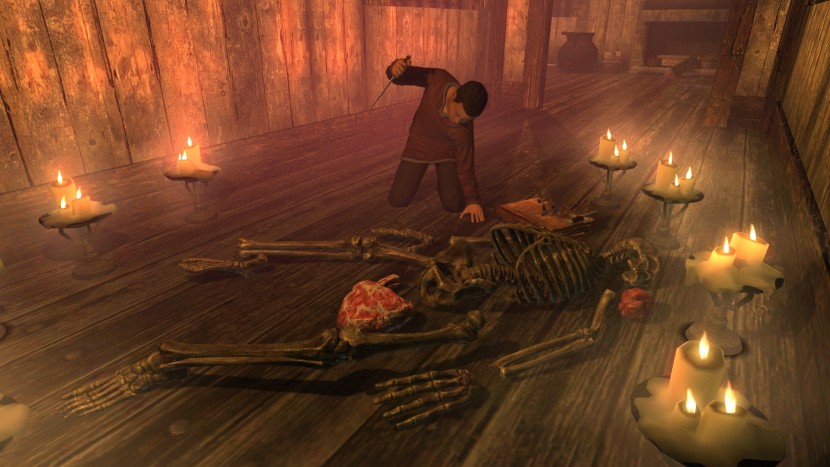
After I became a Nightingale and completed the Thieves' Guild questline, I turned my attention to the quest I had been dreading: Innocence Lost. I had heard about Aventus Aretino during my early days in Riverwood, but didn't visit him until I traveled to Windhelm during the Civil War questline.  When I entered the house, I was treated to the most disturbing scene I had witnessed since Helgen: a young boy performing the Black Sacrament:
I don't want to think about how he got that stuff.

Mistaking me for the assassin he was praying for (perhaps because i was still wearing my Krosis mask), Aventus begged me to kill the headmistress of Riften's Honorhall Orphanage, Grelod the Kind.  He related the tragic tale of his mother's death, Jarl Ulfric's decision to send him away, and his subsequent abuse at the hand of Grelod.  When I protested that I was in no way an assassin, Aventus completely ignored my objections and sent me on my way.

Not surprisingly, I procrastinated for a long time before actually visiting Honorhall.  The first dilemma was whether to believe Aventus.  The child is clearly traumatized, but what if he is projecting his grief over his mother's death onto Grelod?  If Aventus' story is not entirely accurate, then killing Grelod would clearly be murder.  On the other hand, I'm not sure I want to run the risk of not believing a child who says that he is being abused.  But even if Grelod is as bad as the boy says and I decide to kill her, I would be tacitly granting approval to a child ordering a hit.  After much deliberation, I decided to find out the real story for myself.

The first time I entered the orphanage, I was treated to a scene straight out of Annie:
"We love you, Miss Hannigan!"

Ok, so the headmistress really is an awful old crone, but I still don't see anything that would warrant...
...oh...well,uh...never mind.
So, Aventus was, in fact, telling the terrible truth.  Given my response to the mistreatment of children in Laid to Rest and Ill Met by Moonlight, it should come as no surprise that I resolved to kill Grelod.  Not wanting to traumatize the kids any further, I decided to sneak in after everyone was in bed.  It was an easy kill, but a few things bothered me about it in the immediate aftermath:
  • As I said before, I was really uncomfortable legitimizing Aventus' use of the Black Sacrament.
  • When the kids discovered Grelod's body, they were overjoyed.  Understandable, I suppose, but pretty sick.
  • Constance Michel became hysterical.  I had no intention of causing her grief, but she really took Grelod's death hard.
The deed done, I returned to Windhelm to report the news to Aventus.  As I feared, he took the incident as affirmation that assassination was a perfectly legitimate way to handle a bad situation, even going so far as to express a desire to join the Dark Brotherhood himself when he grows up -- in order to help other children like him!  I was deep in the grey zone now.

Not long after our conversation, I received a note from a courier which contained a black handprint and the cryptic message "We know."  Having received mysterious letters before (from "a friend" and from Delphine), I assumed that its meaning would be made clear soon enough.  I got my answer when I went to bed, only to wake up in an abandoned shack.

With me in the shack was my apparent abductor, Astrid, who was clad in an identity-obscuring set of leather armor.  She informed me that by killing Grelod, I had robbed the Dark Brotherhood of a death that rightly belonged to them, and that the Night Mother (whoever or whatever that was) demanded another death to settle the score.  I now had my choice of three other abductees whom I could kill in order to fulfill my debt.  Despite the fact that they were all bound and hooded, I had the opportunity to interview each of them:
  • Alea Quintus is a housewife and mother who comes off as an utter shrew.  She has no idea why she's there, but her combative and insulting demeanor suggests that she may have irked the wrong person at some point.
  • Fultheim the Fearless is a mercenary, and is well aware that his profession may have led him to this predicament.  He vacillates between abject begging and stammering rationalization -- "war is war, right?"
  • Vasha is a Khajiit scoundrel who has been "bagged and dragged" before.  He admits to all sorts of shady activities, and smirkingly attempts to bargain his way out his captivity -- sometimes even employing vague threats about what "his people" might do to me in return.
I was now faced with a multilayered dilemma.  The first question was whether I was going to kill someone at the behest of the Dark Brotherhood.  Aside from the fact that I had been attacked by one of their number early in my travels through Whiterun Hold, I had no desire to do the bidding of a bunch of contract killers.  The Thieves' Guild might technically be a criminal organization, but at least they restricted themselves to nonviolent crime -- one of the main selling points for some of the ex-bandits in the group.  I had to do some real moral gymnastics to rationalize joining the Guild, but there was no way I could justify joining a clan of assassins-for-hire.  I decided to kill no one and just leave.
So much for that idea.
Once I discovered that I could not leave, I was forced to deal with the second question: whom to kill?  I had no quarrel with any of the captives, so I had to base my decision on their apparent traits.  Alea was insufferable, but simply being a shrieking harpy was not enough to warrant a death sentence. Fultheim, by his own admission, had done some bad things as a mercenary, and so might deserve to die, but killing him like this did not feel right; if he was going to die for crimes committed as a soldier, then he should die as a soldier -- in face-to-face battle, which was not an option here.  Vasha was by far the most likely choice, especially if you interpret his claim of being a "defiler of daughters" in the darkest way possible.  Still, I couldn't shake the idea that Vasha, as a Khajiit, might be attempting to talk his way out of a jam by exaggerating his status as a scoundrel -- a sort of refuge in audacity.  After all, I had no proof for any of his claims, which is something I would need if I were going to execute a bound "criminal."
There was, of course, one other person I could kill in order to escape: Astrid.  That choice made the most sense to me; she's part of a murderous criminal organization that had already tried to kill me once, plus she kidnapped three other people and tried to force me to kill one or all of them in order to settle some weird assassin debt.  Of the five people in that shack, Astrid clearly deserved to die.  In fact, as dealt the final blow, she whispered, "Well done."  Even she knew she deserved her end.
After I killed Astrid, freed the prisoners, and escaped the shack, I reported the incident to the first guard I saw, who directed me to Commander Maro of the Penitus Oculatus (the Emperor's personal security force after the downfall of the Blades), currently stationed in Dragon Bridge.  Maro gave me the password to the Dark Brotherhood Sanctuary and tasked me with eliminating the rest of the clan of contract killers.  I gladly accepted.

Compared to the dilemmas I faced in the shack, destroying the Dark Brotherhood was fairly easy.  I decided to give them a taste of their own medicine by sneaking in and assassinating each of the members one by one.  I probably enjoyed killing them more than I should have, but I think I deserved it after what they put me through, to say nothing of the three other people they kidnapped.
As I often do, I perused the wikis after completing this questline and came away feeling even more justified in my actions.  Had I chosen to kill Vasha (my most likely choice), I would have had to kill a number of other innocent people in order to advance -- people like Narfi, the poor, grief-addled beggar of Ivarstead.   Ultimately, I would have had to kill the Emperor himself -- truly an awkward situation for the man who helped win Skyrim for the Empire. Besides, a Dragonborn like me would probably have inspired many more contracts had I let the Brotherhood live.

I also feel the need to point out the fascinating predicament Bethesda puts the player in.  Note that the introductory murder is of someone who clearly deserves to die.  Had the initial victim been, say, one of the people in With Friends Like These..., I doubt I would have even started this quest.

Saturday, February 23, 2013

Thieves' Guild (Loud and Clear/Dampened Spirits)

Because the next two quests in the Thieves' Guild line dealt almost exclusively with shadier characters, it was paradoxically easier to justify my actions.

Loud and Clear

Loud and Clear boils to corporate espionage and sabotage, and the moral profile of my character doesn't really account for these kinds of dealings (see The Rules of Engagement).  Admittedly, destroying the property of a Thieves' Guild/Black-Briar business partner may not be paladin-like, but there are a few other factors to consider beyond the necessity of advancing in the quest line:
  • If done with sufficient stealth, the quest does not demand bloodshed.
  • All of the parties involved are willing participants in ethically questionable dealings rather than innocent victims.
  • Destruction of a business's property is reversible and open to compensation if need be.
One unexpected side benefit of my earlier procrastination was that my Sneak, Pickpocket, and Archery skills were now high enough that I could actually complete the quest without engaging in battle. I entered Aringoth's house undetected, pickpocketed the safe key, stole the bill of sale, and set fire to the prescribed three out of five apiaries (using my fire-enchanted bow from a safe distance) -- all without battling a single mercenary. 


Dampened Spirits

Dampened Spirits continues the plot of the previous quest; Maven Black-Briar, the Don Corleone-esque head of the Black-Briar Meadery, asks the PC to ruin her main competitor: Sabjorn, the owner of Honningbrew Meadery.  She has an inside man (Mallus) who suggests that I poison the batch of mead Sabjorn has reserved for a special tasting he has arranged with an Imperial dignitary.  The moral quandries here were as follows:
  • I didn't know if the poison was lethal.  Given Maven's ties to the Empire, I suspected that the poison was meant to nauseate rather than kill, but I couldn't be sure.
  • I was again helping to ruin another neutral NPC's business.  I should point out, however, that my interactions with Sabjorn prior to poisoning the mead indicate that he is both dishonest and mean, and therefore a more palatable target than the truly neutral Aringoth.
  • The Honningbrew Meadery lies just outside the walls of Whiterun.  As I had feared earlier, I was now engaged in criminal activity right outside the gates of my favorite city.
As in the previous quest, I decided to complete the objectives, despite my misgivings.  Fortunately, I was right about the poison; Commander Caius got sick, but recovered fast enough to arrest Sabjorn on the spot.  The business itself survived with Mallus in charge, but I still felt apprehensive about any further Thieves' Guild involvement in "my" city.

Did I forget to mention that I poisoned an Imperial Commander?


By now, my actions have clearly led me out of Lawful Good territory.  While my original definition of Lawful Good in the context of Skyrim may be arguable (e.g. killing and stealing from enemies is morally justified), I was now destroying the legally-owned property of essentially neutral characters in order gain a position in an important faction.  At this point, Lothar Ironfoot had taken a pronounced turn toward the Chaotic.

Thieves’ Guild (Taking Care of Business)


After my impressive display of thieving skills in the marketplace, Brynjolf invited me to the Ragged Flagon, the Guild’s hangout underneath the city.  There, he finally gave me all of the information I was looking for; he directed me to where Esbern was hiding and he introduced me to Vex, the Guild member who knew about the Stones of Berenziah.  Eager to advance my progress in the main quest, I spoke to Vex quickly, then set about finding Esbern deep in the Ratways under Riften.  I will detail that adventure in another post.  For now, it is enough to note the delay itself; as I pointed out earlier, my ambivalence led me to postpone the next quest in the Thieves’ Guild line until I finally concluded that leading this third crucial faction was necessary.
In order to become I full-fledged member of the Guild, I would have to complete several jobs, the first of which was to collect three debts from local business owners.  Brynjolf made it clear that he preferred non-violent methods (my first hint that there was more to the Guild than crime), but that I was free to do whatever was necessary.   

The biggest hurdle for me here was the nature of the debts.  If the Guild was shaking down local shopkeepers for protection money, then I really couldn’t justify collecting the “debts.”  If, on the other hand, these were voluntary loans (albeit to a loan shark), I could probably manage to collect the money in a morally palatable way.  Unfortunately, the game provides little clarification on this issue.  Like most of the citizens of Riften, all three business owners seem a little on the shady side.  On the other hand, their complaints about the Guild could be read as an indicator of extortion.  I decided to give Brynjolf the benefit of the doubt.

The first debt I collected came from Keevara, the Argonian innkeeper.  In my pre-Guild procrastination, I had helped her boyfriend, Talen-Jei, assemble an engagement ring, so I felt bad about having to lean on her.  Still, Keevara is not a very pleasant woman, and I had a sure-fire, non-violent method to get the money.  Talen-Jei had told me how worried she was about her family, who lived on a farm just beyond the Morrowind border.  As soon as I mentioned them to her, she handed over the money right away.  I suppose that what I did was technically a threat, but I never went beyond implying that I knew of her family’s whereabouts nor did I have any intention of doing anything to these people, so I think I remained in the grey on this one.  She fulfilled her obligation without anyone being harmed in any way.  I must admit, however, that Talen-Jei’s habit of alternately thanking me for helping me with the ring, then berating me for what I did to Keevara is rather distressing.

The second debt was easier on my conscience.  Bersi Honey-Hand, the owner of the Pawned Prawn, caved as soon as I destroyed his prized Dwemer urn.  I have a much higher tolerance for destruction of property than I do for other kinds of violence; things are merely things and can be replaced, and if this thing was so important, I would think that Bersi would have stopped me well before I destroyed it.  I threatened to break it, then I hit it several times, thus giving him every opportunity to pay up before I shattered it.  

The final debt was easier still.  Haelga, owner of Haelga’s Bunkhouse, is pretty clearly a madam and/or a prostitute, and, as I found out by talking to some of the girls in her employ (including her niece!), not a very nice one at that.  Threatening to drop her statue of Dibella down a well was all it took to get her to cough up the money.  Given Haelga's profession and disposition, I had no qualms about collecting from her.

In case you missed the "pretty clearly a madam and/or a prostitute" part.
Without a doubt, my behavior in this quest was the most "grey" it has been so far in this playthrough.  While I had certainly done some questionable and even some bad things, this quest presented a very murky picture for me.  Unlike previous quests in which I had to decide whether or whom to kill, this quest asked whether I would commit nonviolent acts of a potentially criminal nature against people with whom I had no real quarrel.  Were it not for my desire to join the Thieves' Guild, I doubt that I would have engaged in these actions.  While I could dismiss Riften as a "wretched hive of scum and villainy" (with apologies to Star Wars fans everywhere), I feared that I might have to commit more serious crimes in places that I actually loved, such as Whiterun.

Not surprisingly, the next few quests pushed my boundaries a little further.


Monday, February 4, 2013

The Thieves' Guild (A Chance Arrangement)


For the moral agent, the Thieves’ Guild questline provides a veritable minefield of ethical problems.  I almost did not join the Guild for precisely that reason, but as I revealed in a previous post, I thought that joining was necessary for completing the main quest and that the Dragonborn should tie together as many factions as possible; while I was mistaken about the first point, I still stand firmly by the second.

Joining the Thieves’ Guild involved going to Riften – a town so rife with corruption that the first guard I met tried (unsuccessfully) to shake me down before I even passed the gates.  Once inside, I met a proud warrior name Mjoll the Lioness who lamented the dissolute influence of the Guild on the town, and vowed to bring the thieves to justice.  Eventually, I asked the right person the right question, and learned where I could find Brynjolf -- a friendly, high-ranking thief who could lead me to Esbern (the former Blade who would help me defeat Alduin) and who could provide the information I needed in order to solve the mystery of the Stones of Barenziah I kept finding all across Skyrim.   Brynjolf’s help, however, came at a price: I needed to help him frame a Dunmer merchant named Brand-Shei who had been making trouble for the Guild – the same Dunmer merchant whom I had helped with a personal matter just the other day.

The task was designed to not only eliminate a potential threat, but also to test my Sneak, Lockpicking, and Pickpocket skills.  While Brynjolf distracted the shoppers in the marketplace, I was to break into a jeweler’s strong box, steal a necklace, then plant the necklace on Brand-Shei – all in broad daylight.  When I completed the task, the town guard arrested Brand-Shei and Brynjolf gave me the information I needed, and then invited me to join the Guild.

The moral ramifications here are obvious.  I committed a crime and sent an innocent man – one whom I had befriended earlier – to jail. What follows is a list of rationalizations:
  1. I (mistakenly) believed that I needed to join the Guild in order to complete the main quest.
  2. I (mistakenly) believed that I needed to complete the crime successfully in order to join the Guild.
  3. I figured that Brand-Shei would eventually be found innocent or simply allowed to serve a short sentence and be released.  I was wrong, but this appears to be a bug; he is scripted to leave the jail after 10 days, but he has not left to date (several in-game weeks later).
  4. I figured that, if the above turned about to be incorrect, I could break him out of jail.  Wrong again; even when I open the door, he won’t leave.
Sorry, dude.
All four rationalizations are troubling. The first is a purely utilitarian argument: sacrificing one man’s freedom for the greater good.  The second points to a desire to please that trumps conscience: assuming that Brynjolf would reject me if I didn’t succeed.  The third softens the first: Brand-Shei would only suffer a minor inconvenience relative to the greater good.  The fourth suggests that I would be willing to break another law in order to “undo” a previous crime.  The most galling aspect of the whole affair is that all four rationalizations were based on faulty information.  I other words, if I had paid attention better, I could have avoided the Guild entirely, and if I had chosen to fail Brynjolf’s task (as I had already done in several Daedric quests), I could have joined the Guild without framing poor old Brand-Shei.

Not surprisingly, the next few quests further complicated matters.