Small Jobs
The Bedlam Jobs: These jobs required me to steal at least 500 gold in loot from a given city. I managed the Bedlam jobs by choosing morally acceptable targets (those who are rich and/or loathsome, such as Erikur) or by replacing the stolen items with items of equal or greater value. The first method played into my habit of passing judgment on NPCs in order to rationalize my actions; the wealthy wouldn't miss the loot, and the reprehensible deserve the inconvenience. The second method allowed me to create a "no harm, no foul" arrangement with myself in order to assuage any guilt I might feel. I used both methods for other types of jobs as well.
The Fishing/Heist Jobs: In both cases, the contract was to steal a specific item from a specific person or business. I tended to favor the "acceptable target" method for the pickpocketing jobs and the "replacement" method for the safecracking jobs. My logic here was that the items on an NPC were probably of personal as well as monetary value, so replacement would not be acceptable, and I would need to reject any targets from whom I could not justify stealing (see above). Businesses, on the other hand, are interested in monetary value only, so replacing the stolen items made sense.
The Numbers Jobs: Because there are very few morally acceptable target businesses, these jobs presented a unique problem: on the one hand, forging a business's ledger cannot be "balanced" with a replacement, but on the other, it was heavily implied that the forgeries would only be used to hide Guild activities (as opposed to stealing from the business itself). Furthermore, I noticed no ill effect of the forgeries on the targeted businesses. With no good method of balancing the crimes or measuring their long-term impacts, I completed only a few of these jobs.
The Shill Jobs: Similar to A Chance Arrangement, the Shill job required me to plant a stolen item in a random person's house. Since there is no way to balance this kind of crime, I only did a handful of these, and only if the target was morally acceptable (such as Bolli).
The Sweep/Burglary Jobs: These jobs presented the biggest hurdle for me because they came with a ludonarrative twist. Both job types required me to steal specific items from a house, so I used the same "acceptable target" and "replacement" methods as in the Bedlam jobs, but I noticed that the items I stole spawned in the house only after I accepted the job. In other words, if I entered, say, the Atheron residence before taking a Sweep job, none of the target items would be there. The items only exist when I agree to steal them. The game does attempt to deflect the ludonarrative dissonance (usually Vex saying something about the target house having recent bought or inherited the item(s) in question), but after the fifth or sixth job of this type, it becomes rather difficult to make a moral investment. If the items don't exist until I agree to steal them, then there is no real moral question.
Larger Capers (a.k.a. City Influence Quests)
Imitation Amnesty (Whiterun): This quest required me to forge a prison registry in order to provide a new identity for "Arn," a war-buddy of Olfrid Battle-Born. The moral dilemma is that Arn is apparently wanted for a capital offense in Solitude, but was brought in on a public drunkenness charge in Whiteun. The new identity will allow Arn to serve his time in Whiterun on the minor charge, then go free. While my previous forgeries simply allowed the Guild to operate discretely, this one would potentially set a serious criminal free. There were several complicating factors to consider:
- Olfrid never reveals what the charges are, nor whether Arn actually committed the crime. Given the events of Unbound, I am well aware that the Empire sometimes plays fast and loose with the concept of "capital offense"; apparently, trespassing and horse stealing fall under that category alongside high treason. Without knowing what he supposedly did or if he even did it, I had very little way of determining whether sneaking into Dragonsreach to alter an official document was justified in this case.
- As the load screens are fond of pointing out, each hold tracks its crime differently. Therefore, a crime committed in Haafingar might not warrant extradition from Whiterun. The fact that Solitude specifically asked Whiterun to be on the lookout for Arn suggests that this is an unusual case -- perhaps involving the war...
- ...on the other hand, Olfrid is a staunch supporter of the Empire, so it's unlikely that he would want to cover up anything treasonous.
- Unlike the small jobs, this job cannot be turned down and replaced with a similar, more palatable one. Failing this quest would prevent me from becoming Guildmaster.
- I still could not be certain that Arn was guilty of murder. I knew this argument was losing ground by the minute, but I also knew from previous experience that killing an enemy whom the Hold Guard doesn't recognize as an enemy can result in a murder charge.
- Taking leadership of the Guild was still my prime motivation for taking the job. The letter does not change that.
The Dainty Sload (Haafingar): This job was morally challenging in and of itself. I was asked to plant illegal drugs on a dishonest ship captain -- definitely gray and grey morality, but palatable in the context of the big picture: only bad people were being hurt. The real obstacle was minimizing the collateral damage to the captain's crew; labeled as "Corsairs," the only so-named NPCs in the game, I could not just exterminate them as bandits, even though that is most likely what they are. I therefore decided to Sneak through the whole thing in order to avoid any unnecessary deaths. I did, however, opt to pick Sabine Nytte's pocket for the Balmora Blue; stealing from one criminal to frame another seemed justified to me.
Silver Lining (The Reach): Because this quest involved simply retrieving a stolen item from bandits, it was the easiest one to complete from a moral perspective.
Summerset Shadows (Eastmarch): Although not morally complex (wiping out a rival, murderous clan of Altmer thieves), this quest does tap into some other aspects of my playstyle. As I have pointed out before, I take pleasure in killing Thalmor agents, but not all Altmer are Thalmor. The Summerset Shadows, while not an official part of the Aldmeri Dominion, strike me as the criminal echo of the Thalmor; unlike other bandit clans, they are comprised of only one race. Their apparent racism transforms their simple criminal brutality into an aid to the Thalmor cause. I would have gladly taken this job, even if I weren't a member of Guild.
The Ceremony: After completing all of the quests in this line, I was named Guildmaster, thereby cementing my control of all of the joinable factions in Skyrim. I am still not sure if all of the steps along the way were morally worthwhile, but I will stand by my choices.
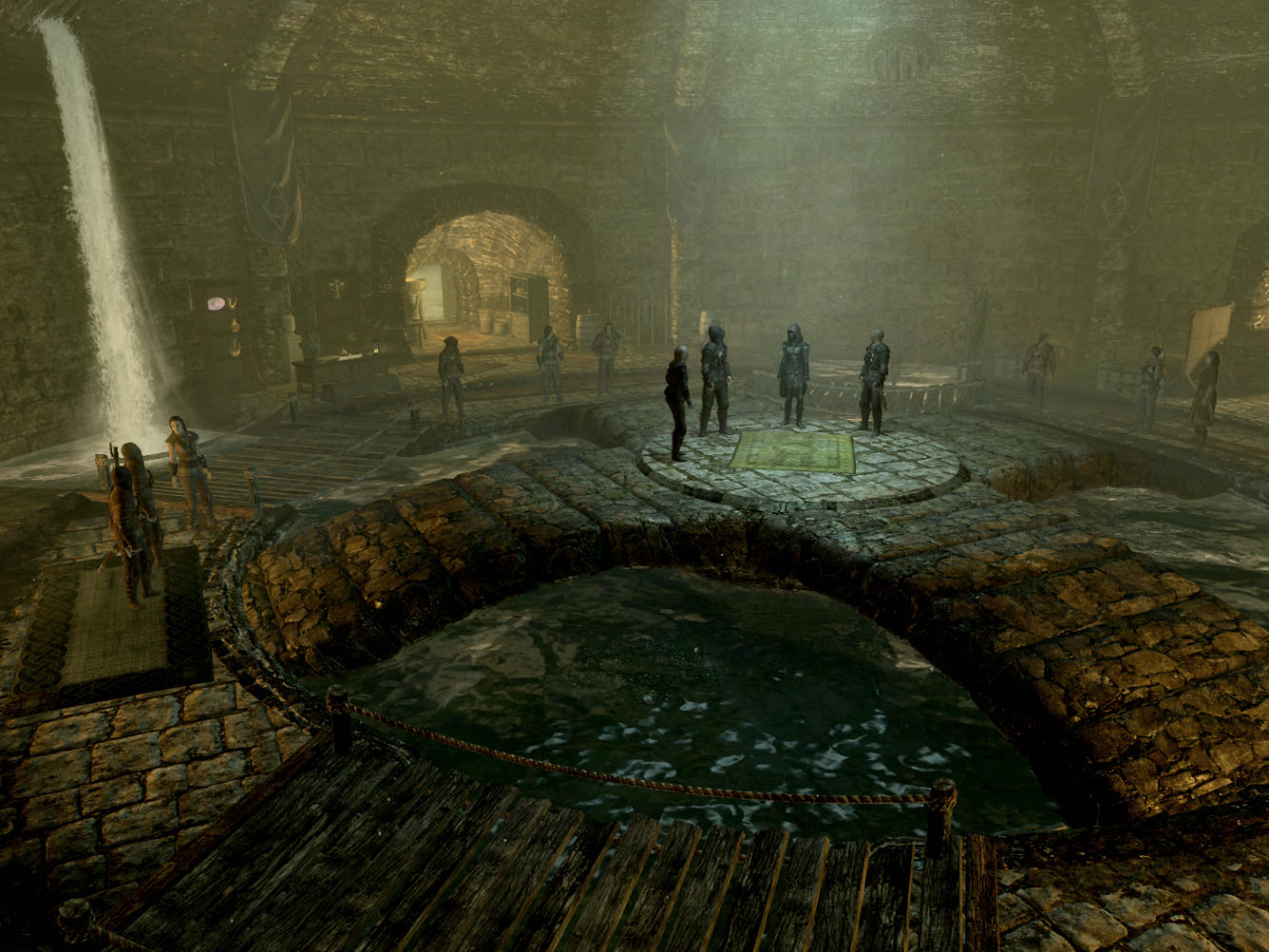 |
| The Guild restored. |

