Please read this first.

Welcome! This blog is devoted to considerations of morality in the The Elder Scrolls V: Skyrim by Bethesda. Rather than a fansite, review, or walkthrough, it is a serious attempt to examine the game through a moral lens. Please note that the purpose of this blog is to discuss morality within the context of the game, not to determine whether playing the game is immoral in and of itself; the latter type of "discussion" tends toward tedium and inhibits, rather than promotes, a meaningful conversation.

If you have not visited this blog before, it might be helpful to read the posts labeled "Orientation," most of which are the first few entries in the blog archive (see right). These posts include a short introduction to this project, a content-specific author bio, and a few other pieces that explain key concepts relevant to this study. These posts are of particular use to those readers less familiar with Skyrim (or video games in general).

PLEASE NOTE: HERE BE SPOILERS!

If you have visited this blog before, thanks and welcome back!
Showing posts with label Werewolf. Show all posts

Saturday, August 10, 2013

Dawnguard


Dawnguard is undoubtedly one of my favorite questlines.  The plot smacks of Greek drama, the main characters are poignant and well-written (Serana in particular), and the surprises are truly shocking (Snow Elves!).  That said, I have a hard time writing about it from a moral perspective because the only major decision point in the game (Dawnguard or Volkihar?) involves a choice I had made much earlier in the game, and the more in-depth treatment of vampires in the DLC offers nothing that would cause me to change my mind.

My outlook on vampires was formed initially by my experiences during Laid to Rest and solidified by way of comparison during the Companions questline.   In short, whereas NPC werewolves are depicted as loyal, honorable, and in control of their condition, vampires come off as manipulative, self-centered, and unable to help themselves.  While the player may certainly attempt to run a restrained and responsible vampire, joining the Volkihar would be a bridge too far for Lothar’s moral profile.  Keeping human cattle and blotting out the sun are not really my wheelhouse.

To extend the contrast between lycanthropy and vampirism further, consider the relevant Daedric Princes – Hircine and Molag Bal, respectively.  While neither of them are model citizens, the latter seems less evil than the former.  Hircine presents as a single-minded purist who cares only for the hunt and little for the collateral damage it may cause.  Like the natural order, he may be ruthless and destructive, but is rarely malicious unless personally offended.  We hear reports of werewolf attacks, but we never actually see the Companions doing anything dishonorable.  Molag Bal, on the other hand, delights in the rape, subjugation, and torture of others.  He is malice personified, and his progeny (for the most part) seem to follow suit.

In other words, there was no way I was going to join the vampires.  Still, I think the Dawnguard faction had potential for some moral dilemmas that Bethesda never invested in.  Isran in particular struck me as a character who might ask me to cross some lines.  He reeks of zealotry, so I can easily envision him giving me an order to, say, torture a captive vampire.
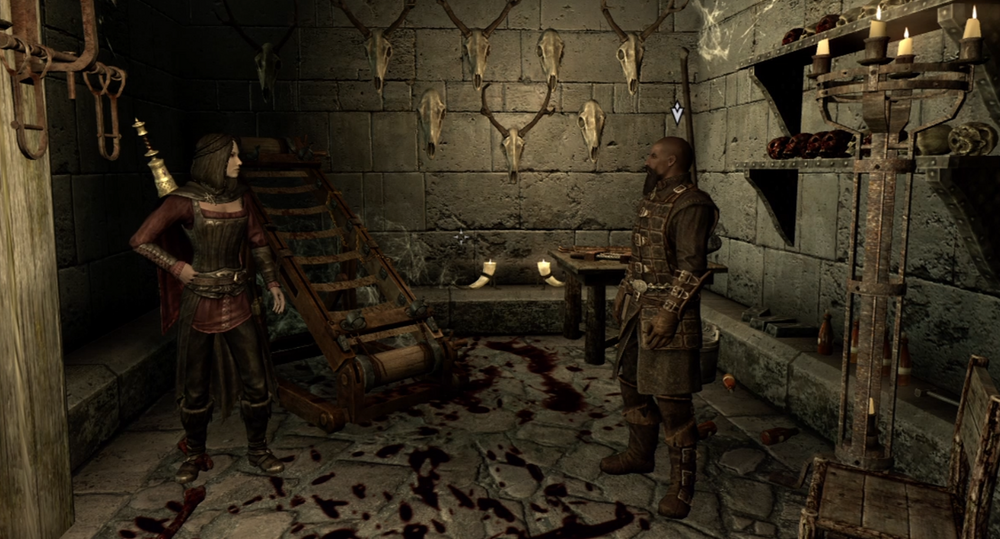
You...you guys see the torture stuff, right...guys?
Alternately, what if the Dawnguard discovers a nest of vampires that are behaving themselves -- restricting their feeding to spouses, followers, and other non-thrall volunteers, for example.  Should we wipe them out?  The ex-Vigilant of Stendarr (a faction that always creeped me out a little) would likely say yes, but what if the Dragonborn was given the option of saying no and possibly standing up to Isran?  I would then have to think more carefully about my cooperation with the Dawnguard..  Precedent for this kind of objective exists in the game, and casting a shadow on the faction one has joined makes for good role-playing.  I realize that Dawnguard is DLC, and therefore not expected to be as robust as the main game, but I still think Bethesda missed a opportunity for moral complexity in an otherwise excellent questline.

The only other potential moral dilemma concerns the Soul Cairn -- a setting which partially answers some of the questions I asked in an earlier article.  I will reconsider the morality of soul gems in the next post.

Wednesday, November 28, 2012

Ill Met By Moonlight


Ill Met By Moonlight is a Daedric quest involving Hircine, the Daedric Prince of the Hunt.  It began in Falkreath, where I met Mathies and Idara, farmers who were grieving the brutal murder of their young daughter.  They tearfully reported that an itinerant laborer on their farm had torn their little girl to pieces, like a wild animal.  That laborer, Sinding, was now in the city jail awaiting trial for his crime.

When I visited Sinding, he admitted both to being a werewolf and to killing the girl, but claimed that her death wasn’t really his fault.  Apparently, in an effort to control his transformations, he stole the Ring of Hircine.  The Daedric Prince, supremely displeased with Sinding’s temerity, cursed the ring so that he was now transforming at random.  It was during one of these random transformations that he killed the little girl.  Before he was arrested, he came to the conclusion that he needed to win back Hircine’s favor by hunting and killing a rare beast – the White Stag.  Obviously, being in jail made his plan untenable, so he asked me to help him by taking the ring and hunting the White Stag for him.

The first moral dilemma was, of course, whether to help Sinding.  Regardless of whether I believed his story or his remorse, he killed a child, so I was not inclined to help.  However, so long as Sinding possessed this ring, he was a threat to everyone, including his jailers, if for no other reason than Hircine would probably not stop until he was satisfied.  Furthermore, Sinding was already incarcerated and would most likely be executed, so there was no need for me to break the law by taking justice into my own hands.

The second dilemma involved the ring itself.  As a werewolf myself, if I took the ring, I would also take on the curse of random transformation.  In my consideration of the Companions questline, I discussed the moral implications of lycanthropy in some detail.  Ultimately, I concluded that being a werewolf in Skyrim is morally neutral because the PC can not only choose when to transform but is also in complete control of his actions when transformed.  If choice is removed but control is retained, as seemed to be the case with the cursed ring, then the issue becomes only slightly more complex.  If I were to transform in the marketplace, for example, I would immediately draw the hostility of every witness, and would therefore have to choose among fighting innocent people, running away as fast as possible, or dying.  Given my previous experiences with Beast Form, decided that it was a calculated risk worth taking.

Once I agreed to take the ring, Sinding did something that, had I anticipated it, would have led me to kill him in his cell, regardless of the legal penalty.  As soon as the ring was in my possession, he transformed voluntarily and escaped out of the hole in the high ceiling of his cell.  The lesson here is that even the most carefully thought-out moral plans can have unintended consequences.

As much as I wanted to hunt Sinding down, I now had to deal with the curse, so I decided that the best course of action would be to hunt the White Stag and get Hircine’s attention as soon as possible.  Fortunately, I completed this stage of the quest quickly, only transforming right after I killed the White Stag out in the wilderness.  Hircine did in fact appear and informed me that Sinding was hiding out in Bloated Man’s Grotto and that he had already sent other hunters after him.  Knowing that the hunters would probably be no match for a desperate werewolf, I headed straight for the Grotto.

When I arrived, I found that my suspicions were correct; Sinding had already killed several of the hunters.  I felt bad about my role in their deaths, but as they were evidently Hircine’s cultists, and therefore a brutal lot to begin with, I did not lose much sleep over it.  I tracked down Sinding, at which point he asked that I let him go.  His plan was to live in the wilderness, far away from innocent people who could be hurt by his Beast Form.  All I would need to do was to kill the remaining hunters.

Nope.
This third moral crossroads was, despite its climactic nature, the easiest one to navigate.  Sinding had to die; even if I had confidence in his plan (which I didn't), he needed to pay for his crime. As I pointed out earlier, Bethesda is clearly capable of writing an “addiction mechanism” (progressive ability and attribute penalties for non-compliance) for their games, as evidenced by their handling of vampirism. Had they chosen to do so, they could have created a similar system for lycanthropy.  The fact that they didn’t leads me to the conclusion that Sinding’s desperation is purely psychological.  Even Aela, who presents as a bit too enthusiastic about her Beast Form, is always in control, even as a wolf.  Therefore, Sinding’s uncontrollable blood lust is a psychological condition at best, and a manipulative mask for his sociopathology at worst.  To drive this point home even further, I myself transformed before I killed him, thus infusing Sinding’s execution with a touch of poetic justice.


After I killed Sinding, Hircine appeared once again to reward me for a successful hunt; the Daedric Prince gave me enchanted armor made from Sinding’s own skin, which was gruesome and not all that powerful.  The real prize for me was the chance to put down a vicious child-killer.

In my usual post-quest research, I learned that I could have double-crossed Sinding and received two different Daedric artifacts – the aforementioned armor (the Savior’s Skin) as well as the Ring of Hircine, which allows the wearer to transform as often as he wishes.  To gain both prizes, I would have had to agree to help Sinding, kill the remaining hunters, collect the ring from Hircine, then return to kill Sinding and collect the armor.  While I would have had minor qualms about deceiving Sinding (he deserved to face his execution head-on), I would have had a very hard time justifying the killing of the hunters.  As Hircine’s cultists, and therefore big game hunters, they accepted the possibilty of death at the claws of their prey, not murder at the hands of their comrade.  The ring is certainly the better prize, but it was not worth the lives of the hunters.


Wednesday, November 21, 2012

The Companions (after The Silver Hand)


After the completion of The Silver Hand, I went out on two more simple radiant quests as a Companion.  Eventually, Kodlak Whitemane took me aside and expressed his concern about our actions against the Silver Hand.  He then revealed the origin of the Circle’s lycanthropy and its potential cure.  Unlike Aela, Kodlak viewed the Beast Form as a generational curse that consigned the afflicted to an eternity in the Hunting Grounds of the Daedric Prince Hircine, rather than in Sovngarde (the Skyrim version of Vanhalla).  Because the curse/gift had originally been brought on by a pact a former Harbinger had made with the Glenmoril Witches, Kodlak asked me to obtain one of their heads to use in a purification ceremony.  I agreed to help, and set out for the Glenmoril Coven.

The first and easiest moral facet of this quest (called Blood’s Honor) is the killing of the witches.  As it turns out, the witches are, in fact, very hostile Hagravens, and therefore fair game.  While collecting their heads may seem macabre, it is a necessary act to fulfill Kodlak’s wish, which engages the other moral issue in the quest.  

Kodlak’s desire to rid himself of lycanthropy arises more from a longing for Sovngarde than from any compunctions about his own actions during transformation.  Hircine’s Hunting Grounds is not a Hell of tormented souls; rather, it is a plane of constant struggle between predator and prey.  For someone like Aela, whose fondness for hunting borders on obsession, an eternity in Hircine’s realm would be a just and welcome reward.  Kodlak, however, is a true Nord son of Skyrim, and as such, aspires to a place among the honored dead in Sovngarde.  He believes that his status makes him ineligible for his rightful place, and the thought of an eternal hunt depresses him.  Even though I had enjoyed being a werewolf so far, I sympathized with Kodlak’s plight, and agreed to help him cure himself.  The salient point is that lycanthropy is a gift to those who welcome it and a curse to those who don’t, which makes it a morally neutral state.

Unfortunately, I did not get to inform Kodlak of my success; I returned to Jorrvaskr to find that the Silver Hand had retaliated against the Companions for our earlier raid.  Not only had Kodlak been killed in the attack, but all of the fragments of Wuuthrad had been stolen…thus began The Purity of Revenge.  This next quest was ethically simple; we were avenging our fallen Harbinger and reclaiming our rightful property.  Once again, I felt it fitting to kill the Silver Hand leader while in Beast Form.  Viklas didn’t seem to mind.
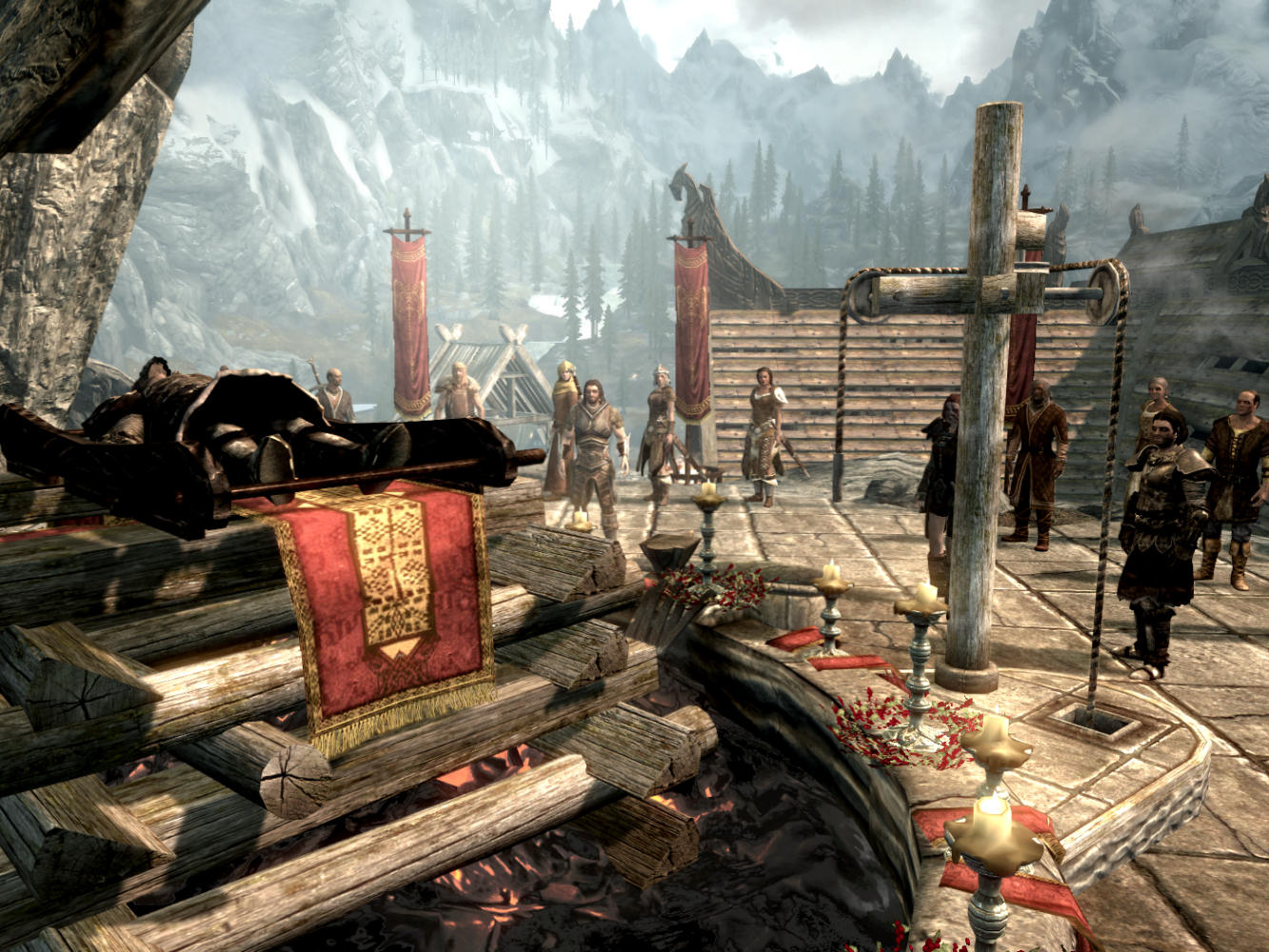
After completing The Purity of Revenge, The Companions gathered at the Skyforge for Kodlak’s funeral.  I have to say, this was one of the most moving moments in the game so far.  Aside from the pathos of the funeral itself, I was struck by the tragedy of Kodlak’s eternal fate; just when I had made it possible for him to be cured of his “curse,” he was struck down and therefore prevented from entering Sovngarde. Still, I hoped against hope that Kodlak’s assumptions about the afterlife were mistaken; after all, he had no real proof that he would automatically be consigned to Hircine’s Hunting Grounds.

Manly tears were shed.
Following the funeral, Eorland White-mane used the Skyforge, which had just been used to cremate Kodlak’s remains, to re-forge Wuuthrad.  The Circle (of which I was now a part) gathered in the Underforge to mourn Kodlak’s fate.   Of note is the fact that, even though many of them did not agree with “the old man’s” stance on lycanthropy, they truly lamented the possibility that he had missed out on Sovngarde.  This sympathy really impressed me; even Aela was able to put aside her enthusiasm for “hunting” and observe that Kodlak deserved better.  Fortunately, Eorland appeared and informed the Circle that it was not too late.  If we took the re-forged Wuuthrad to Ysgramor’s Tomb, we would be able to perform a purification ritual that would cleanse Kodlak’s spirit, even after death.  Once more, it should be noted that the Circle immediately agreed to risk their own lives in order to fulfill Kodlak’s final wish – a wish they themselves rejected.

This quest, Glory of the Dead, posed a few minor ethical issues.  Ysgramor’s Tomb contains the ghosts of former Companions who, according to Viklas, are there to test the courage of anyone who would dare enter.  Because the ghosts were “in the family” and the battles were part of a warrior’s test, I was able to overcome my misgivings about fighting the spirits of fellow Companions.  Once we reached the burial chamber, we encountered Kodlak’s spirit, warming his hands at the Flame of the Harbinger.  Sadly, Kodlak had been right all along; he was indeed trapped in Hircine’s realm, constantly pursued by the Daedric Lord of the Hunt.  According to his wishes, I threw the head of a Glenmoril Witch into the Flame, which sundered the wolf spirit from Kodlak.  A brief fight ensued, and after I defeated the wolf, Kodlak thanked me for freeing him.  Before he passed on to Sovngarde, Kodlak named me his successor as Harbinger of the Companions, which the rest of the Circle accepted.

Even though the quest was complete, I had a few decisions to make.  First, because I still had four Glenmoril Witch heads, I could have cured myself of the curse that had tormented my predecessor.  I decided that, since I had suffered no ill effects and that I was no more inclined to immoral behavior than I was before, I would remain a werewolf, at least for the time being.  Second, as I left the tomb, I had the option of taking Wuuthrad, which had already served its function of opening the burial chamber, back from Ysgramor’s Tomb.  On the one hand, it rightfully belongs to Ysgramor and should be left with him as a prized possession in accordance with Nord burial traditions.  On the other hand, it is a powerful weapon designed to be used against elves, not to sit forever as a decoration.  As the new Harbinger, and therefore a successor to Ysgramor himself, I felt justified in keeping the battleaxe in order to continue my private war against the Thalmor.

When I returned to Jorrvaskr as the new Harbinger, I explored Kodlak’s bedchamber further (I had been in the room earlier to retrieve a Wuuthrad fragment for Eorland).  In it, I found and read Kodlak’s journal, in which he described not only his sadness over his condition, but also his increasing admiration for me and his confidence that I would be the new Harbinger.  For the second time in this questline, I cried.