Please read this first.

Welcome! This blog is devoted to considerations of morality in the The Elder Scrolls V: Skyrim by Bethesda. Rather than a fansite, review, or walkthrough, it is a serious attempt to examine the game through a moral lens. Please note that the purpose of this blog is to discuss morality within the context of the game, not to determine whether playing the game is immoral in and of itself; the latter type of "discussion" tends toward tedium and inhibits, rather than promotes, a meaningful conversation.

If you have not visited this blog before, it might be helpful to read the posts labeled "Orientation," most of which are the first few entries in the blog archive (see right). These posts include a short introduction to this project, a content-specific author bio, and a few other pieces that explain key concepts relevant to this study. These posts are of particular use to those readers less familiar with Skyrim (or video games in general).

PLEASE NOTE: HERE BE SPOILERS!

If you have visited this blog before, thanks and welcome back!
Showing posts with label Dawnguard. Show all posts

Wednesday, July 16, 2014

The Dark Brotherhood, Part 5 (The Silence Has Been Broken) (Katnys)

By the time Katnys returned to the Sanctuary, Astrid had decided on a course of action.  While she still didn't trust Cicero, she could not deny that the Night Mother had indeed spoken to Katnys, and it would therefore be foolish to ignore the message. With Astrid's blessing, Katnys was now to travel to Volunruud in order to meet with Motierre and see why the Night Mother might be interested in him.

Before she could go, however, she needed to report her contract completions to Nazir. The news of Lurbuk's death brought the usual sarcasm with the gold, but when Katnys confirmed that she had killed Hern as well, Nazir dropped his sardonic veneer to offer his sincere respect for facing down a vampire.  He then suggested that she check for signs of vampirism herself, making reference to the Brotherhood's own resident vampire, Babette.

That's when it dawned on her: the ambush at Half-Moon Mill, the strange draining attack, that nagging thirst on the way home...Katnys had contracted Sanguinare Vampiris! She knew enough to understand that if she didn't act quickly, she would become a full-blown vampire before the week was out.  Katnys found the Cure Disease potion she had picked up somewhere along the way, opened the vial...and stopped.

Vampirism was bad, of course.  Katnys had encountered vampires before; she witnessed a vampire attack in Whiterun, and even though she didn't help the town guards and citizens put the monsters down, that one Dawnguard soldier took her aside and invited her to join his band of vampire hunters. At the time, she was too focused on avenging her sister and the whole "Dragonborn" business to get involved.  Now that she was infected, she was involved whether she liked it or not.

As she held the Cure Disease potion to her lips, she thought about those vampires; they were powerful, they could enthrall people, drain health from afar, even become invisible. But most of all, they didn't grow old and die.  Nazir mentioned Babette; look at what she had accomplished through this "disease."  What if Katnys needed more power, more time to exact her vengeance on the Empire? Wouldn't becoming a vampire actually help?  What did she have to lose?  She would talk it over with Jenassa on the way to Volunruud; Katnys had grown to really love and trust Jenassa during their travels together and her opinion meant more than anyone else's.

Once outside the Sanctuary, Katnys told her companion everything.  Jenassa, for her part, had little to say, but the little she did say decided the issue for Katnys: "We're one of the same kind, you and I. I'm glad to have met you. I am a lethal instrument, yours to command. Blade and shadow, silence and death - these are my arts. I'll make great art for you.  I am the shadow at your back.  Let's get going."  Jenassa would be beside her, no matter what.

Glowing from Jenassa's expression of acceptance and loyalty, Katnys led the way to Volunruud.  Once inside the tomb, she found a tattered journal next to what was, presumably, the author's skeleton.  Katnys opened the journal, fearing that she had failed to reach Motierre in time, only to discover that the journal belonged to some foolish explorer named Heddic; she pocketed the journal (there would be time to follow up on that later) and followed a noise to her left that sounded increasingly like muffled conversation.  In front of a large closed door lay the bodies of several vanquished draugr.  If Motierre was behind that door, he was someone to be reckoned with.

As it turned out, Motierre was indeed in the chamber beyond, but it was most likely his hulking bodyguard, Rexus, who had dispatched the draugr.  Katnys startled and raised her bow upon first laying eyes on Rexus in his Imperial armor -- was this some sort of Imperial trap?  Motierre, however, rushed forward to put her at ease.  He was obviously still shaken from performing the Black Sacrament, and was eager to get down to business.  Katnys, however, was not prepared for the target he was to offer: the Emperor!

It was all Katnys could do to keep the cold, silent demeanor she had begun to adopt as an assassin.  In an instant, in that stinking Nord crypt, listening to veiled insults of a Breton fop and his Imperial pet -- everything suddenly made sense.  How did Motierre put it?  The stars had aligned.  The dragon attack at Helgen, the Aretino boy, the Brotherhood contracts that tugged at her conscience, the Night Mother's revelation: it had all led to this.  With this contract, Katnys would finally avenge her sister.  The Emperor himself would pay for Prym's blood!

Quickly remembering herself, Katnys took some items from Rexus (she hadn't really been paying attention -- Motierre said something about an amulet, a letter, and killing some other people) and made straight for the Sanctuary.  Astrid was, of course, taken aback by the news, but then gave Katnys a quick history lesson and embraced the challenge Motierre had put before the Brotherhood:

She said the magic word.
The next step for Katnys was to get the amulet appraised.  For that, she'd have to make her way to Riften and connect with another shadowy group: the Thieves Guild.  Finding the Guild wasn't too hard -- it was a bit of an open secret -- but before she and Jenassa could enter the Ragged Flagon and speak with the fence, Delvin Mallory, they did have to kill a few thugs in the Ratway.  While the skirmishes in the Ratway were of little consequence in and of themselves, Katnys noticed that a few things had changed for her.  First, she could smell blood much more strongly, and it was now an appetizing aroma.  Second, she realized that, if she concentrated, she could see in the dark much better than before.  She even dared to try to make a thrall, and succeeded...even if it only lasted a few minutes.  But, there were more important matter to attend to.

Once inside the Ragged Flagon, Mallory confirmed that the amulet belonged to a member of the Emperor's Elder Council, and gave Katnys the letter of credit Astrid had mentioned. Upon her return, Katnys delivered the letter, and in exchange, Astrid revealed that to her that Katnys would carry out the first assassination herself: Vittoria Vici, manager of the East Empire Company's holdings in Solitude, was to be killed at her own wedding.  Slaughtering an Empire lackey in front of a crowd of Imperial dandies-- what a lovely opening act!

Tuesday, August 20, 2013

Beyond Death: Soul Gems Revisited


Not long after I first wrote about the moral vagaries surrounding the use of soul gems, a reader pointed out that Dawnguard sheds some light on the issue.  At the time, I had not yet done the Dawnguard questline, and so I looked forward to finally getting some firm ideas about the ultimate fate of the entrapped souls.  Now that I have explored the Soul Cairn, I have more questions than answers.

What I know:
  • Upon death, a Soul Trapped being’s soul is absorbed into a soul gem.
  • Said gems may be used to enchant or recharge weapons and other items.
  • The Soul Cairn is populated by entrapped souls.
  • The Soul Cairn is vast and depressing -- more Limbo than Hell.
  • Some souls deal better with the Soul Cairn than others (Jiub, Morven Stroud)
  • Not all of the entities within the Soul Cairn are entrapped souls.
  • Soul Gems can be filled by activating Soul Fissures inside the Cairn.
  • During The Black Star, when Malyn Varen dies inside a soul gem, his soul is utterly destroyed (Nelacar refers to it as non-existence).
  • As demonstrated by the encounter during The Black Star, the space inside a soul gem is not the same as the Soul Cairn.
What I still don't know:
  • Soul husks are plant-like objects, but the name suggests that they are something left behind.  Are they the residue of a soul being used in an enchantment?
  • Are the souls in the Soul Cairn currently trapped in gems and awaiting annihilation, or are they here because their souls were already used up in an enchantment?
  • Is the Soul Cairn only for the souls of man and mer?  On the one hand, aside from Arvak, I only encountered sentient souls. On the other, the fissures filled up my petty, lesser, common, and greater gems.
Therefore, there seem to be two viable ways of understanding the Soul Cairn:
  1. The Soul Cairn is a way station for entrapped souls.  A soul is trapped and transported to the Soul Cairn, where it waits until the soul gem to which it is tethered is consumed.  When the corresponding gem is used in an enchantment, the soul is obliterated.
  2. The Soul Cairn is the ultimate destination for souls used in soul gems.  The soul remains trapped in the gem until the item is used for enchanting, at which point the soul is cast into the Soul Cairn.  It is not annihilation per se, but rather an eternal nowhere.
Without further information, I'm just counting angels on the head of a pin, but in a way, the metaphysical details don't really matter.  Soul Trap still stands as an awful thing to do to a sentient enemy, and should be used only on the worst of the worst, if at all.  I, for example, refuse to use it on Stormcloaks, Forsworn, random thieves in Riften, or the Afflicted, but I'm comfortable using it on Thalmor agents and bandits.

For another view, I suggest this thread from The Escapist.

Saturday, August 10, 2013

Dawnguard


Dawnguard is undoubtedly one of my favorite questlines.  The plot smacks of Greek drama, the main characters are poignant and well-written (Serana in particular), and the surprises are truly shocking (Snow Elves!).  That said, I have a hard time writing about it from a moral perspective because the only major decision point in the game (Dawnguard or Volkihar?) involves a choice I had made much earlier in the game, and the more in-depth treatment of vampires in the DLC offers nothing that would cause me to change my mind.

My outlook on vampires was formed initially by my experiences during Laid to Rest and solidified by way of comparison during the Companions questline.   In short, whereas NPC werewolves are depicted as loyal, honorable, and in control of their condition, vampires come off as manipulative, self-centered, and unable to help themselves.  While the player may certainly attempt to run a restrained and responsible vampire, joining the Volkihar would be a bridge too far for Lothar’s moral profile.  Keeping human cattle and blotting out the sun are not really my wheelhouse.

To extend the contrast between lycanthropy and vampirism further, consider the relevant Daedric Princes – Hircine and Molag Bal, respectively.  While neither of them are model citizens, the latter seems less evil than the former.  Hircine presents as a single-minded purist who cares only for the hunt and little for the collateral damage it may cause.  Like the natural order, he may be ruthless and destructive, but is rarely malicious unless personally offended.  We hear reports of werewolf attacks, but we never actually see the Companions doing anything dishonorable.  Molag Bal, on the other hand, delights in the rape, subjugation, and torture of others.  He is malice personified, and his progeny (for the most part) seem to follow suit.

In other words, there was no way I was going to join the vampires.  Still, I think the Dawnguard faction had potential for some moral dilemmas that Bethesda never invested in.  Isran in particular struck me as a character who might ask me to cross some lines.  He reeks of zealotry, so I can easily envision him giving me an order to, say, torture a captive vampire.

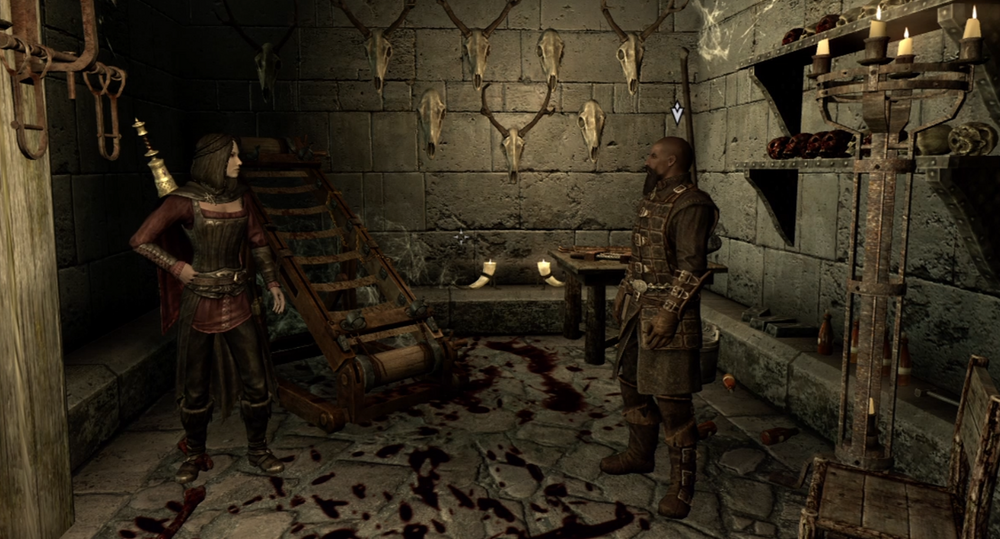
You...you guys see the torture stuff, right...guys?
Alternately, what if the Dawnguard discovers a nest of vampires that are behaving themselves -- restricting their feeding to spouses, followers, and other non-thrall volunteers, for example.  Should we wipe them out?  The ex-Vigilant of Stendarr (a faction that always creeped me out a little) would likely say yes, but what if the Dragonborn was given the option of saying no and possibly standing up to Isran?  I would then have to think more carefully about my cooperation with the Dawnguard..  Precedent for this kind of objective exists in the game, and casting a shadow on the faction one has joined makes for good role-playing.  I realize that Dawnguard is DLC, and therefore not expected to be as robust as the main game, but I still think Bethesda missed a opportunity for moral complexity in an otherwise excellent questline.

The only other potential moral dilemma concerns the Soul Cairn -- a setting which partially answers some of the questions I asked in an earlier article.  I will reconsider the morality of soul gems in the next post.