Please read this first.

Welcome! This blog is devoted to considerations of morality in the The Elder Scrolls V: Skyrim by Bethesda. Rather than a fansite, review, or walkthrough, it is a serious attempt to examine the game through a moral lens. Please note that the purpose of this blog is to discuss morality within the context of the game, not to determine whether playing the game is immoral in and of itself; the latter type of "discussion" tends toward tedium and inhibits, rather than promotes, a meaningful conversation.

If you have not visited this blog before, it might be helpful to read the posts labeled "Orientation," most of which are the first few entries in the blog archive (see right). These posts include a short introduction to this project, a content-specific author bio, and a few other pieces that explain key concepts relevant to this study. These posts are of particular use to those readers less familiar with Skyrim (or video games in general).

PLEASE NOTE: HERE BE SPOILERS!

If you have visited this blog before, thanks and welcome back!

Friday, June 28, 2013

A Cornered Rat

About halfway through the Thieves Guild questline, I returned to the main quest, now armed with the knowledge of Esbern's whereabouts.  I began my search of the Ratway by dispatching the Thalmor agents who were also looking for the elderly Blade loremaster.  I carefully advanced through the vaults and into the warrens, taking out a few thugs here and there.  I ran into nothing of moral significance until I reached the heart of the warrens, and as I review the events that unfolded there, I'm sure that the dilemma I faced was in no way scripted by the game.

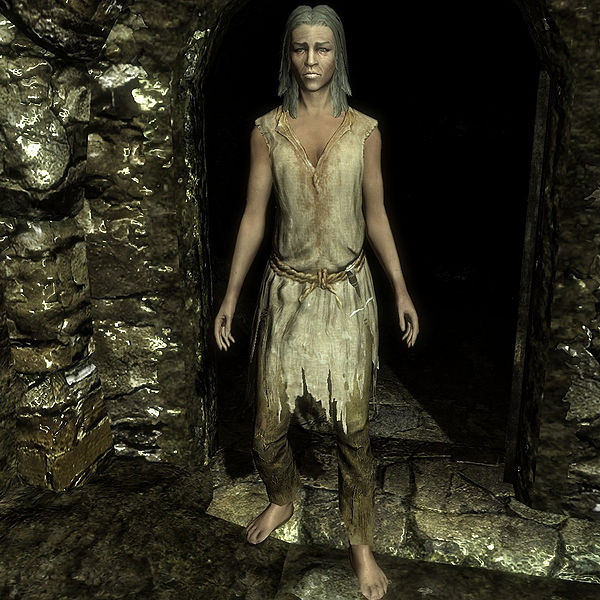
I found that the warrens were occupied by three madmen other than Esbern: Salvianus, the Imperial Legionnaire whom the Great War drove insane; Knjakr, the Sweeney Todd-like chef; and Hefid the Deaf, a poor beggar woman who mutters a kind of OCD litany.  Salvianus, while clearly insane, was a gentle soul who only wanted to try to explain the hopelessness he felt, so I listened to him as long as I could before moving on.  Knjakr attacked me the moment I tried to speak with him, so I had to kill him in self-defense.  Hefid, however, presented me with an unexpected challenge.

When I interrupted Hefid's incessant listing of common objects, she completely freaked out, drew a dagger, and ran away from me.  I would have been happy to let her go, but for one problem: she ran straight to Esbern's door and continued to brandish her weapon no matter what I did.  When I tried to talk, she didn't respond, preferring instead to throw herself at the heavily bolted door to Esbern's room.

I now had a real dilemma on my hands.  Opening Esbern's door (assuming I could do so), would send an armed madwoman into the deadbolted cell of a paranoid ex-Blade.  At best, he kills her, and probably attacks me as an accomplice.  At worst, she kills him, and the last remaining hope to defeat Alduin is gone.  Because I could not think of a scenario which didn't end with her death, I decided to kill her as quickly and mercifully as possible.

After gaining Esbern's trust and hearing his tale, we set out to find Delphine.  We didn't take two steps outside his door before we were set upon by more Thalmor agents.  We killed them, but poor Salvianus got caught in the crossfire -- his worst nightmare finally coming true.  I paid my respects, then escorted Esbern back to Riverwood.

I don't feel good about killing Hefid, but once I had spoken to her, I don't see how I could have avoided it.  A quick FUS might have pushed her aside, but would probably also have provoked her to attack me.  Furthermore, even if she had survived the initial encounter, what would have happened during the fight with the Thalmor?  And, if I'm being completely honest here, what kind of life did she have, tormented by her obsessive list in her dank, dark cell?  Might she be better off dead?
"Knife. Yes. Book. Yes. Bucket. Yes. Inkpot? No."  R.I.P. Hefid the Deaf


Tuesday, April 2, 2013

Thieves' Guild (Under New Management)

After taking on the mantle of the Nightingale and defeating the traitorous Mercer Frey, I was tasked with returning the Guild to its former glory by re-establishing its reputation all across Skyrim.  In order to redeem the Guild and earn the title of Guildmaster, I would have to pull off a series of at least 20 small jobs, followed by four larger capers in The Reach, Whiterun, Haafingar, and Eastmarch.  Each job presented its own moral dilemma, which I navigated with varying degrees of success.

Small Jobs

The Bedlam Jobs: These jobs required me to steal at least 500 gold in loot from a given city.  I managed the Bedlam jobs by choosing morally acceptable targets (those who are rich and/or loathsome, such as Erikur) or by replacing the stolen items with items of equal or greater value. The first method played into my habit of passing judgment on NPCs in order to rationalize my actions; the wealthy wouldn't miss the loot, and the reprehensible deserve the inconvenience.  The second method allowed me to create a "no harm, no foul" arrangement with myself in order to assuage any guilt I might feel.  I used both methods for other types of jobs as well.

The Fishing/Heist Jobs: In both cases, the contract was to steal a specific item from a specific person or business.  I tended to favor the "acceptable target" method for the pickpocketing jobs and the "replacement" method for the safecracking jobs.  My logic here was that the items on an NPC were probably of personal as well as monetary value, so replacement would not be acceptable, and I would need to reject any targets from whom I could not justify stealing (see above).  Businesses, on the other hand, are interested in monetary value only, so replacing the stolen items made sense.

The Numbers Jobs: Because there are very few morally acceptable target businesses, these jobs presented a unique problem: on the one hand, forging a business's ledger cannot be "balanced" with a replacement, but on the other, it was heavily implied that the forgeries would only be used to hide Guild activities (as opposed to stealing from the business itself).  Furthermore, I noticed no ill effect of the forgeries on the targeted businesses.  With no good method of balancing the crimes or measuring their long-term impacts, I completed only a few of these jobs.

The Shill Jobs: Similar to A Chance Arrangement, the Shill job required me to plant a stolen item in a random person's house.  Since there is no way to balance this kind of crime, I only did a handful of these, and only if the target was morally acceptable (such as Bolli).

The Sweep/Burglary Jobs: These jobs presented the biggest hurdle for me because they came with a ludonarrative twist.  Both job types required me to steal specific items from a house, so I used the same "acceptable target" and "replacement" methods as in the Bedlam jobs, but I noticed that the items I stole spawned in the house only after I accepted the job.  In other words, if I entered, say, the Atheron residence before taking a Sweep job, none of the target items would be there.  The items only exist when I agree to steal them.  The game does attempt to deflect the ludonarrative dissonance (usually Vex saying something about the target house having recent bought or inherited the item(s) in question), but after the fifth or sixth job of this type, it becomes rather difficult to make a moral investment.  If the items don't exist until I agree to steal them, then there is no real moral question.

Larger Capers (a.k.a. City Influence Quests)

Imitation Amnesty (Whiterun): This quest required me to forge a prison registry in order to provide a new identity for "Arn," a war-buddy of Olfrid Battle-Born.  The moral dilemma is that Arn is apparently wanted for a capital offense in Solitude, but was brought in on a public drunkenness charge in Whiteun.  The new identity will allow Arn to serve his time in Whiterun on the minor charge, then go free.  While my previous forgeries simply allowed the Guild to operate discretely, this one would potentially set a serious criminal free.  There were several complicating factors to consider:
  • Olfrid never reveals what the charges are, nor whether Arn actually committed the crime.  Given the events of Unbound, I am well aware that the Empire sometimes plays fast and loose with the concept of "capital offense"; apparently, trespassing and horse stealing fall under that category alongside high treason.  Without knowing what he supposedly did or if he even did it, I had very little way of determining whether sneaking into Dragonsreach to alter an official document was justified in this case.
  • As the load screens are fond of pointing out, each hold tracks its crime differently.  Therefore, a crime committed in Haafingar might not warrant extradition from Whiterun.  The fact that Solitude specifically asked Whiterun to be on the lookout for Arn suggests that this is an unusual case -- perhaps involving the war...
  • ...on the other hand, Olfrid is a staunch supporter of the Empire, so it's unlikely that he would want to cover up anything treasonous.
  • Unlike the small jobs, this job cannot be turned down and replaced with a similar, more palatable one.  Failing this quest would prevent me from becoming Guildmaster.
I agreed to take the job.  Without additional information, I was not convinced that the crime was justified, but as I pointed out in that last bullet, there was a larger picture to consider.  Unfortunately, during the job, I discovered a letter which revealed that Arn was wanted for murder.  Now I had a real problem: do I allow a man charged with murder go free?  The revised considerations:
  • I still could not be certain that Arn was guilty of murder.  I knew this argument was losing ground by the minute, but I also knew from previous experience that killing an enemy whom the Hold Guard doesn't recognize as an enemy can result in a murder charge. 
  • Taking leadership of the Guild was still my prime motivation for taking the job.  The letter does not change that.
I went forward, despite my misgivings. I really compromised my moral stance this time, and it did not feel good.

The Dainty Sload (Haafingar): This job was morally challenging in and of itself.  I was asked to plant illegal drugs on a dishonest ship captain -- definitely gray and grey morality, but palatable in the context of the big picture: only bad people were being hurt.  The real obstacle was minimizing the collateral damage to the captain's crew; labeled as "Corsairs," the only so-named NPCs in the game, I could not just exterminate them as bandits, even though that is most likely what they are.  I therefore decided to Sneak through the whole thing in order to avoid any unnecessary deaths.  I did, however, opt to pick Sabine Nytte's pocket for the Balmora Blue; stealing from one criminal to frame another seemed justified to me.

Silver Lining (The Reach): Because this quest involved simply retrieving a stolen item from bandits, it was the easiest one to complete from a moral perspective.

Summerset Shadows (Eastmarch): Although not morally complex (wiping out a rival, murderous clan of Altmer thieves), this quest does tap into some other aspects of my playstyle.  As I have pointed out before, I take pleasure in killing Thalmor agents, but not all Altmer are Thalmor.  The Summerset Shadows, while not an official part of the Aldmeri Dominion, strike me as the criminal echo of the Thalmor; unlike other bandit clans, they are comprised of only one race.  Their apparent racism transforms their simple criminal  brutality into an aid to the Thalmor cause.  I would have gladly taken this job, even if I weren't a member of Guild.

The Ceremony: After completing all of the quests in this line, I was named Guildmaster, thereby cementing my control of all of the joinable factions in Skyrim.  I am still not sure if all of the steps along the way were morally worthwhile, but I will stand by my choices.
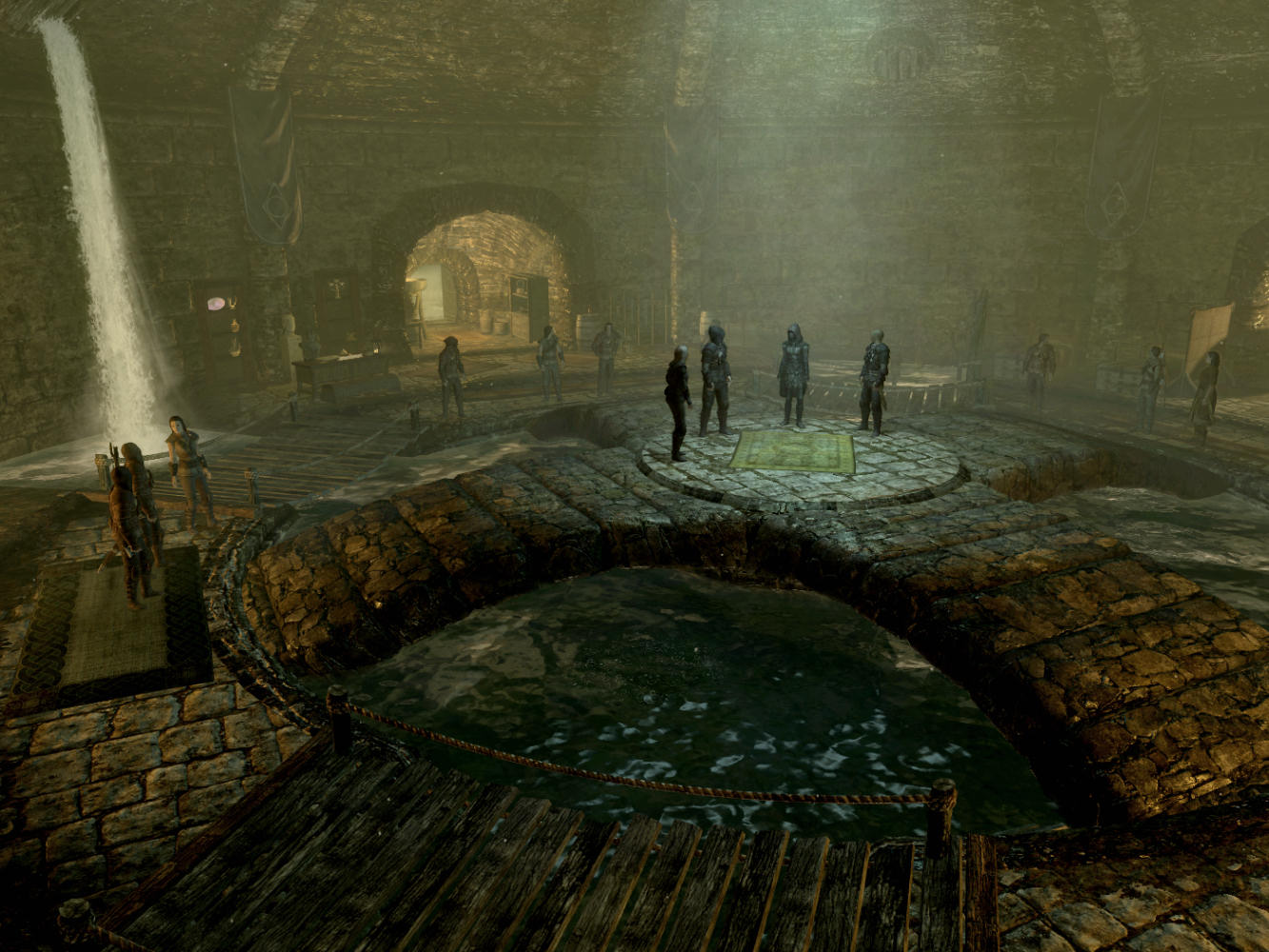
The Guild restored.

Saturday, March 30, 2013

Thieves' Guild (Scoundrel's Folly through Darkness Returns)

Scoundrel's Folly

As I pointed out in my Anniversary Update post, this quest presents some significant challenges to the moral agent.  I was able to avoid the initial problem of stealing from Jarl Elisif in order to gain Gulum-Ei's information by simply Intimidating the Argonian.  Following him into the warehouse, however, was much trickier, but I managed to complete it without killing anyone other than the bandits inside Gulum-Ei's hideout.  I spared Gulum-Ei because, despite the gauntlet I had to run to catch up to him, he did not attack me directly, nor did he even know I was tailing him. 

Speaking with Silence

Speaking with Silence is far more interesting plot-wise, but presents very few moral challenges.  Nevertheless, the revelations in this quest shed some light on the morality of the Guild as a whole.  Without detailing all of the intricate plot elements, I will simply say that The Thieves' Guild as it first presented in Skyrim is a hollow shell of its former self, mainly because of Mercer's betrayal.  Therefore, many of the less charitable first impressions may have been based on an incomplete picture of the Guild.

Hard Answers

The next quest, like Scoundrel's Folly before it, presents a single moral challenge: trespassing into a friendly facility without being caught by the legitimate guards of said facility.  I did not even have to steal anything this time; I made a charcoal rubbing of the artifact I needed and sneaked back out.

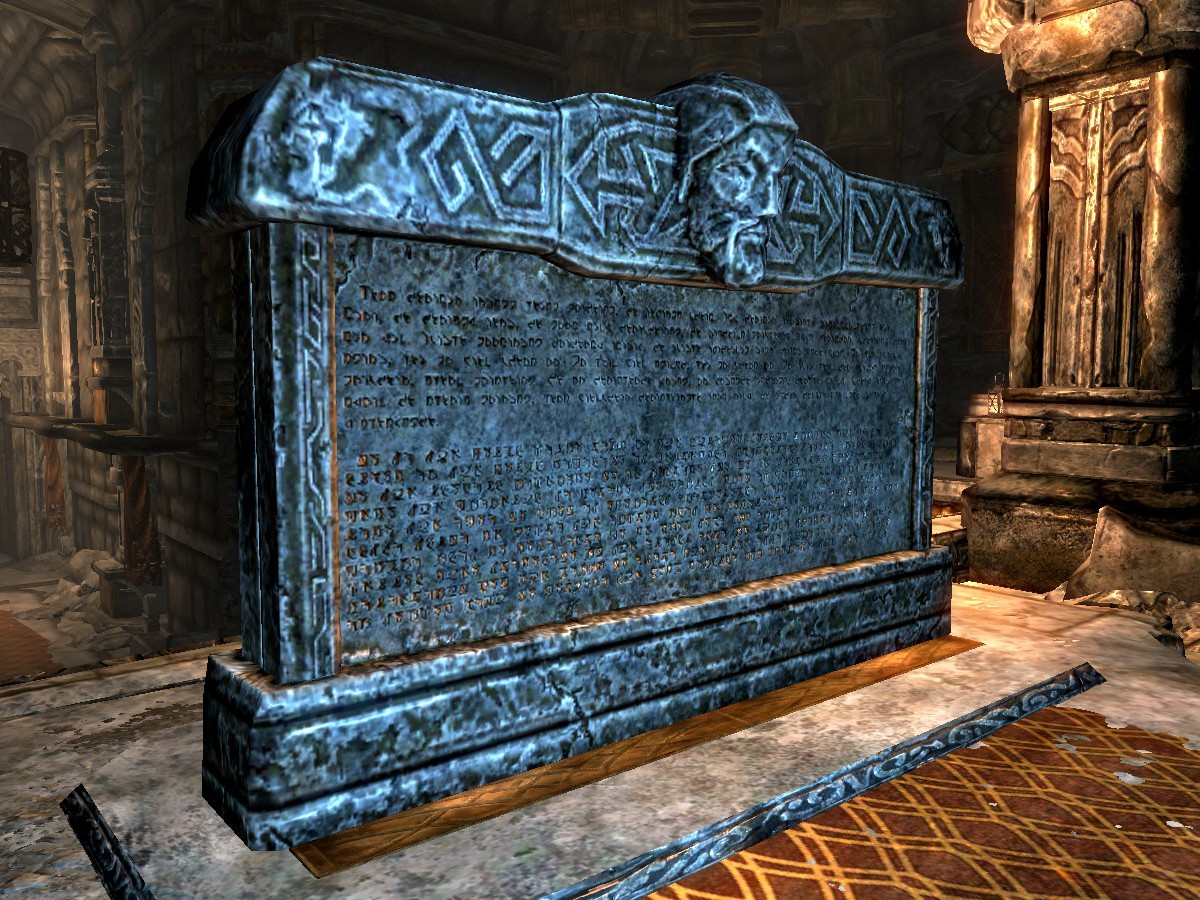
Nope.  Not even with a hundred Fortify Carry Weight potions.


The Pursuit

This quest presents a minor dilemma in the person of Vald, the hired thug at Mercer's house.  My options for getting past Vald consisted of the following:
  • Kill him
  • Persuade him
  • Pay his debt to Maven
Vald is initially non-hostile, so killing would have been wrong (he's obviously not very bright, so he probably has no idea that Mercer had betrayed the Guild).  I failed to Persuade him, so paying his debt was the only viable choice.  It turned out to be a minor chore (finding a special quill that Vald lost in transport), and Vald was grateful enough that he vacated his post.  The rest of this quest pitted me against bandits in Mercer's employ, so there were no further moral dilemmas.

Trinity Restored

This quest reveals the deeper essence of the Guild, which confirms my earlier suspicions about it being much more than a gang of criminals. Even though I was required to enter into a contract with the Daedric Prince Nocturnal, devotion to this entity consists of doing what I was doing anyway: thieving.  Other than that, there are no further opportunities for moral agency.

Blindsighted

Aside from killing some bandits and a bunch of Falmer, we had to confront and kill Mercer Frey.  Very straightforward.

Darkness Returns

None of these tests of strength, wit, and stealth are morally complex.

These quests form the main part of the Thieves' Guild line, and are engaging from both a moral and an narrative perspective.  By completing them, I learned that the Guild exists to honor stealth and regulate crime, not merely to line the pockets of its members.  When it is running at full strength, it is an organization that stabilizes the community by setting standards of criminal behavior and driving out destabilizing elements.  As a moral agent, I was able to find justification for their existence, but that justification was about to be tested in the final part of the questline: Under New Management.

Thursday, March 28, 2013

Update: Boethiah's Calling/Unearthed


I am interrupting my treatment of the Thieves’ Guild questline in order to provide an update on one of the Daedric quests that has been a real thorn in my side: Boethiah’s Calling.  In my first post on this quest, I declared that I would not complete the quest unless I found a follower who deserved to be sacrificed – a condition I did not expect the game to meet.  While some of the available followers inhabit a moral grey zone (e.g. Janessa), no one outside of the Dark Brotherhood really deserved to be deceived and murdered, and I could not justify joining the Brotherhood (and committing the prerequisite murders) just to sacrifice one of them.  Therefore, I resigned myself to leaving the quest incomplete (since there is no failure condition) for the remainder of the game.

The Dragonborn DLC, however, provided exactly the kind of follower I was looking for.  Most of the Dunmer NPCs  I met in Skyrim were either enemies or grim figures who, while perhaps on my side of the moral spectrum, were nevertheless prone to a kind of nihilistic cynicism.  My visits to Solstheim fleshed out my picture of the Dunmer, but still, I became accustomed to their overall lack of transcendent idealism.  Therefore, when I first met Ralis at the beginning of Unearthed, I felt comfortable funding his excavation project in spite of his obvious avarice and the distinct possibility that he was skimming off the top; after all, even if he was bilking me out of my gold, he was spending it in an economically depressed area and providing jobs for the locals with money that I would never miss: I was carrying about 120,000 gold at this point and had far more than that in loot at home. 

As the quest haltingly progressed through its stages, I became more concerned about Ralis’s seeming lack of regard for the safety of the miners, but I had little choice other than to provide more funds for the project.  By the final stage, I was in for 11,000 gold, but at least a half-dozen miners and guards had died at the hands of the draugr they awakened.  Of course, when I returned to the project site, saw the additional carnage, and read Ralis’s journals, I realized that Ralis had been slowly possessed by the Dragon Priest Ahzidal.  The truly unnerving part for me was that, unlike other similar possessions in the game, I had actually been speaking with Ralis as he slowly succumbed to Ahzidal’s influence; I had assumed he was just a sociopath.

After defeating the resurrected Ahzidal, I was able to speak with the now clear-headed Ralis about what happened.  Although his memory was clouded by the experience, he was aware that he had killed several of the miners himself as part of the resurrection ritual.  The fact that he was possessed would have exonerated him as far as I was concerned, but he completely failed to show any remorse; instead, he seemed far more interested in making sure that no one ever found out: 

If you choose the dialogue option "I can't let you go unpunished," Ralis flips out, claims that Ahzidal will "command us all" and attacks.  So, you can have a sociopath for a follower, or defend yourself from a raving lunatic.
 Tamriel is a hard place, and people sometimes commit great acts of evil.  Some characters, such as Erandur, are willing to do penance for their crimes, and should be permitted to do so in peace.  Others, such as Sinding and Ralis, lack the appropriate moral horror that should accompany their misdeeds, and therefore deserve punishment commensurate to their sins.  Therefore, the question was not whether I would kill Ralis, but whether I would execute him directly then and there, or gain his trust, then sacrifice him at the Saracellum of Boethiah.  I chose the latter:

  • As much as I dislike doing the will of a Daedra, killing someone I would have killed anyway hardly seems like an act of devotion.
  •  I also dislike deception, but given the fact that Ralis himself deceived the miners, and that, as a Dunmer, most likely worshiped Boethiah anyway, leading him to sacrifice feels like poetic justice.
  • Furthermore, my reward was to hunt down a gang of bandits and kill their leader in order to obtain the Daedric artifact (the Ebony Mail) he was wearing – something I would gladly have done anyway.
Certainly, my decision was a calculated and brutal one, but ultimately a just one as well.  Now that I possess the Ebony Mail (along with several other Daedric artifacts), I can be sure that it will not end up in the wrong hands.

Saturday, February 23, 2013

Thieves' Guild (Loud and Clear/Dampened Spirits)

Because the next two quests in the Thieves' Guild line dealt almost exclusively with shadier characters, it was paradoxically easier to justify my actions.

Loud and Clear

Loud and Clear boils to corporate espionage and sabotage, and the moral profile of my character doesn't really account for these kinds of dealings (see The Rules of Engagement).  Admittedly, destroying the property of a Thieves' Guild/Black-Briar business partner may not be paladin-like, but there are a few other factors to consider beyond the necessity of advancing in the quest line:
  • If done with sufficient stealth, the quest does not demand bloodshed.
  • All of the parties involved are willing participants in ethically questionable dealings rather than innocent victims.
  • Destruction of a business's property is reversible and open to compensation if need be.
One unexpected side benefit of my earlier procrastination was that my Sneak, Pickpocket, and Archery skills were now high enough that I could actually complete the quest without engaging in battle. I entered Aringoth's house undetected, pickpocketed the safe key, stole the bill of sale, and set fire to the prescribed three out of five apiaries (using my fire-enchanted bow from a safe distance) -- all without battling a single mercenary. 


Dampened Spirits

Dampened Spirits continues the plot of the previous quest; Maven Black-Briar, the Don Corleone-esque head of the Black-Briar Meadery, asks the PC to ruin her main competitor: Sabjorn, the owner of Honningbrew Meadery.  She has an inside man (Mallus) who suggests that I poison the batch of mead Sabjorn has reserved for a special tasting he has arranged with an Imperial dignitary.  The moral quandries here were as follows:
  • I didn't know if the poison was lethal.  Given Maven's ties to the Empire, I suspected that the poison was meant to nauseate rather than kill, but I couldn't be sure.
  • I was again helping to ruin another neutral NPC's business.  I should point out, however, that my interactions with Sabjorn prior to poisoning the mead indicate that he is both dishonest and mean, and therefore a more palatable target than the truly neutral Aringoth.
  • The Honningbrew Meadery lies just outside the walls of Whiterun.  As I had feared earlier, I was now engaged in criminal activity right outside the gates of my favorite city.
As in the previous quest, I decided to complete the objectives, despite my misgivings.  Fortunately, I was right about the poison; Commander Caius got sick, but recovered fast enough to arrest Sabjorn on the spot.  The business itself survived with Mallus in charge, but I still felt apprehensive about any further Thieves' Guild involvement in "my" city.

Did I forget to mention that I poisoned an Imperial Commander?


By now, my actions have clearly led me out of Lawful Good territory.  While my original definition of Lawful Good in the context of Skyrim may be arguable (e.g. killing and stealing from enemies is morally justified), I was now destroying the legally-owned property of essentially neutral characters in order gain a position in an important faction.  At this point, Lothar Ironfoot had taken a pronounced turn toward the Chaotic.

Thieves’ Guild (Taking Care of Business)


After my impressive display of thieving skills in the marketplace, Brynjolf invited me to the Ragged Flagon, the Guild’s hangout underneath the city.  There, he finally gave me all of the information I was looking for; he directed me to where Esbern was hiding and he introduced me to Vex, the Guild member who knew about the Stones of Berenziah.  Eager to advance my progress in the main quest, I spoke to Vex quickly, then set about finding Esbern deep in the Ratways under Riften.  I will detail that adventure in another post.  For now, it is enough to note the delay itself; as I pointed out earlier, my ambivalence led me to postpone the next quest in the Thieves’ Guild line until I finally concluded that leading this third crucial faction was necessary.
In order to become I full-fledged member of the Guild, I would have to complete several jobs, the first of which was to collect three debts from local business owners.  Brynjolf made it clear that he preferred non-violent methods (my first hint that there was more to the Guild than crime), but that I was free to do whatever was necessary.   

The biggest hurdle for me here was the nature of the debts.  If the Guild was shaking down local shopkeepers for protection money, then I really couldn’t justify collecting the “debts.”  If, on the other hand, these were voluntary loans (albeit to a loan shark), I could probably manage to collect the money in a morally palatable way.  Unfortunately, the game provides little clarification on this issue.  Like most of the citizens of Riften, all three business owners seem a little on the shady side.  On the other hand, their complaints about the Guild could be read as an indicator of extortion.  I decided to give Brynjolf the benefit of the doubt.

The first debt I collected came from Keevara, the Argonian innkeeper.  In my pre-Guild procrastination, I had helped her boyfriend, Talen-Jei, assemble an engagement ring, so I felt bad about having to lean on her.  Still, Keevara is not a very pleasant woman, and I had a sure-fire, non-violent method to get the money.  Talen-Jei had told me how worried she was about her family, who lived on a farm just beyond the Morrowind border.  As soon as I mentioned them to her, she handed over the money right away.  I suppose that what I did was technically a threat, but I never went beyond implying that I knew of her family’s whereabouts nor did I have any intention of doing anything to these people, so I think I remained in the grey on this one.  She fulfilled her obligation without anyone being harmed in any way.  I must admit, however, that Talen-Jei’s habit of alternately thanking me for helping me with the ring, then berating me for what I did to Keevara is rather distressing.

The second debt was easier on my conscience.  Bersi Honey-Hand, the owner of the Pawned Prawn, caved as soon as I destroyed his prized Dwemer urn.  I have a much higher tolerance for destruction of property than I do for other kinds of violence; things are merely things and can be replaced, and if this thing was so important, I would think that Bersi would have stopped me well before I destroyed it.  I threatened to break it, then I hit it several times, thus giving him every opportunity to pay up before I shattered it.  

The final debt was easier still.  Haelga, owner of Haelga’s Bunkhouse, is pretty clearly a madam and/or a prostitute, and, as I found out by talking to some of the girls in her employ (including her niece!), not a very nice one at that.  Threatening to drop her statue of Dibella down a well was all it took to get her to cough up the money.  Given Haelga's profession and disposition, I had no qualms about collecting from her.

In case you missed the "pretty clearly a madam and/or a prostitute" part.
Without a doubt, my behavior in this quest was the most "grey" it has been so far in this playthrough.  While I had certainly done some questionable and even some bad things, this quest presented a very murky picture for me.  Unlike previous quests in which I had to decide whether or whom to kill, this quest asked whether I would commit nonviolent acts of a potentially criminal nature against people with whom I had no real quarrel.  Were it not for my desire to join the Thieves' Guild, I doubt that I would have engaged in these actions.  While I could dismiss Riften as a "wretched hive of scum and villainy" (with apologies to Star Wars fans everywhere), I feared that I might have to commit more serious crimes in places that I actually loved, such as Whiterun.

Not surprisingly, the next few quests pushed my boundaries a little further.


Monday, February 4, 2013

The Thieves' Guild (A Chance Arrangement)


For the moral agent, the Thieves’ Guild questline provides a veritable minefield of ethical problems.  I almost did not join the Guild for precisely that reason, but as I revealed in a previous post, I thought that joining was necessary for completing the main quest and that the Dragonborn should tie together as many factions as possible; while I was mistaken about the first point, I still stand firmly by the second.

Joining the Thieves’ Guild involved going to Riften – a town so rife with corruption that the first guard I met tried (unsuccessfully) to shake me down before I even passed the gates.  Once inside, I met a proud warrior name Mjoll the Lioness who lamented the dissolute influence of the Guild on the town, and vowed to bring the thieves to justice.  Eventually, I asked the right person the right question, and learned where I could find Brynjolf -- a friendly, high-ranking thief who could lead me to Esbern (the former Blade who would help me defeat Alduin) and who could provide the information I needed in order to solve the mystery of the Stones of Barenziah I kept finding all across Skyrim.   Brynjolf’s help, however, came at a price: I needed to help him frame a Dunmer merchant named Brand-Shei who had been making trouble for the Guild – the same Dunmer merchant whom I had helped with a personal matter just the other day.

The task was designed to not only eliminate a potential threat, but also to test my Sneak, Lockpicking, and Pickpocket skills.  While Brynjolf distracted the shoppers in the marketplace, I was to break into a jeweler’s strong box, steal a necklace, then plant the necklace on Brand-Shei – all in broad daylight.  When I completed the task, the town guard arrested Brand-Shei and Brynjolf gave me the information I needed, and then invited me to join the Guild.

The moral ramifications here are obvious.  I committed a crime and sent an innocent man – one whom I had befriended earlier – to jail. What follows is a list of rationalizations:
  1. I (mistakenly) believed that I needed to join the Guild in order to complete the main quest.
  2. I (mistakenly) believed that I needed to complete the crime successfully in order to join the Guild.
  3. I figured that Brand-Shei would eventually be found innocent or simply allowed to serve a short sentence and be released.  I was wrong, but this appears to be a bug; he is scripted to leave the jail after 10 days, but he has not left to date (several in-game weeks later).
  4. I figured that, if the above turned about to be incorrect, I could break him out of jail.  Wrong again; even when I open the door, he won’t leave.
Sorry, dude.
All four rationalizations are troubling. The first is a purely utilitarian argument: sacrificing one man’s freedom for the greater good.  The second points to a desire to please that trumps conscience: assuming that Brynjolf would reject me if I didn’t succeed.  The third softens the first: Brand-Shei would only suffer a minor inconvenience relative to the greater good.  The fourth suggests that I would be willing to break another law in order to “undo” a previous crime.  The most galling aspect of the whole affair is that all four rationalizations were based on faulty information.  I other words, if I had paid attention better, I could have avoided the Guild entirely, and if I had chosen to fail Brynjolf’s task (as I had already done in several Daedric quests), I could have joined the Guild without framing poor old Brand-Shei.

Not surprisingly, the next few quests further complicated matters.