- In a warrior culture like Skyrim's, brawling is only slightly more serious than harsh language.
- All adults in Skyrim, including senior citizens, are passable fighters. See 1. above.
The first stage was rather cut-and-dry. Nettlebane was in the clutches of a Hagraven coven. Because Hagravens and their followers are almost always hostile, there is rarely a question of killing them. Furthermore, they seem to delight in dismembering and sacrificing other creatures, including humans, game animals, and Spriggans (a kind of woodland guardian spirit):
 |
| A Hagraven |
Once my housecarl Lydia and I recovered Nettlebane, we returned to Danica, who then instructed us to go to the Eldergleam Sanctuary. Along for this part of the journey was Maurice Jondrelle, a pilgrim. I did not entirely trust this NPC, but I also suspected that he might play a role later in the quest.
I was wrong on both counts. On the way to the sanctuary, our merry little band encountered several random hostiles such as wolves and frostbite spiders; in each encounter, Maurice displayed a disturbing habit of rushing into battle armed with only his clothes and a woodcutter's axe. Unlike other followers, he wouldn't take other equipment nor would he wait where he was told. When the dragon attacked in the middle of our fight with a pack of wolves, I did my best to watch out for Maurice, but even with Lydia dispatching several of the wolves herself, I couldn't prevent poor, brave, stupid Maurice from rushing the dragon with his garden implement.
 |
| R.I.P., Maurice. |
This was the first time I lost an ally in battle, and even though Maurice was useless, I still felt as though I had failed. I had a moral obligation to protect the pilgrim in spite of his own foolishness, but I had simply been overwhelmed. Perhaps if I had focused more attention on shielding Maurice and less on defeating the foe, he might have survived.
Once we arrived at the sanctuary, I was presented with another dilemma. In order to obtain the sap from the trunk of the Eldergleam, I needed to cut some of its roots out of my path. The Eldergleam, as I quickly learned, was protected by Spriggans, with whom I was sympathetic after seeing how the Hagravens treat them. However, because what I was doing was, in fact, an act of violence against the Eldergleam, they attacked me. To further complicate matters, the Gildergreen is a sappling that was taken from the older tree many years ago. Therefore, in order to preserve the descendent of the Eldergleam, I had to fight my way through the tree's noble protectors. I reluctantly chose to proceed, my reason being that the Spriggans were acting on instinct and could not be reasoned with. Had I been able to Persuade them that I was actually doing a good thing, I would have. Instead, I had to destroy them in order to complete the quest.
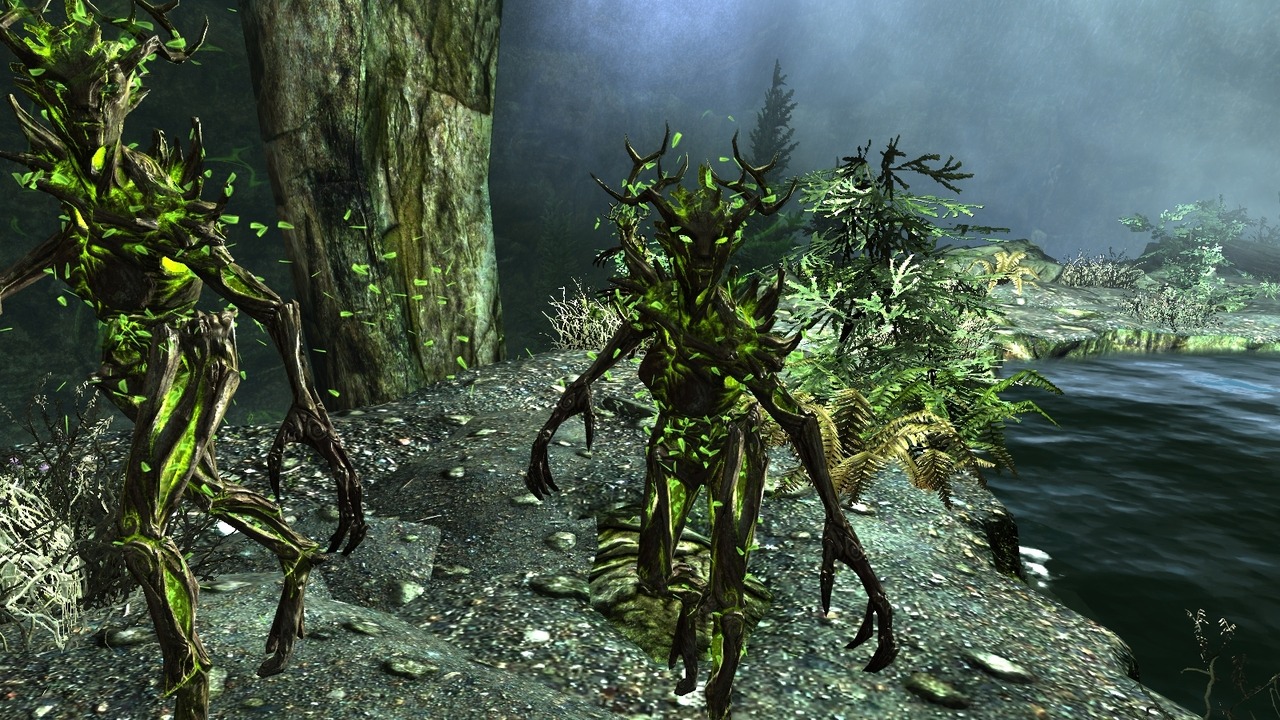 |
| Spriggans defending their turf. |
After I returned to Danica and watched her heal the Gildergleam, I reflected on the quest -- and did a little research on the wikis. Maurice, as it turns out, would have solved my dilemma, had he lived. If he makes it to the sanctuary, he tells you to put Nettlebane away and beseeches the Eldergleam to present a new sapling, thereby avoiding the offense to the Spriggans. If I had been more careful to protect Maurice from himself, the Eldergleam Spriggans would still be alive. I also wonder if I could have avoided conflict by using Battle Cry (or another Fear type of enchantment), Invisibility, or even a well-timed FUS-RO-DAH to get away from the Spriggans without destroying them.
Both alternatives described above would have required me to rise above the hack-and-slash rut that many of the warrior-oriented quests engender. When battle skills are your main asset, you begin to see every challenge as a battle. Would I have made the same decisions if were playing a PC more in the Thief or Mage playstyle, in which stealth and ingenuity, rather than raw combat, are the valued attributes? In other words, would I have been more likely to make a better moral decision if I had proceeded more thoughtfully?
